





 Portuguese
  English
  Spanish
  4 min of reading
  0 comments


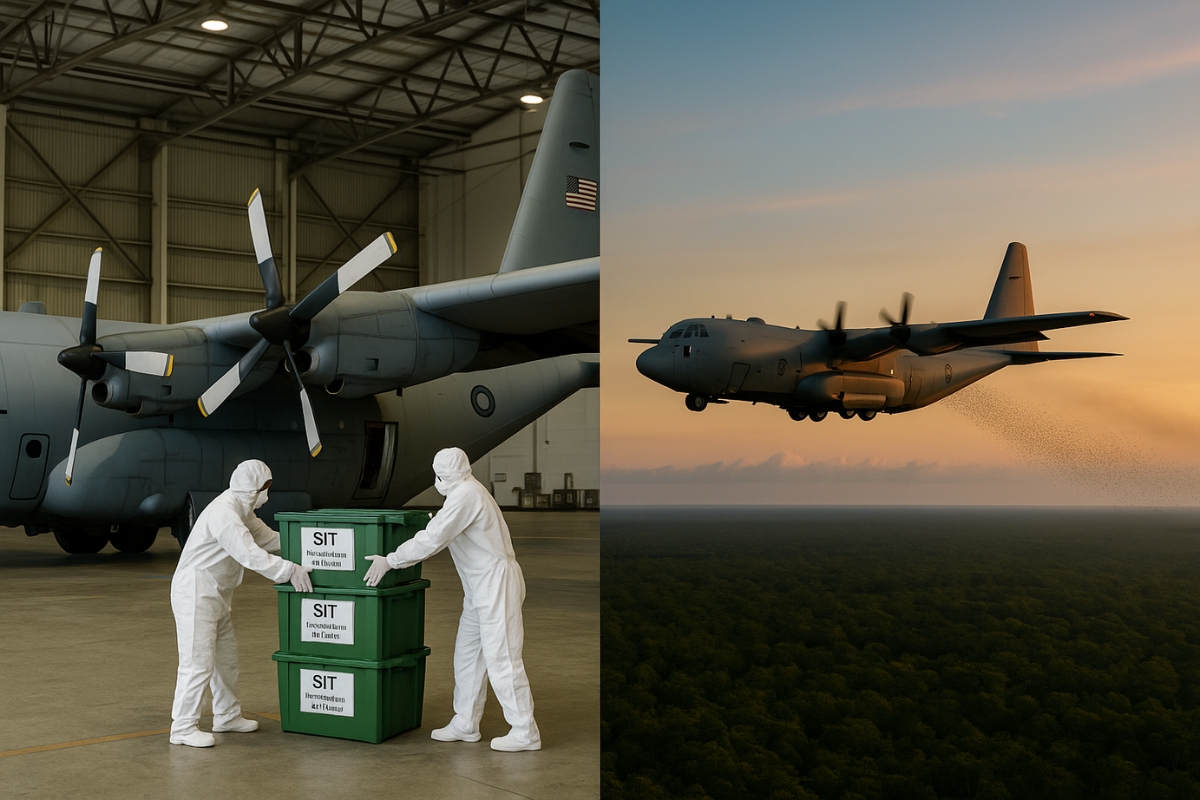
The U.S. Operation Releasing Millions of Sterile Flies at the Panama–Colombia Border Aims to Stop the Screwworm Fly, a Pest That Devours Live Animals and Causes Billion-Dollar Losses to Latin American Livestock
Most people have no idea, but while daily life goes on normally, a behind-the-scenes operation is underway at the border between Panama and Colombia. It involves planes, heavy logistics, laboratory technicians, and an absurd number of flies. All to prevent an ancient pest from spreading across the continent again and causing billion-dollar losses to livestock.
The United States sends more than 14 million sterile flies to this region every week. It’s such a large volume that the operation has become routine, although almost no one outside the agricultural sector knows what is happening. The target is the Cochliomyia hominivorax, the infamous screwworm fly, a parasite capable of destroying livestock production and even endangering humans.
How This Strategy That Seems Straight Out of a Laboratory Movie Works
The technique used has a name: SIT – Sterile Insect Technique. It does not involve genetic manipulation, nor the use of pesticides, nor any chemicals. It is literally biological control.
-
A Mercado Livre customer opened their package and found 32 resumes of people looking for jobs crumpled as protective paper inside the box, exposing names, addresses, documents, and phone numbers of dozens of candidates.

-
Iceberg A23a, one of the largest in the world, is undergoing accelerated collapse and may disappear: what explains the end of the ice giant?

-
The simplest swap at home can reduce energy consumption by up to 90% without changing habits, using a technology that lasts up to 25 times longer and consumes only a fraction of the electricity.

-
With over 14 million baskets of earth moved, an ancient North American metropolis built a monumental pyramid of 30 meters and established a city with 20,000 inhabitants nearly a thousand years ago.


It works like this: laboratories create millions of male flies. Then, these insects undergo a sterilization process using radiation. Once sterile, they are released by airplane into at-risk areas. They mate normally with wild females, but no eggs develop. Over time, the pest population plummets.

In theory, it’s simple. In practice, it requires international coordination, sanitary control, and a gigantic production chain.
This approach has already worked in Mexico, the United States, and parts of the Caribbean. Now, the focus is to prevent the pest from advancing north again, crossing the Darién jungle, one of the most difficult regions in the world for any type of monitoring.
Why Is the Screwworm Fly So Dangerous?
Those who have seen a screwworm case know the damage this fly can cause. The larvae feed on living tissue inside open wounds. It’s not an exaggeration: they literally devour the host alive.
Cattle, horses, goats, wildlife… and even people. Just one poorly cared for wound.
This means weight loss, decreased milk production, severe infections, and in extreme cases, animal death. For small farmers, a single outbreak can destroy a whole year of work. For entire regions, it can represent large-scale losses.
FAO estimates that countries with the presence of this pest incur losses of billion dollars every year. And that doesn’t even include the cost of veterinary care in remote areas, where access is already limited.
The Joint Operation Between the U.S., Panama, and Colombia
The release of sterile flies is coordinated by COPEG, a binational entity based in Panama. The USDA funds a large part of the operation, which acts as a sort of continental “sanitary shield.”
The numbers are impressive. Since the beginning of the program, more than 2 billion sterile flies have already been released over the border. Planes equipped with automatic dispensers make periodic flights to maintain the ideal density of sterilized insects in the air.
Carlos Chavarría, an entomology expert at COPEG, sums up the logic well:
“The success of the technique depends on consistency. It is necessary to maintain the pace of releases and remain vigilant for outbreaks on farms and at-risk areas.”
There is no rest. If the operation stops for a few weeks, the pest returns.
Is There Environmental Controversy?
When the subject involves the release of insects, debates always arise. But in this case, there have been no significant reactions from environmentalists. The reason is simple: there is no genetic modification involved, there’s no alteration to the ecosystem, and there are no toxic residues. The insects simply cannot reproduce.
In comparison to conventional pesticides, the sterile insect technique is considered more sustainable and less aggressive to the environment.
Of course, some researchers still discuss issues like the performance of sterile males in nature or the risk of underreporting outbreaks. But the general consensus is that the benefits far outweigh the uncertainties.
And Brazil in This Story?
Brazil knows the screwworm fly well. Northern and Northeastern states still report frequent cases, especially on family farms where cattle management is more exposed.
Embrapa has already participated in studies and biological control programs that use similar principles. Researchers from UNESP are also investigating the technique with other pests, such as Aedes aegypti.
But Brazil has never had a corridor as critical as Darién, where animals and goods circulate on a large scale between infested and pest-free areas. Therefore, closely monitoring the trinational effort is important, especially to keep the national livestock protected.
What Is at Stake for the Future of Latin American Agriculture?
With expanding agricultural borders, warmer climates, and intense animal movement, pests like Cochliomyia hominivorax find fertile ground to spread. The strategy of sterile flies acts as a sort of invisible fence, keeping the pest away from already clean areas.
It’s pure prevention. And prevention costs much less than dealing with already established outbreaks.
This type of initiative shows how science, international cooperation, and vigilance can combine to form a barrier that protects the entire rural economic chain.







-

2 pessoas reagiram a isso.