





 Portuguese
  English
  Spanish
  10 min of reading
  0 comments


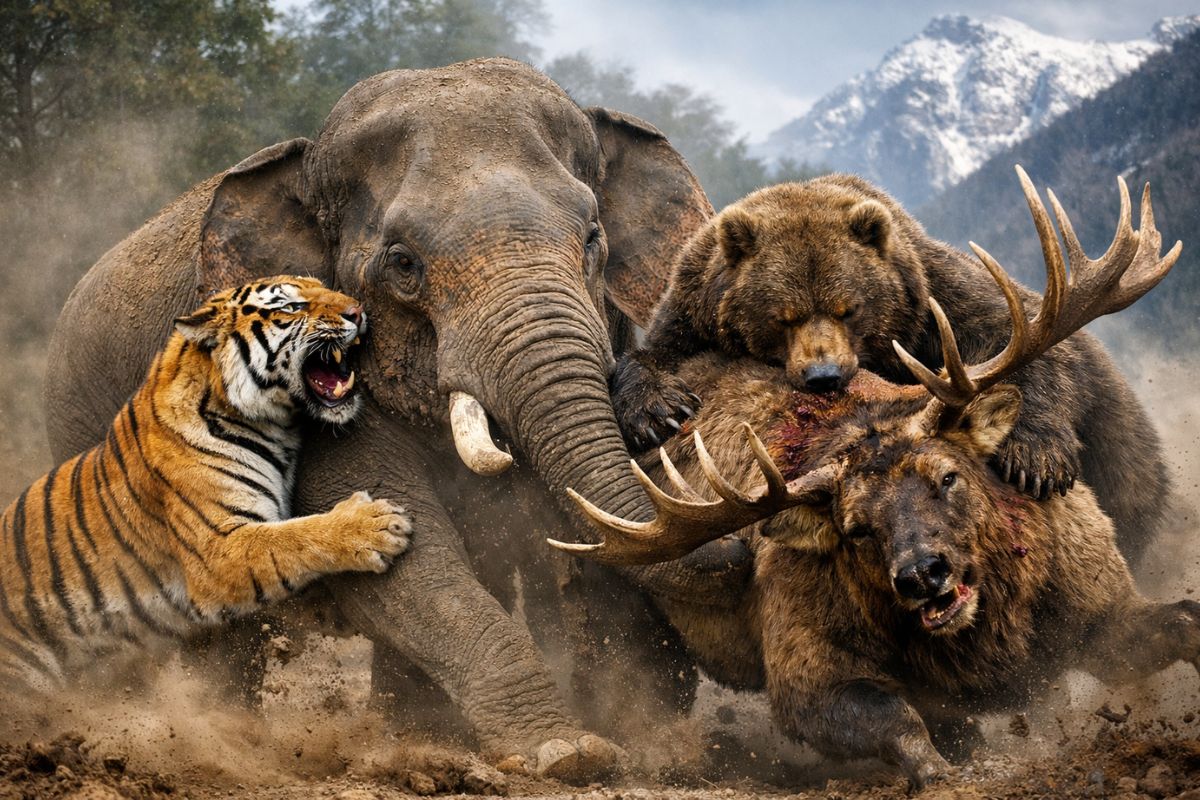
From Siberia to Southeast Asia, Megafauna Survived Pleistocene Oscillations and Today Depends on Threatened Tropical Forests. Among Predators, Tigers and Asiatic Lions Share the Top of the Food Chain While Asian Elephants, Rhinos, Wild Buffalo, Gaurs, and Yaks Sustain Huge Ecosystems and Show Why Asia Still Holds Giants.
The predators most emblematic of Asia live on the edge between two worlds: a past in which the continent hosted mammoths and woolly rhinos, and a present where the remaining giants survive in pockets of habitat, pressured by rapid changes in the landscape.
And to understand why these predators still exist and what they find to hunt, we need to look at “megafauna” as biologists define: megaherbivores over 1,000 kg and megacarnivores over 100 kg, the animals that truly impact the balance of an entire ecosystem.
What Is Megafauna and Why Does Asia Still Have Giants

When someone talks about megafauna, it seems just like “big animals,” but here the focus is direct and based on body mass. Megaherbivores are herbivorous mammals over 1,000 kg. Megacarnivores are carnivores over 100 kg. This classification matters because, from this scale, the animal is not just “another one”: it takes down trees, opens clearings, changes vegetation, controls populations, and influences who lives and who disappears.
-
These living root bridges and ladders are over 700 years old and help indigenous people survive in one of the rainiest regions in the world.

-
From sertanejo star to international investor: Ana Castela invests millions in a mansion in the USA, creates a themed accommodation in Orlando, and shows that the “boiadeira” also wants to grow away from the stage.

-
The 10 most stunning motorhomes in the world: a $3 million trailer with a rooftop nightclub and garage for a Ferrari, “palaces on wheels” with Italian marble, private cinema, and five-star hotel luxury for billionaires.

-
Trump wanted to spend $400 million on the White House, but the courts prohibited the million-dollar construction.


Asia is a continent of extremes, ranging from the intense cold of Siberia to the tropical heat of southern India and Southeast Asia, with strong monsoons in some areas, severe droughts in others, and marked temperature variations throughout the year. However, none of this has been stable over time. Throughout the Pleistocene, with intense climatic oscillations, the continent underwent profound remodeling. Landscapes that are now dense forests were once more open environments and later reverted back to forest.
The Pleistocene “Shuffled the Board” and Decided Who Remained
One way to reconstruct this history is to study teeth: isotopes in tooth enamel preserve chemical signatures of what the animal ate and drank, revealing how the environment was. Carbon and oxygen isotopes change depending on whether the animal lived in closed forests or open landscapes, for example.
A study cited in the material shows that Southeast Asia alternated over time between mosaics of savannas, fields, and forests. And these shifts decided who persisted and who disappeared. The pattern appears as a harsh message: when savannas expanded, certain large herbivores were favored. When forests regained dominance, many species lost space and could not adapt quickly enough.
The irony is that the megafauna that remains today is closely linked to tropical forests, precisely the environments that are now most degraded. And it was not only the megafauna that suffered in this back and forth: almost all human species that lived in Southeast Asia also disappeared during this interval. These hominins seem to have depended on open landscapes such as savannas and sparse forests, and the disappearance of these environments was directly associated with their extinction. The great exception was our own species, Homo sapiens, with a unique capacity to occupy a wide variety of environments, including dense tropical forests.
Predators on Top: Who Rules the Asian Food Chain
Asia is home to some of the largest and most emblematic predators on the planet, species that occupy the top of the food chains and directly influence the survival of all megafauna.
Tiger, the Largest Living Felid, and the Brutal Decline of Its Territory

The tiger is the largest living felid, reaching up to 2.80 meters in length and weighing up to 260 kg. Throughout the 19th and 20th centuries, it was classified into up to nine subspecies, including Bengal, Malayan, Indochinese, South China, Siberian, Caspian, Javan, Balinese, and Sumatran tigers. With advances in research, this classification has begun to be questioned, as many subspecies were defined by differences in size, coloration, and stripe patterns observed in few museum specimens, which did not always represent entire populations.
The most shocking impact is on the map: since the early 20th century, tigers have lost at least 93% of their historical range, completely disappearing from regions of Western and Central Asia, large areas of China, and islands such as Java and Bali. Today, what remains are fragmented populations, surviving in isolated pockets of forest, like living witnesses to a diversity that was once much greater.
Asiatic Lion, the “Surprise” Giant Outside Africa

The second largest Asian felid is the lion. And yes, there are lions in Asia: they are not exclusive to African savannas. Historically, they lived across much of Eurasia during the Pleistocene, but today their natural distribution in Asia is restricted to a single wild population in western India.
Adults of this Asian population generally reach around 2.5 to 2.9 meters in length and can weigh up to 190 kilos. Compared to African lions, the Asiatic lion has a slightly smaller and less robust body, and a shorter and sparser mane that usually does not completely cover the ears. Many individuals also exhibit a fold of skin along the abdomen, a characteristic often associated with Asian populations. Currently, it represents a minimal fraction of the global population of the species and survives thanks to conservation efforts.
The Giants That Sustain Hunting and Shape the Landscape
There is no top of the food chain without a base. And the base here consists of megaherbivores and other large animals that literally “shape” the environment: they open clearings, knock down trees, scatter seeds, and sustain complex ecosystems for hundreds of thousands of years.
Asian Elephant, the Largest Terrestrial Animal on the Continent

The Asian elephant is the largest terrestrial animal in Asia and the third-largest elephant in the world, a close relative of extinct mammoths. Males are slightly larger than females, reaching around four tons and approximately 2.75 meters in height at the shoulder.
Females and calves live in small groups, while males move away upon reaching adolescence. For a long time, it was believed that groups were rigidly led by matriarchs, but the material suggests that females can form broader and more fluid social networks, with more flexible bonds than those observed in African elephants. Another difference from their African relatives is the frequent use of their front legs, as well as digging or scraping the ground, helping, along with their trunks, to manipulate objects with greater agility.
Asian Rhinos: Rarity, Armor, and Populations on the Edge

The Sumatran rhino is the smallest rhino that exists, but still impressive, reaching about 3 meters in length and weighing up to 800 kilos. It is the only Asian rhino still covered by visible hair and one of the few two-horned rhinos, which explains names like hairy rhino and Asian two-horned rhino. Once widely distributed across the tropical forests of South and Southeast Asia, it now survives in a few isolated areas, mainly on the island of Sumatra and in a small population in Borneo, with fewer than 80 known individuals.
The Indian rhino is the largest of the Asian rhinos and one of the largest terrestrial mammals in Asia, capable of exceeding 4 meters in length, reaching nearly 2 meters in height at the shoulder, and weighing over two tons. Its thick, wrinkled skin gives it the appearance of natural armor. Unlike most rhinos, it has long, sharp incisors, used in fights between males, which can cause deep wounds and make these battles some of the most violent among large terrestrial herbivores. After nearly disappearing due to excessive hunting and habitat loss, it has partially recovered but remains vulnerable and fragmented.
The Javan rhino is one of the most endangered mammals on Earth. Today, it survives exclusively in a small area of tropical forest on the island of Java, Indonesia. It is a close relative of the Indian rhino, both belonging to the genus Rhinoceros. It can exceed 3 meters in length and weigh more than two tons. It has only one horn, the smallest among living rhinos, which in males rarely exceeds 25 centimeters. Adult females are unique in that they do not develop a horn, having only a few centimeters of protuberance. In the past, it was distributed across much of Southeast Asia. Today, fewer than 100 individuals remain in a single population, a result of centuries of hunting and ongoing habitat destruction.
Giant Bovines: Strength, Horns, and Life in Wetlands and Mountains

The wild water buffalo lives fragmented across countries such as India, Nepal, Bhutan, Thailand, and Cambodia, inhabiting swamps, floodplains, and wet areas near rivers. Adults can measure up to 3 meters in length and weigh up to 1,200 kilos, with males and females sporting wide, curved horns that can exceed 2 meters from tip to tip.
The gaur, known as the Indian bison, is the largest wild bovine alive today. It can exceed a ton and stand over two meters tall at the shoulder. Previously spread across almost all of South and Southeast Asia, today it survives in isolated areas of wet forests after completely disappearing from regions where it had been part of the landscape for thousands of years.
The wild yak is native to the high mountains and plateaus of Central Asia, especially the Tibetan Plateau, historically extending across regions of China, India, Nepal, and Mongolia. It can measure up to around 3 meters in length, 2 meters tall at the shoulder, and exceed a ton. It lives above 4,000 meters, in rarefied air and extreme temperatures, being one of the large mammals capable of inhabiting some of the most inhospitable environments on the planet.
Asian Bears: From Bamboo to Ice, From Insect to Large Predator

It is impossible to talk about Asian megafauna without mentioning bears, members of the order Carnivora. They vary greatly in what they eat and what they hunt, and this changes the ecological role of each species.
The giant panda is the most famous case of a bear with a nearly entirely herbivorous diet, primarily feeding on bamboo shoots in dense, humid forests at high altitudes in central China. It can reach nearly 2 meters in length and 160 kilos, with males being larger than females. Despite its gentle appearance, it can attack when it feels threatened, especially when surprised or in situations where females are protecting their cubs. A remarkable adaptation is the “false thumb,” a modified wrist bone that functions as a pincer to hold and manipulate bamboo with great precision. Even with a small recent recovery, it remains threatened, with habitat fragmentation and a low reproductive rate as part of the problem, and has become a symbol of conservation efforts.
The Asian black bear, also known as the moon bear or collar bear, features a clear mark on its chest, often in the shape of a “V.” It lives across much of Asia, primarily in dense, mountainous forests. Males can weigh up to 200 kg and reach 2 m in length. It is agile and adapted to arboreal life, spending much time in trees to feed, rest, and even build platforms of branches to sleep on. Once distributed from the Middle East to Japan, it now occurs in a fragmented manner, pressured by habitat loss and exploitation linked to the use of bile in traditional Chinese medicine.
The honey bear can also show a clear spot on its chest, but this varies and may be absent in some populations, such as in Sri Lanka. It has long, disheveled fur, thicker on the neck and shoulders. Unlike many bears, it feeds on insects, primarily ants and termites, using elongated and flexible lips to suck prey from termite mounds. A rare detail: females carry their cubs on their backs, an important strategy for protecting their young.
In the far north, the polar bear joins the Asian megafauna by occurring in the extreme north of Russia, within the Arctic region of the continent. It can reach 3 meters in length, nearly 2 m tall when upright, and weigh up to 700 kg. It is considered a marine mammal as it depends on Arctic sea ice to move and hunt, primarily seals, swimming long distances between ice floes. The growing threat mentioned is the reduction of sea ice associated with global warming.
The brown bear is one of the largest terrestrial carnivores on the continent, occurring in the Russian Far East and Siberia, as well as in the Tibetan Plateau, Himalayas, northeast China, and Japan. It can measure up to 2.8 meters and weigh over 600 kilos, varying by region, with males generally being larger. It is omnivorous, highly adaptable, living from taigas and cold forests to high-altitude mountainous regions, feeding on fruits, roots, invertebrates, and large prey when available. Although still widely distributed in northern Asia, some populations are reduced or fragmented due to habitat loss and conflicts with humans.
What Is at Stake When Predators and Giants Disappear


When top predators disappear, the food chain loses its brake. When megaherbivores disappear, the landscape loses the “hand” that opens clearings, knocks down trees, scatters seeds, and sustains ancient vegetation dynamics. The impact is not just on the animal that disappears; it is on the entire ecosystem that changes behavior.
And there is one detail that makes everything even more tense: much of the megafauna that survived the Pleistocene is now tied to tropical forests, precisely the most degraded areas today. In other words, the continent that still hosts giants also concentrates the most fragile points on the board.
Do you think that Asia’s predators and giants will still survive the coming decades, or are we witnessing the “slow end” of the last great megafauna on the continent?









-

-

-

-

-

6 pessoas reagiram a isso.