





 Portuguese
  English
  Spanish
  6 min of reading
  0 comments


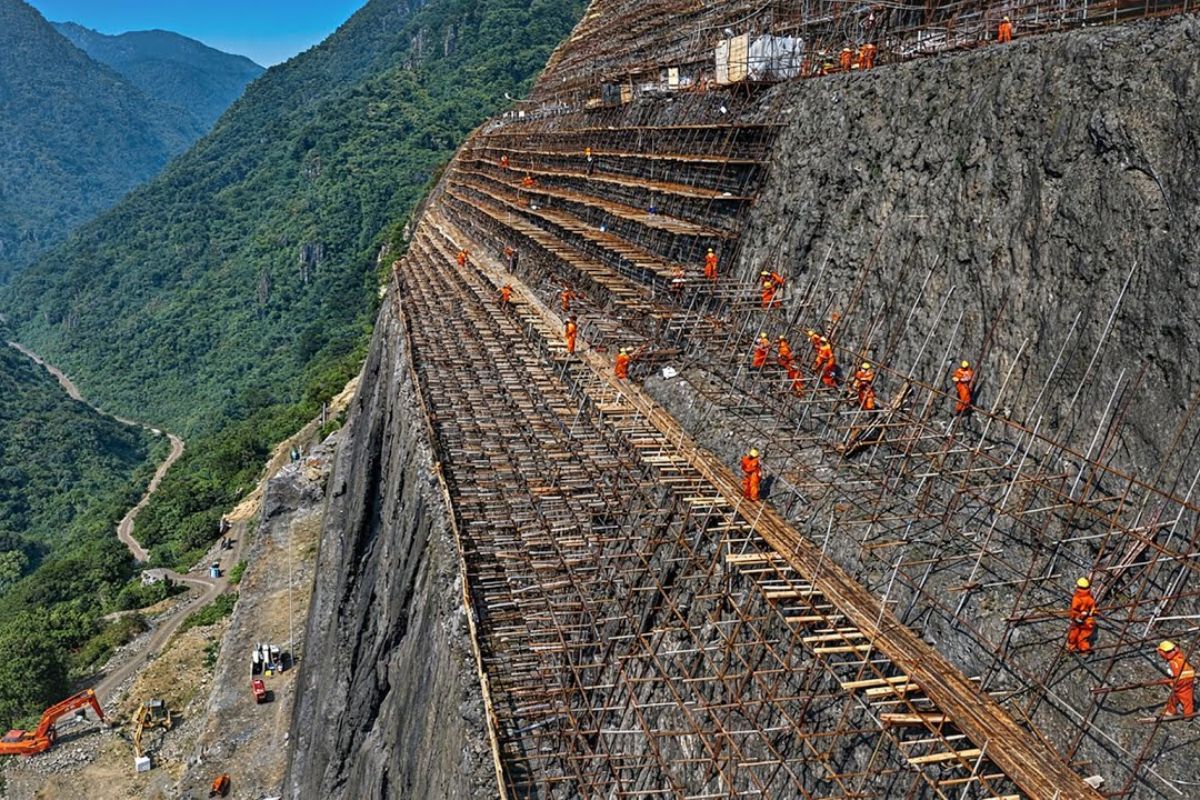
The Rogun Dam in Tajikistan Combines Glacier River Diversion, Rock Fill with Clay Core, Deep Tunnels, and a 2036 Timeline to Transform Energy Security, Irrigation, and Export Revenue, but Carries Billion-Dollar Costs, Seismic Risks, Regional Tension, and Ongoing Political Pressure in the High-Mountain Country.
The Rogun Dam has become the axis of a national decision that mixes heavy engineering, energy needs, and economic survival. In a landlocked country with limited fossil resources and a population of just over 10 million people, the project has been placed at the center of the long-term strategy.
In the remote Vakhsh River valley, the scale of the project explains why it attracts so much attention: a structure planned to be about 335 meters high, an installed capacity of 3,600 megawatts, and a reservoir estimated at approximately 13 km³. It is an intervention designed to alter, at the same time, the map of electricity and the water regime of the country.
From Abandoned Soviet Project to State Priority
The origin of the Rogun Dam is not recent. The idea emerged in the 1960s when Tajikistan was part of the Soviet Union, and Moscow prioritized large-scale infrastructure projects in Central Asia.
-
This is the cost to build a simple 60 m2 house in 2026, including contingencies, foundation, finishing, labor, and hidden fees.

-
Amphibious houses with a floating dock system gain global attention by revealing technology that allows homes to rise with floods and avoid losses in high-risk areas.

-
Between tunnels, bridges, and billions in investment, Istanbul is preparing to receive a 125-kilometer railway that crosses continents, enhances the circulation of goods and passengers, and changes the strategic outlook of Turkish transportation.

-
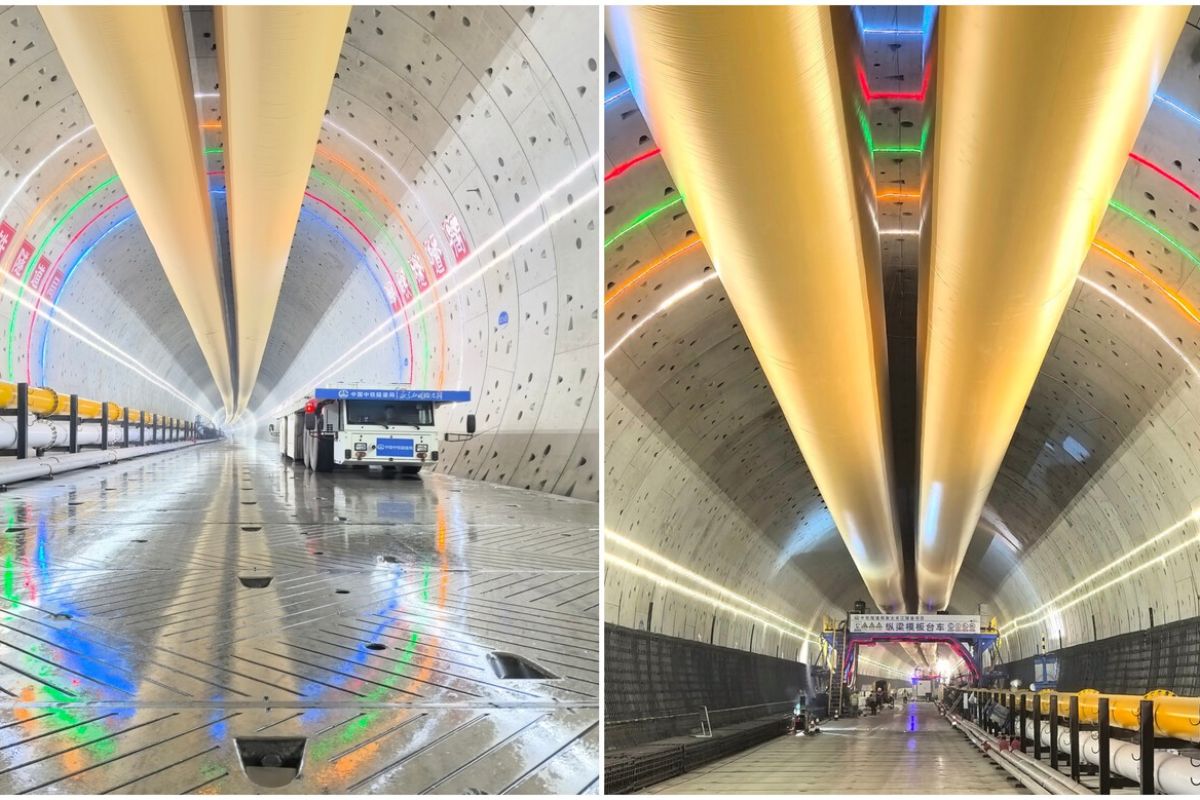
China completes the most critical section under the Yangtze River with the intelligent tunneling machine Linghang, excavating 11.32 continuous kilometers at depths of up to 89 meters and transforming the Chongming-Taicang tunnel into a landmark that redefines the scale of high-speed rail engineering in the 21st century.

The formal launch occurred in 1976, with the proposal to control the flow of the Vakhsh, generate energy on a large scale, and regulate regional water supply.
However, the trajectory was interrupted by the Soviet collapse and civil war after 1991. The construction site remained partially built and without continuity for more than two decades.
When the project is revived, it is no longer just a dam; it is an attempt to reclaim lost historical time in a strategic sector.
The Engineering of the Rogun Dam in Extreme Environment

Unlike a conventional mass concrete dam, the Rogun Dam was designed as a rockfill dam with a clay core.
In practice, this means a body formed by rock and gravel compacted in successive layers, while the central clay core acts as an impermeable barrier. This arrangement aims for structural stability and control of infiltration in a high hydraulic energy valley.

Before raising the main body, the construction required a dry and stable foundation, which led to the diversion of the river through four tunnels in the hillside, each over a kilometer long.
Two tunnels are from the Soviet phase and were rehabilitated, while two were completed during the project restart. Without this diversion, there is no dam; there is only an attempt to build within an active mountain flow.
The geotechnical treatment includes excavation of fragile materials, injection of grout into natural fractures of the rock, and implementation of drainage to reduce water pressure beneath the structure.
In parallel, slopes were reinforced with anchoring, mesh, and shotcrete, while instrumentation monitors deformation, settlement, and pore pressure in real time.
This level of operational control is decisive because the work advances in phases, with compaction in thin layers, continuous inspections, and integration with discharge structures, vertical shafts, and tunnel lining.
The dam grows in height, but the true daily test lies in the invisible behavior of the foundation and the slopes.
What Changes in Energy and Water Between 2029 and 2036

The Rogun Dam has stopped being just a pure construction site since the first two units began generating electricity in 2018 and 2019.

This initial phase serves a dual purpose: it meets part of domestic demand and allows for validation of the operational design under real conditions, with technical adjustments before the final height of the dam.
According to the reported schedule, the main body is expected to reach the design elevation around 2029, while the complete filling of the reservoir is cautiously planned to be completed by 2036.
This interval is both technical and political: accelerating too much increases risk, while slowing down too much pressures the national budget.
If the parameters are met, the total capacity of 3,600 MW could double the country’s current electricity production and create seasonal surplus, especially in summer. On paper, this enhances internal energy security and opens space for regional energy exports, creating a new source of external revenue for an economy with limited tax collection.
The other front is water-related. With a large reservoir, the Rogun Dam is likely to increase the capacity to regulate flows throughout the year, potentially affecting downstream irrigation. In this case, energy and water are not separate agendas; they are parts of the same national stability equation.
What Is the Cost, Who Pays, and Why Does Geopolitics Matter
Financial figures released for the project vary across sources within its narrative, with estimates around US$ 6.3 billion and also close to US$ 8 billion. In any scenario, it represents a huge amount considering Tajikistan’s economic scale, which is often described as nearly half of the national GDP.
This weight explains the recurrent funding scarcity over the years and the caution of international donors.
The involvement of multilateral institutions has been conditioned on independent feasibility studies and regional impact assessments. The risk is not only in concrete and geology; it lies in the capacity to sustain financial flow for years without disrupting fiscal balance.
There is also a diplomatic layer. Downstream countries, especially Uzbekistan, have historically raised concerns regarding water security and availability for agriculture in the Amu Darya system.
In practical terms, every large dam upstream reorganizes regional expectations of water access and requires more sophisticated transboundary governance.
Thus, the Rogun Dam operates at the intersection of infrastructure, energy security, and international relations. The project will be judged not only by its final height but also by its ability to produce energy without escalating water conflicts in the neighborhood.
What Comparisons with Megaprojects Reveal and What They Do Not Resolve
Comparisons with major global dams help gauge ambition but do not eliminate structural differences.
Projects in continental economies with massive domestic markets and significantly greater financial capacity operate with risk cushions that Tajikistan lacks. Similar technical scale does not imply a similar economic context.
Nevertheless, the comparison reveals a useful point: dams only deliver sustainable benefits when they combine a robust foundation, safe operation, realistic scheduling, and ongoing water governance.
A dam can change a country’s future, but it can also amplify fragilities if execution, financing, and diplomacy do not proceed at the same pace.
In the case of the Rogun Dam, the project synthesizes this tension. There is real potential for energy transformation, but there is also a long execution window until 2036, during which costs, climate, geopolitics, and investor confidence will continue to pressure every engineering and state decision.
The Rogun Dam is simultaneously a hydraulic work, a macroeconomic bet, and a test of national coordination in a highly complex environment. If it meets the promised technical parameters, it could reduce energy vulnerability, improve water predictability, and reposition Tajikistan in Central Asia. If it fails, it could leave a legacy of high costs, regional tension, and idle capacity.
Should a project like the Rogun Dam first prioritize internal energy security or regional water agreements to reduce downstream friction? And, looking at low-income countries, do you believe that mega-infrastructure is still the most efficient way to unlock long-term growth?










-

-

-

-

-

-

409 pessoas reagiram a isso.