





 Portuguese
  English
  Spanish
  5 min of reading
  0 comments


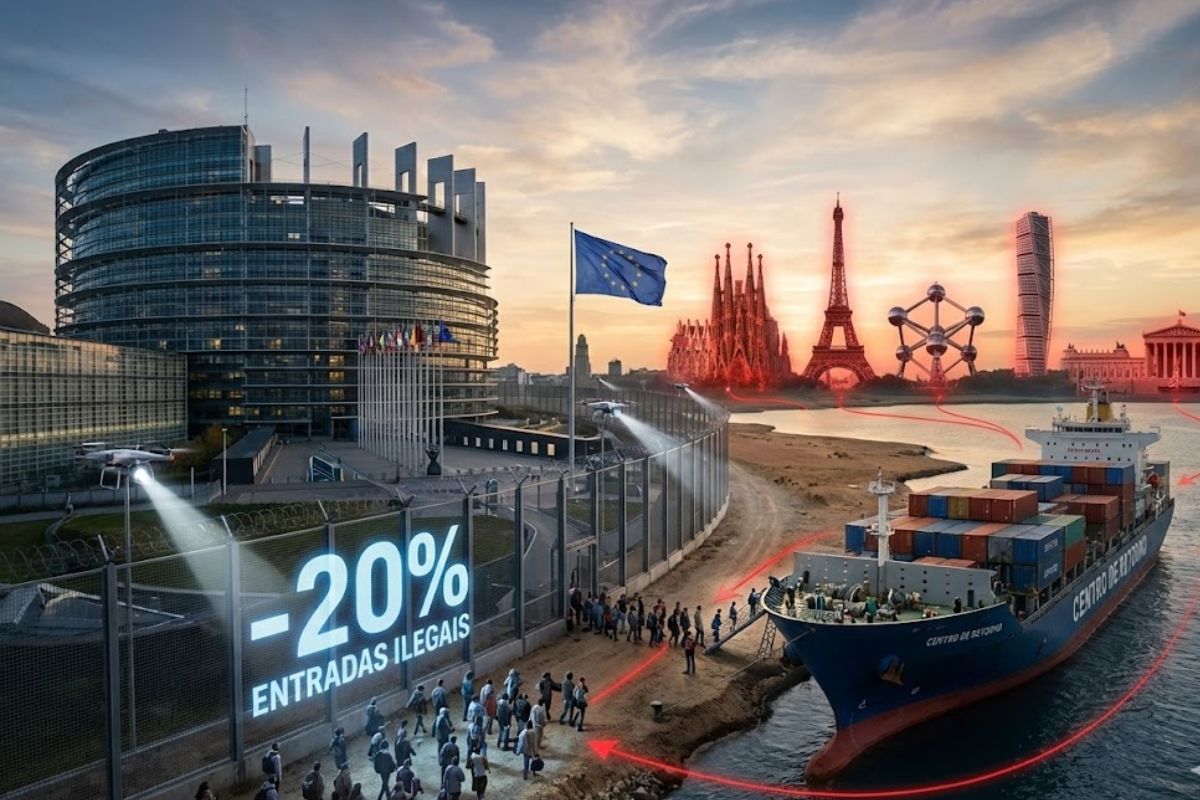
Ministers of the Interior of the 27 EU countries approved on December 8, in Brussels, a package that creates return centers outside the bloc, allows the return of rejected asylum seekers to countries considered safe and increases sanctions, despite a 22% drop in illegal entries in 2025, according to data from the European agency Frontex.
The EU member countries approved on this Monday, December 8, 2025, in Brussels, a package to tighten migration policy, creating return centers outside the bloc and allowing rejected asylum seekers to be sent to countries considered safe. The proposal was presented by the European Commission and received the backing of the 27 Interior Ministers gathered in the Belgian capital.
According to the g1 portal, the package still needs to be approved by the European Parliament and is not expected to come into effect until 2026, even in the face of a 22% drop, to 133,400 illegal entries into the EU in the first nine months of 2025 compared to the same period in 2024, according to the Frontex border agency. Nevertheless, governments see this moment as an opportunity to further tighten the crackdown on irregular immigration.
Package Approved in Brussels Focuses on Faster Deportation
Gathered in Brussels, the Interior Ministers of the 27 member states endorsed the measures presented by the European Commission, the executive arm of the EU, in a context of strong pressure from parties advocating for reduced immigration.
-
The institute that trained the greatest aerospace engineers in Brazil has just opened its first campus outside São Paulo after 75 years: ITA Ceará will have R$ 445 million, new courses in energy and systems, and classes are expected to start in 2027.

-
Luciano Hang, owner of Havan, goes to Juiz de Fora after the tragedy in February, brings R$ 1 million, hands out R$ 2,000 cards, and donates up to R$ 15,000 to victims in the region.

-
The Brazilian passport allows legal residence in dozens of countries without the need for a prior visa, and most Brazilians are unaware that they can apply for residency directly upon arriving in nations in South America, Africa, and even Europe.

-
Petrobras sends a message to Brazilian truck drivers after fuel collapse and reveals plan to have 100% domestic diesel.


The political message is that the EU wants to show the public that it controls its borders and decides who can or cannot stay.
The core of the package is the creation of “return centers” outside the EU borders, where migrants whose asylum requests have been rejected by European countries would be sent.
These centers would function as screening and preparation points for removal, keeping rejected individuals away from Union territory before final deportation.
In addition, the text provides for harsher penalties for those who refuse to leave European territory after their requests are denied, increasing the pressure on migrants in irregular situations. Among the tools are shorter deadlines for voluntary departure and the possibility of harsher coercive measures when there is resistance to return.
EU May Send Rejected Asylum Seekers to Countries Considered “Safe”
Another sensitive point of the package is the possibility of sending immigrants to countries that are not their countries of origin, as long as the EU considers them “safe.”
In practice, this paves the way for rejected asylum seekers to be relocated to third countries willing to reach agreements with Brussels.
This mechanism is viewed by European governments as a way to deter irregular crossings, reducing the expectation of remaining in the EU even after asylum denial.
At the same time, experts and human rights entities warn of the risk of shifting responsibilities to countries with weaker protection systems.
According to European Commissioner Magnus Brunner, the architect of the change in migration policy, it is “very important to convey to citizens the sense that we have control over what is happening”.
The reading in European capitals is that, without a firm discourse, the electoral space for far-right forces promising to close borders is growing.
Decline in Arrivals Did Not Prevent EU from Tightening
The approval comes at a time when irregular entries into Europe are declining. According to Frontex, illegal arrivals in the EU decreased by 22% in the first nine months of 2025, to 133,400 records, compared to the same period in 2024. The annual cumulative reduction is estimated at around 20% compared to the previous year.
Even so, internal pressure has not diminished. Governments argue that it is precisely the current scenario that allows them to tighten the rules without repeating recent humanitarian crises.
European leaders estimate that a tough package now could neutralize far-right narratives promising even more radical measures against migrants and refugees.
Spain, France and NGOs See Risks for Human Rights
Despite a favorable majority, the package is not consensual within the EU. Spain questions the effectiveness of “return centers” after experiences deemed failed in other countries, raising doubts about costs, logistics, and actual results in reducing irregular arrivals.
France, for its part, raises concerns about both the legality and effectiveness of part of the proposals, especially regarding the sending of rejected individuals to countries considered “safe” by the EU.
Paris fears that decisions may be contested in European courts and that processes may drag on, failing to deliver the promised speed.
Organizations defending exiles and leftist parties reacted harshly. For these groups, the measures represent a setback and may violate basic human rights of refugees and asylum seekers, especially if there is a return to countries that, in practice, do not ensure adequate protection against persecution or violence.
Dispute in the EU Over Who Will Welcome Asylum Seekers
While the EU tightens the rules for those with rejected applications, another front of dispute opens: who will welcome the asylum seekers who continue to arrive at the bloc’s external borders. Greece and Italy, which are on important migration routes, are pressing for a more balanced division of responsibility.
The proposal under discussion stipulates that the EU will require other member states to receive part of the asylum seekers in their territories, easing the burden on border countries.
If they refuse to accept these individuals, governments would have to contribute financially, paying 20,000 euros per applicant, the equivalent of around R$124,000, to the countries under the most pressure.
At this point, however, resistance is significant. Belgium, Sweden and Austria have made it clear that they will not accept asylum seekers from other member states, signaling that they prefer to contribute financial resources rather than receive new flows of migrants.
Ministers admit, privately, that publicly taking on quotas for welcoming has high political costs in their countries.
An anonymous European official summarized the impasse: “Few interior ministers will be willing to tell the press: ‘Alright, we will welcome 30,000’”.
And you, do you think the EU is responsibly protecting its borders or is it going too far in tightening migration policy and creating return centers outside the bloc?










-

-

2 pessoas reagiram a isso.