





 Portuguese
  English
  Spanish
  4 min of reading
  0 comments


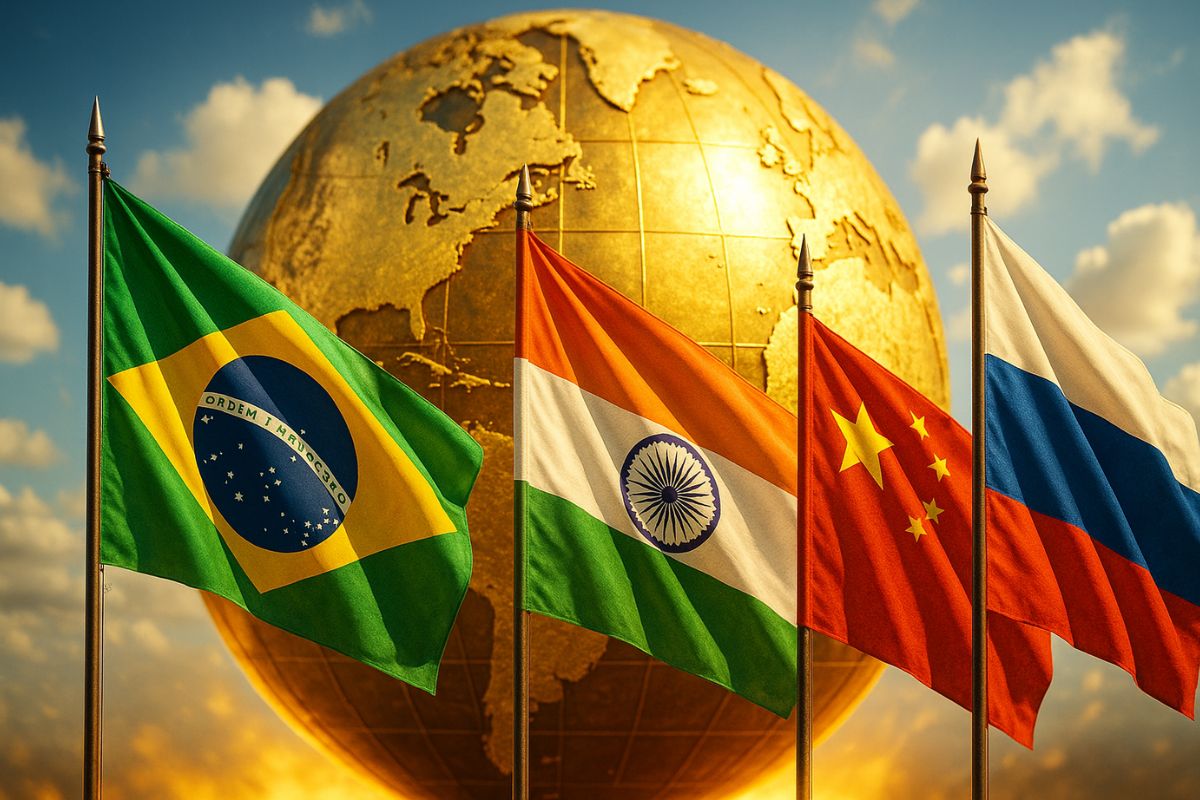
Donald Trump’s Actions Against BRICS Countries Are Seen As An Attempt To Weaken The Bloc And Protect Dollar Hegemony, According To O Globo
The President of the United States, Donald Trump has been launching a preemptive attack to fragment BRICS, according to members of the Brazilian government and experts interviewed by the newspaper O Globo. The assessment is that the White House is acting to prevent the group from advancing in discussions about alternatives to the dollar in international trade, a topic championed by leaders such as Lula.
Trump’s measures, which include heavy tariffs against Brazil and India, are interpreted as a strategy to pressure the most exposed countries and create internal divisions within the bloc. Although BRICS’s progress is still gradual, the concern in the U.S. is that any move toward monetary autonomy could shake its dominant position in the global financial system.
Who Are Trump’s Preferred Targets in the Attack on BRICS?
Brazil and India have been the most affected by the recent tariffs imposed by the U.S. In the case of Brazil, the 50% surcharge on exports has been interpreted as a way to destabilize the country, which will preside over the bloc in 2025. As for India, which will assume the presidency in 2026, it faced additional sanctions due to its purchase of oil from Russia, the target of American restrictions due to the war in Ukraine.
-
Brazilian city bets on the business environment to generate jobs and attract investments in the energy sector — secretary reveals strategy at Macaé Energy 2026.

-
50 viaducts, 4 tunnels, 28 bridges, and 40 kilometers of bike paths: BR-262 in Espírito Santo will receive 8.6 billion reais for the largest engineering project in the state’s history, inspired by the Immigrant Highway in São Paulo.

-
Brazil produces too much clean energy and doesn’t know what to do with it: over 20% of solar and wind capacity was wasted in 2025 while investors flee and 509 renewable generation projects were abandoned in the last year.

-
Piauí will produce a new fuel that replaces diesel without needing to change anything in the truck’s engine and reduces pollutant gas emissions by half: truck drivers from all over the Northeast are already celebrating the news that will arrive later this decade.


The pressure on these two countries is seen as an attempt to divide BRICS from its main democracies. Meanwhile, nations such as China and Russia continue to deepen bilateral relations, including in local currencies, reinforcing the perception in Washington of a movement against dollar hegemony.
Why Does BRICS Upset the United States?
BRICS, originally formed by Brazil, Russia, India, China, and South Africa, expanded in 2024 to 11 members, including Saudi Arabia, Egypt, the United Arab Emirates, Iran, Indonesia, and Ethiopia. The bloc’s enlargement has expanded its geopolitical reach, even if the initiatives are still at an early stage.
For Trump, the mere possibility of BRICS countries trading in local currencies already poses a challenge to dollar supremacy. Although experts highlight that the creation of a single currency is unlikely in the short term, the U.S. interprets the agenda as a direct risk to its global economic leadership.
What Are The Interpretations of Trump’s Strategy?
International relations experts point out that Trump’s preemptive attack on BRICS has political, economic, and symbolic dimensions. The director of the Brics Policy Center, Marta Fernández, highlights that Washington reacts even to initial measures, fearing that the group will create real alternatives to the dollar.
For Rubens Duarte, a professor at the Army Command and General Staff School, the pressure is a way to test the loyalty of traditional partners, exploiting internal divisions within each country. In Brazil’s case, there is also the interpretation that Trump is trying to influence domestic politics by conditioning negotiations to internal decisions, such as processes in the Supreme Federal Court.
Is It Worth Betting on the Strengthening of BRICS?
Despite external pressures, experts remind us that BRICS does not seek to replace U.S. hegemony, but rather to expand trade alternatives. Marcos Caramuru, former Brazilian ambassador to China, states that the central discussion is about more agile payment systems and the use of local currencies, not about eliminating the dollar.
The evolution of BRICS depends on the countries’ ability to maintain cooperation even in the face of fragmentation attempts. For Brazil, this means balancing its relationship with the U.S., its third-largest trading partner, without giving up on rapprochement with China and India, which currently lead trade within the group.
Trump’s attacks on BRICS are interpreted as a preemptive move to weaken the bloc before it advances in concrete measures against dollar hegemony. Although internal debates are still gradual, the American pressure exposes the geopolitical weight that the group has been gaining.
And you, do you believe that BRICS will be able to withstand U.S. pressures and consolidate new forms of international trade, or will the bloc tend to fragment in the face of Trump’s preemptive attacks? Leave your opinion in the comments — we want to hear your view on this global clash.









-

-

-

-

4 pessoas reagiram a isso.