





 Portuguese
  English
  Spanish
  3 min of reading
  4 comments


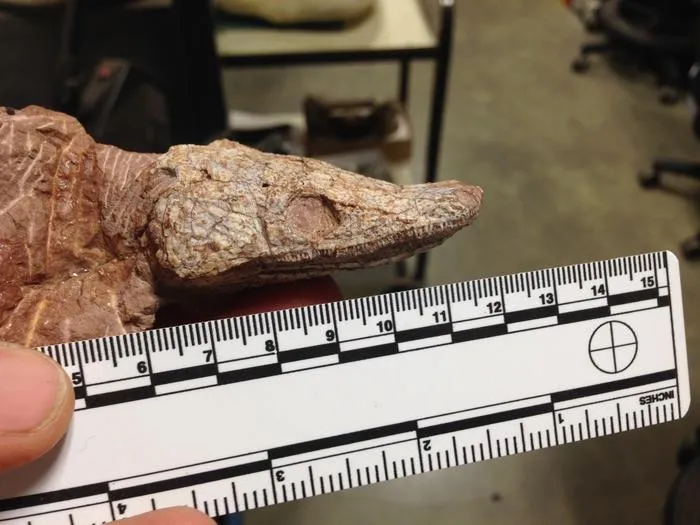


A paleontologist found a prehistoric amphibian 230 million years ago when opening a rock. The creature showed an advanced survival strategy for its time.
Imagine a world where torrential rains lasted for months, followed by droughts so intense that few animals could survive. This was the west of the American state of Wyoming, about 230 million years ago. A paleontologist discovered a small amphibian that developed an ingenious survival strategy by hiding deep in riverbeds to escape the devastating aridity.
The casual discovery of a paleontologist that revealed a new prehistoric world
In 2014, David Lovelace, a researcher at the University of Wisconsin-Madison, was conducting his routine exploration of the Popo Agie formation in Dubois, Wyoming.
Known by locals as “Big Red Dead” due to the scarcity of fossils, the region did not seem promising. Nevertheless, Lovelace decided to pick up a rock the size of a football on his walk back to the car. Something that seemed trivial ended up revealing an extraordinary secret.
-
In a flooded well, archaeologists found a 1,700-year-old Roman egg that still contains clear and yolk intact inside the very thin shell.

-
Something is happening around the Earth: Inside the huge explosion of fireballs in 2026

-
A hot air bubble coming from Argentina expands over Brazil, causing thermometers to exceed 38 degrees with a thermal sensation of 40 degrees in late March, affecting 6 states at once.

-
The radish leaf that almost everyone throws away has more polyphenols, flavonoids, and fiber than the consumed root, and a 2025 study showed that the leaf contains compounds that protect the intestine, combat inflammation, and may inhibit the growth of cancer cells.


A fossilized burrow hides a unique amphibian
In the lab, while attempting to extract a small fossilized burrow from the rock, Lovelace was surprised. With a strike of the hammer, the stone broke, revealing the skull of a small animal.
At first glance, it appeared to be a reptile, but details such as the tiny teeth and indications of a sensory organ used by aquatic amphibians suggested something different.
After computer tomography scans conducted in collaboration with the Field Museum in Chicago, a partial skeleton was identified in another burrow from the same site. The team realized they were dealing with a remarkable specimen.

Hannah Miller
Survival Strategy: Digging for Life
Researchers believe that the amphibian, about 30 centimeters long, belonged to the temnospondyls, primitive creatures that lived during the age of dinosaurs.
It used its shell-shaped head to dig in the mud and create refuges where it could reduce its metabolic rate, a practice known as estivation.
This ability allowed the creature to survive during the severe droughts that occurred between monsoon seasons.
Cal So, a researcher at the Field Museum and lead author of the study published in Proceedings of the Royal Society B, explained:
“These animals buried themselves in the river bottoms to seek moisture and protect themselves during the dry season. However, in some cases, the river changed course, leaving them stranded in the ground and eventually leading to their death.”
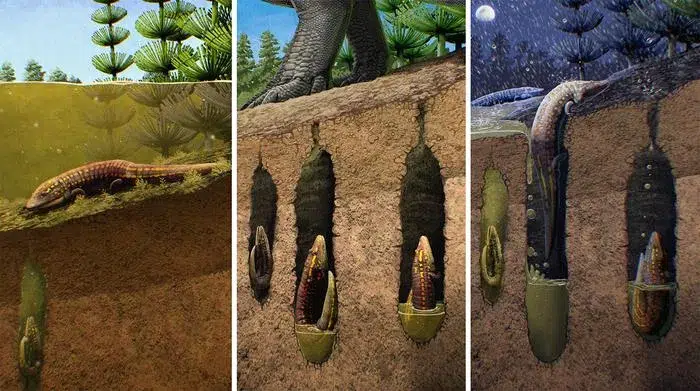
© Gabriel N. Ugueto
A Site Rich in Hidden History
After the initial discovery, Lovelace returned to the Popo Agie to study the local geology and search for more clues about the prehistoric amphibian. To his surprise, the fossilized burrows were everywhere.
“We couldn’t not find them; the site was ridiculously full of burrows,” he said in a statement.
Although the team has not yet discovered a complete skeleton, the burrows reveal a fascinating story of how amphibians faced the challenges of the Late Triassic.
These remnants show that even in adverse conditions, life found ingenious ways to persist.
Despite the innovative survival strategy, the individuals discovered in the Popo Agie formation were not lucky. The river changed course, and the waters never returned to reach them.
They became trapped in the soil, where their fossilized burrows remained untouched for millions of years, waiting to tell their story.







Descoberta inédita e muito boa ajuda a entender a evolução na terra!
Amo ciências. Ciências é de Deus. Agora falar desse **** como 230 milhões de anos e ainda descrever como era o ambiente e seu habitat daquela época é demais. Não sabemos contar história de 2000 anos, ainda mais 230 milhões anos.
Saiu editado a palavra que não tem nenhum cunho depreciativo.
Sua dúvida é muito válida! Como é possível saber tanto sobre um **** e seu ambiente de 230 milhões de anos atrás? Isso é feito graças ao trabalho de cientistas que utilizam métodos avançados para estudar fósseis e o ambiente onde foram encontrados. Vou explicar como isso funciona:
Datação Geológica: Os cientistas utilizam métodos como a datação radiométrica para determinar a idade das rochas. Eles medem elementos químicos, como o urânio e o potássio, que decaem em outros elementos a uma taxa conhecida. Isso ajuda a calcular há quantos milhões de anos essas rochas se formaram.
Estudo dos Fósseis: Quando fósseis são encontrados, os pesquisadores analisam suas características físicas, como formato dos ossos e dentes, para identificar o tipo de **** e suas possíveis adaptações ao ambiente.
Reconstrução do Ambiente: Os sedimentos ao redor do fóssil contam uma história. Por exemplo, as camadas de solo podem indicar períodos de seca ou enchentes. **** e padrões na rocha mostram se o local era um rio, deserto ou floresta.
Comparação com Espécies Modernas: Muitas vezes, os cientistas comparam fósseis com animais vivos que possuem características parecidas. Isso ajuda a inferir comportamentos, como a estivação do anfíbio descoberto.
Interpretação Baseada em Evidências: Nenhuma dessas informações é baseada apenas em suposições. Cada dado vem de análises cuidadosas e corroboradas por outros estudos científicos.
É verdade que não sabemos todos os detalhes de 2000 anos atrás, mas a ciência tem ferramentas específicas para estudar períodos bem mais antigos, porque se baseia em registros naturais e não apenas escritos. Isso nos permite reconstruir histórias incríveis sobre a Terra e seus habitantes pré-históricos.