





 Portuguese
  English
  Spanish
  5 min of reading
  0 comments


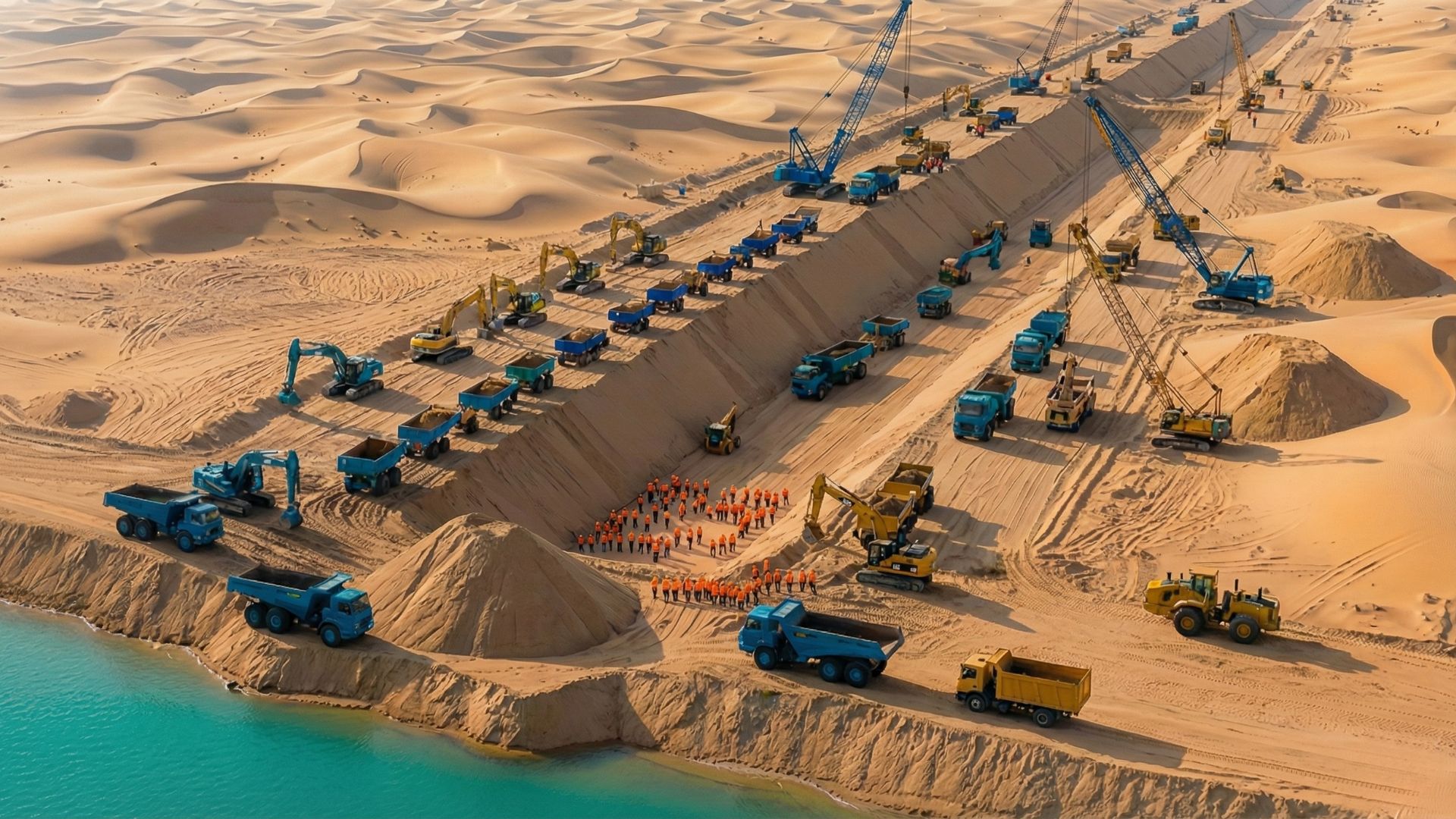
Monumental Water Project Crossed Desert Areas with Extreme Engineering Solutions, Mobilized Thousands of Workers, and Redesigned the Water Flow in Arid Regions, According to Technical Report Released in Specialized Video on Infrastructure and Mega Projects.
Pakistan opened an irrigation canal of almost 500 kilometers to bring water from the Indus River to the arid interior of the country, in a project that began in 2002, mobilizing over 10,000 workers and an estimated investment of over 800 million dollars.
The information was detailed by Machine World channel, in a video published on YouTube, which presents the project as a new water artery amid the desert and describes the technical challenges faced over more than two decades.
According to the report presented by Machine World, the intervention was planned to redesign the hydrography in southwestern Pakistan by diverting part of the flow from the Indus, one of the most powerful water systems in South Asia, to areas where agriculture and supply depended on brief and unpredictable rains.
-
House without a door and without a window: a resident lives high in the mountains, says he enjoys the “free life,” mentions that the cat comes and goes hunting bats and rats, and that when it rains he wakes up with wet feet.
-
Satellite images show that Morocco became so green in 2026 that the country looks different from space: two months of heavy rains transformed arid land into dense vegetation for the first time in a decade.
-
Archaeologists were excavating the foundation of a historic house in Russia when they discovered a buried treasure with gold coins, left behind in the final days of the Russian Empire and now valued at over R$ 2.8 million.

-
The Mediterranean has become the target of the largest underwater archaeological mission ever coordinated by UNESCO: eight countries have joined forces to map shipwrecks and protect a historic corridor.

Despite the proximity of the river, local communities still faced long queues for drinking water, a contrast that motivated the decision to transport the resource into the arid interior.
Canal in the Desert and the Logic of Water Transportation
The video from Machine World contextualizes the project in an environment marked by centuries of severe droughts, which shaped human settlement in the arid plains of South Asia.
The dried soil and irregular rainfall imposed strict limits on survival and made agricultural production unstable, especially under extreme heat.
In this scenario, the canal’s construction appears as a direct response to chronic water scarcity.
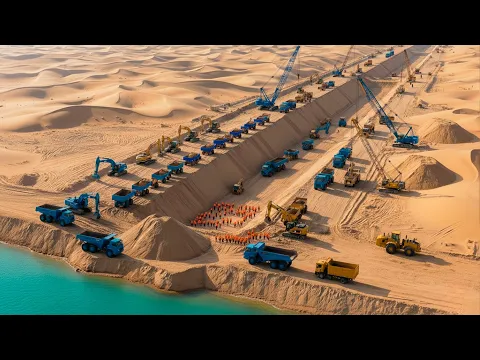
The structure, with 499 kilometers in length, was planned to cross desert plains and convey water to regions where nature had never allowed for a permanent flow.

Excavation in Unstable Soil Under Extreme Temperatures
According to Machine World, opening the bed required the continuous removal of tons of sand and rock, in prolonged shifts under high temperatures.
Large hydraulic excavators operated in uninterrupted shifts, raising dense clouds of dust as they moved across the unstable soil.
The work went beyond simple excavation.
The sandy terrain presented a high risk of collapse, which forced teams to adopt specific solutions to stabilize the banks and prepare the bed before the water arrived.
The goal was to prevent deformations that could compromise the integrity of the structure over time.
Controlled Slope for Gravity Transport
The video highlights that each kilometer of the canal required precise slope calculations to allow water to flow solely by the force of gravity.
An improperly calculated slope could cause erosion of the walls or reduce the efficiency of water transport.
This precision is essential in an environment where intense heat accelerates evaporation.
Controlling the flow meant, at the same time, preserving the canal and ensuring that water effectively reached agricultural areas and distribution centers.
Concrete Coating to Prevent Infiltration
Another point emphasized by Machine World is the challenge posed by extreme porosity of desert soil.
In such regions, sand can absorb large volumes of water quickly, which would make the canal unviable without an efficient sealing system.
To tackle this problem, the project included concrete coatings and high-durability containment structures.
These solutions allowed overcoming geological obstacles and maintaining a stable flow, ensuring that the Indus could nourish previously unviable agricultural areas.
Gates, Sluices, and Flow Regulation
The entry of water into the canal occurs through large steel gates installed in a main regulator, described in the video as the point where the Indus is officially diverted.
Given the scale of the project, the canal does not function as a simple continuous ditch.
According to Machine World, over 900 auxiliary structures were necessary to control floods and regulate flow.
Bridges, spillways, siphons, and aqueducts ensure the crossing of natural courses and integration with roads and railways.
Sluices distributed along the route feed secondary branches and control the flow.
Hydraulic Tests and Commissioning
After years of construction, the system entered the hydraulic testing phase.
The video reports that the sluices were gradually opened, with a progressive increase in discharge, while technical teams monitored pressure, leaks, and possible ground movements along the route.
The release of water into a previously dry and cracked bed is described as a symbolic milestone for areas referred to as Derabugti and Jalmagsi.
With the canal substantially finalized after about 20 years of work, the structure moved from the construction phase to a routine of continuous operation.
Mega Water Projects in Other Deserts
The content from Machine World is not limited to Pakistan.
The video also addresses large water transportation projects in other deserts, such as in the Negev, Israel, where a canal of about 402 kilometers was excavated with a U-shaped profile, 45 meters wide at the base and an average depth of 7 meters.
In this case, the precise alignment allowed the exclusive use of gravity, eliminating the need for pumps.
The coating was treated as a decisive stage, with concrete slabs, expansion joints, and, in critical stretches, geomembranes to prevent infiltration.
The video also cites examples in Saudi Arabia, with seawater harvesting, transportation through long steel pipelines, and subsequent desalination.
The process involves welding, ultrasonic inspection, anti-corrosive protection, and high energy consumption to make the water suitable for human consumption and irrigation.
By gathering these examples, Machine World presents an overview of how large water transportation and treatment systems have become strategic in arid regions.
In a scenario of increasing scarcity, to what extent will projects of this magnitude continue to be the main response to ensure water where it has never naturally existed?







-

-

-

-

-

-

61 pessoas reagiram a isso.