





 Portuguese
  English
  Spanish
  4 min of reading
  0 comments


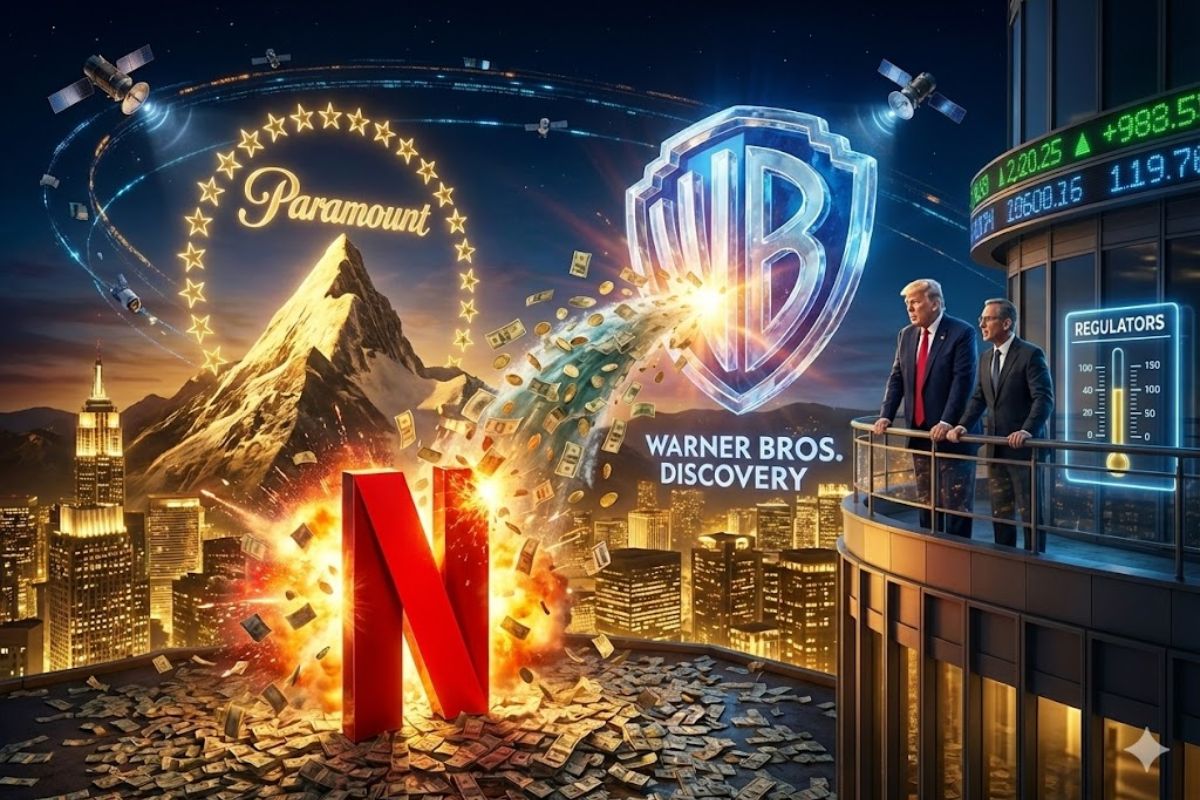
Paramount Delivers Public Offer Directly to Warner Bros Discovery Shareholders, Says Its All-Cash Proposal Is Worth US$ 18 Billion More Than the Deal With Netflix, Reduces Regulatory Risks, Pressures Trump and Has Support from the Ellison Family, RedBird Capital, Bank of America, Citi, and Apollo
Paramount announced a public acquisition offer to buy all outstanding shares of Warner Bros. Discovery (WBD) for US$ 30 per share in cash, heating up the global competition for control of streaming. According to a statement, the transaction covers the entire company, including the Global Networks segment, and is presented as a more attractive alternative to the ongoing deal with Netflix.
According to the note, Paramount’s offer is described as “a superior alternative to the transaction with Netflix”, which currently proposes a lower value and a “complex and volatile mix of stock and cash”, subject to a lengthy process of regulatory approval in multiple jurisdictions, with uncertain outcomes and the possibility of a veto by U.S. President Donald Trump.
Cash Offer Aims for Total Control of Warner Bros. Discovery
Under the announced proposal, Paramount wants to acquire 100% of Warner Bros. Discovery, purchasing all outstanding shares at US$ 30 per share, entirely in cash.
-
The institute that trained the greatest aerospace engineers in Brazil has just opened its first campus outside São Paulo after 75 years: ITA Ceará will have R$ 445 million, new courses in energy and systems, and classes are expected to start in 2027.

-
Luciano Hang, owner of Havan, goes to Juiz de Fora after the tragedy in February, brings R$ 1 million, hands out R$ 2,000 cards, and donates up to R$ 15,000 to victims in the region.

-
The Brazilian passport allows legal residence in dozens of countries without the need for a prior visa, and most Brazilians are unaware that they can apply for residency directly upon arriving in nations in South America, Africa, and even Europe.

-
Petrobras sends a message to Brazilian truck drivers after fuel collapse and reveals plan to have 100% domestic diesel.


The business structure aims to directly oppose the deal with Netflix, which involves stock swaps and cash payments under conditions deemed riskier for current WBD investors.
In the statement, the company emphasizes that it is taking the proposal directly to shareholders, without waiting solely for negotiations with the Warner board.
The strategy, according to Paramount itself, is to “give them the opportunity to act in their own best interests”, offering more price predictability and cash receipt, instead of exposure to the volatility of the streaming giant’s stock.
Paramount Promises US$ 18 Billion More Than Netflix
One of the main advantages of the initiative is the financial premium. Paramount’s offer for the entirety of WBD provides shareholders with US$ 18 billion more in cash than the consideration presented by Netflix, according to the company.
By highlighting this difference, Paramount tries to convince investors that its proposal not only pays more but pays in a simpler and more direct way, without relying on multiple combinations of stocks, conversion timelines, and market fluctuations.
The implicit reading is that, in an environment of significant regulatory and political uncertainty, cash now may be worth more than a future promise tied to the stock market.
Financing Backed by Ellison Family, RedBird, and Major Banks
To sustain the offensive, Paramount claims that the deal will be fully backed by the Ellison family and RedBird Capital, two significant players in the media, technology, and sports landscape.
In addition, the financial structure includes a US$ 54 billion debt contribution provided by Bank of America, Citi, and Apollo, as detailed in the statement.
In practice, this package is used by Paramount to reinforce the message that there is sufficient financial “ammunition” to complete the purchase of Warner Bros.
Discovery and meet all commitments to shareholders, reducing doubts about the financing capacity of the operation in a sector pressured by high interest rates, intense competition, and significant investments in content.
Trump and Regulators at the Center of the Streaming Dispute
Paramount also explores the political and regulatory risk of Warner’s deal with Netflix. In the text, the company states that the rival’s offer exposes shareholders to a lengthy regulatory approval process in multiple jurisdictions, with an uncertain outcome.
Among the obstacles is the fact that the deal could still be blocked by Donald Trump, who has previously expressed critical views regarding Netflix’s acquisition of Warner Bros. Discovery.
In addition to Trump, regulatory bodies such as Cade and competition authorities in other countries have been frequently cited in analyses regarding the consolidation of the media and streaming sector.
Meanwhile, experts point out that “technology is swallowing media”, a context in which moves such as Paramount’s offer and the deal with Netflix are seen as desperate responses to the race for scale, subscribers, and data.
By putting pressure on the existing deal, Paramount attempts to reposition the industry landscape, suggesting that its cash proposal could face less resistance while also redesigning the power map in a market where films, series, sports, and news increasingly depend on global digital distribution platforms.
Paramount x Netflix: Which Offer Makes More Sense for Warner’s Shareholders?
With more money at stake, explicit support from heavyweight investors, and a direct critique of the complex structure of the transaction with Netflix, Paramount signals that it is willing to engage in a long battle for control of WBD.
On the other hand, the streaming giant continues to argue that its asset combination strengthens global scale, content portfolio, and investment capacity in technology and data.
In the end, the impasse is likely to be resolved by how much each proposal delivers today in cash to shareholders, how risky the regulatory path will be, and which group will have more strength to convince Trump and other authorities that the concentration of power in streaming will not stifle competition or harm consumers and content producers.
And you, in light of Paramount’s offensive against the deal with Netflix, do you think Warner’s shareholders should choose the immediate cash offer or bet on the combination with the streaming giant?










Seja o primeiro a reagir!