





 Portuguese
  English
  Spanish
  5 min of reading
  0 comments


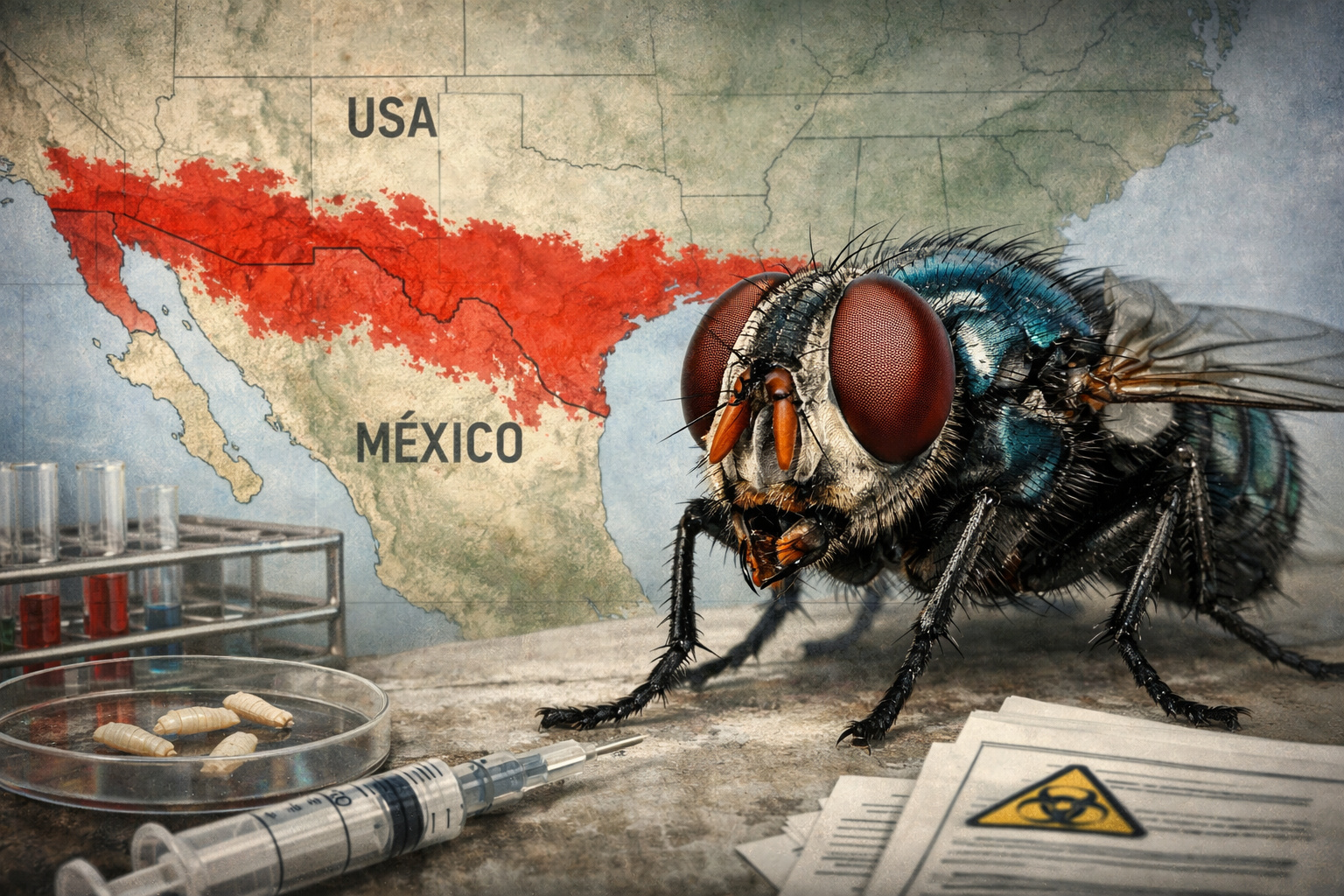
Outbreak of the Worm Known as New World Screwworm Has Caused Deaths, Threatens Largest Cattle Region in the U.S., Generates Highest Alert from the CDC and Exposes Failures in a Control System Regarded as Global Model for Decades
The silent advance of a parasite considered eradicated for decades has reignited maximum alerts in North America. The so-called screwworm (Cochliomyia hominivorax), known internationally as New World screwworm, has already caused seven human deaths and infected at least 1,190 people in South America and Mexico. Now, according to health authorities, the parasite is on an expansion path toward the United States, reigniting historical fears in the public health and agriculture sectors.
This information was disclosed by ScienceAlert, based on official data from the Centers for Disease Control and Prevention (CDC) of the United States, which issued a health alert directed to doctors, veterinarians, and professionals in the North American health system. The notice emphasizes the need for active surveillance given the unprecedented proximity of the parasite to U.S. territory after decades of successful control.
What Is the “Flesh-Eating” Worm and Why It Concerns Health Authorities

The New World screwworm is the larva of a parasitic fly that develops inside open wounds and mucous membranes of warm-blooded animals. Unlike other species that feed on necrotic tissue, this parasite consumes living tissue, making infections extremely aggressive.
-
He started running at 66 years old, broke records at 82, and is now a subject of study for having a metabolic age comparable to that of a 20-year-old, in a case that is intriguing scientists and inspiring the world.

-
Oldest tree on the planet reappears after 130 years of searches: Wattieza, 385 million years old, was 10 meters tall and had no leaves or seeds; Gilboa fossils in New York solved the mystery in 2007.

-
A 48-square-meter house assembled in hours with 4,000 bricks made of recycled plastic that does not absorb moisture, has natural thermal insulation, and costs less than 90,000 reais in a complete kit.

-
Luciano Hang revealed that Havan’s air fleet has already accumulated more than 20,000 landings, 10,000 flight hours, and 6 million kilometers traveled, and he says that without the planes, the company would never have grown so quickly.


Initially, the main targets are cattle, horses, and pigs, but the risk does not stop at livestock. The fly can also lay its eggs in dogs, cats, and humans. Without proper treatment, the infection can rapidly progress and become fatal. According to technical data, an adult cow can die in just one week after the infestation begins.
Currently, there are 601 active cases in animals in Mexico, with eight of them in the state of Tamaulipas, which directly borders Texas. This specific data was crucial for the CDC to elevate the alert level, as this is a strategic area for the North American agricultural sector.

Before the 1960s, ranchers in Texas dealt with about 1 million screwworm cases per year, a scenario that caused severe economic losses and justified massive investments in eradication programs.
Historical Barrier Fails, Parasite Breaks Containment and Reignites Billion-Dollar Risk
The current fear is directly linked to the partial failure of one of the most successful control systems in the history of animal health. The eradication of the worm in the United States was officially declared in 1966, following a scientific effort that became a global reference.
The method exploited a crucial biological characteristic of the parasite: females mate only once during their 21-day lifespan, while males can mate multiple times. From this, scientists began using gamma radiation to produce sterile male flies, which were then released en masse into the environment.
Between the 1960s and 1980s, billion sterile flies were released by airplanes in regions of southern Florida, Texas, California, Arizona, and New Mexico. The result was considered historic. In 1982, the parasite was declared locally extinct in the U.S., Mexico, and parts of Central America, thanks to the combination of the so-called sterile insect technique, chemical treatments in herds, and favorable climatic conditions.
To prevent the return of the pest, a permanent facility was maintained in Panama, a country that serves as a natural corridor between South America and North America. The region of Darién Gap, a dense and hostile jungle area, was viewed as an additional geographical barrier to the spread of the parasite.
However, in 2023, something changed. The worm managed to break through this sanitary barrier, resuming its march northward. By November 2024, the parasite had already reached Mexican territory. In September 2025, Mexican authorities confirmed the infection of an eight-month-old calf, located about 70 miles (approximately 113 km) from the United States border.
Climate, Irregular Animal Traffic and Billion-Dollar Economic Risk
According to the CDC, the accelerated advance of the parasite is directly linked to structural and environmental factors. The agency points out that unregulated movement of cattle, increased human and animal flow through the Darién Gap region, and the expansion of new agricultural areas have decisively contributed to the worm’s dissemination.
Additionally, scientists warn that climate change may be extending the parasite’s breeding window. Higher temperatures favor longer cycles of fly activity and allow them to occupy new geographical regions that were previously considered unsuitable for their survival.
The potential impact is alarming. If the parasite establishes itself in Texas, the largest cattle-producing state in the U.S., economic losses could reach US$ 1.8 billion, according to estimates from the U.S. Department of Agriculture (USDA). The figure includes direct production losses, costs for veterinary treatments, quarantines, and trade restrictions.
So far, no human or animal case related to this outbreak has been confirmed on U.S. territory. Nevertheless, the CDC emphasizes that the alert is preventative in nature.
In an official statement, the agency stated that, “given the potential for geographical expansion, the CDC issues this health alert to raise awareness about the outbreak, guide case identification, sample collection, diagnosis, treatment and notification protocols, and provide recommendations to the public.”
The complete alert remains available on the official channels of the CDC, while health and agricultural sector authorities closely monitor the situation.








-

-

5 pessoas reagiram a isso.