





 Portuguese
  English
  Spanish
  6 min of reading
  0 comments


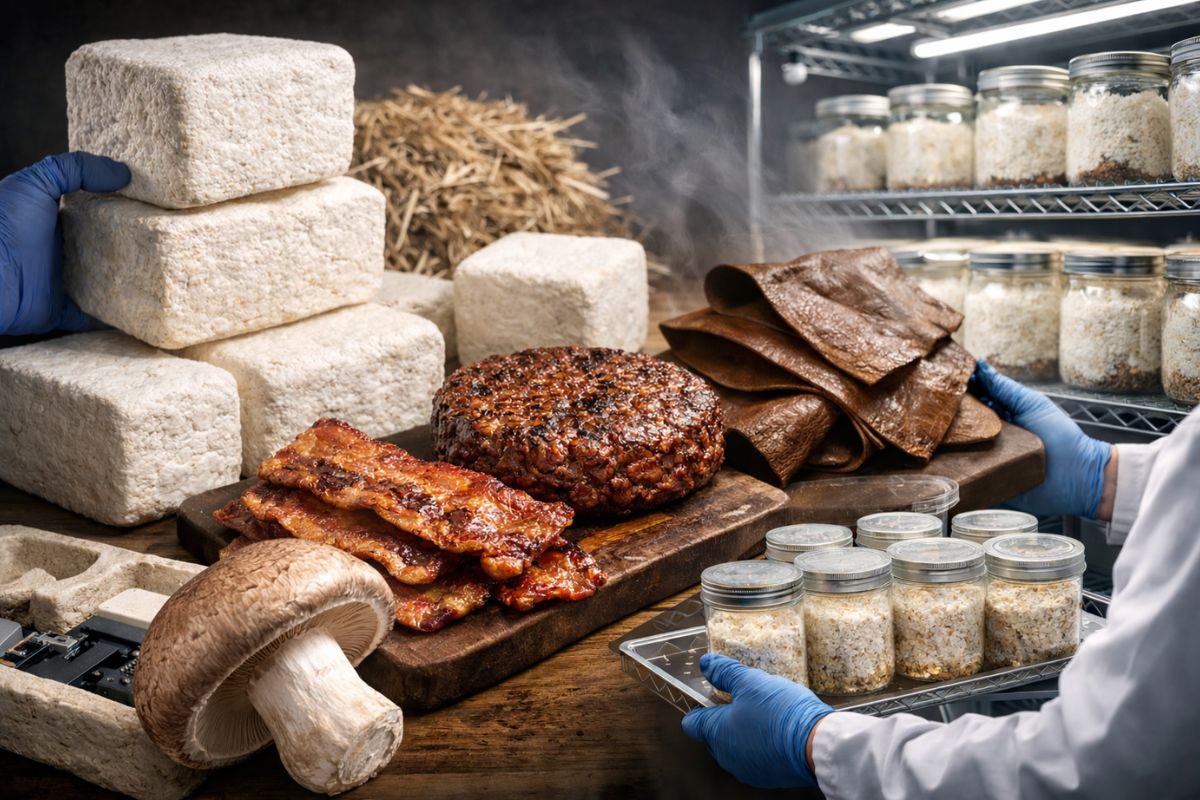
At The Ecovative Headquarters In Green Island, New York, Mushroom Mycelium Is Grown On Wood Shavings, Corn Stalks, Or Hemp, Compacted Into Natural Molds, It Becomes Foam-Like Packaging That Degrades In 30 Days And, In Vertical Farms, Generates Vegan Bacon And Leather In 10 Days.
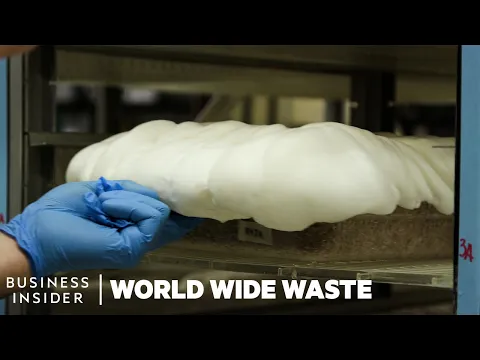
At First Glance, It Looks Like A Giant Marshmallow, soft and white, resembling industrial dessert. However, instead of sugar, the mushroom stands in for its most “invisible” and useful part: mycelium, a living network that grows by feeding on agricultural waste and, when guided, turns into material, food, and even an alternative to leather.
What stands out is the practical promise behind the curious aesthetics: to replace Styrofoam, that lightweight volume that occupies a third of landfill space, with packaging that disintegrates in about 30 days, while also producing proteins and materials in about 10 days of growth, using fewer resources than livestock, according to the company.
The Marshmallow That Is Not Sweet: What The Mushroom Mycelium Does When Nobody Is Watching

The “magic” is not in the mushroom’s hat, but in the living root, mycelium, which forms structures and occupies space as if it were a biological glue. The idea is simple to explain and complex to execute: to take advantage of what nature already does well, grow and bind particles, and transform this into a manufacturing platform.
-
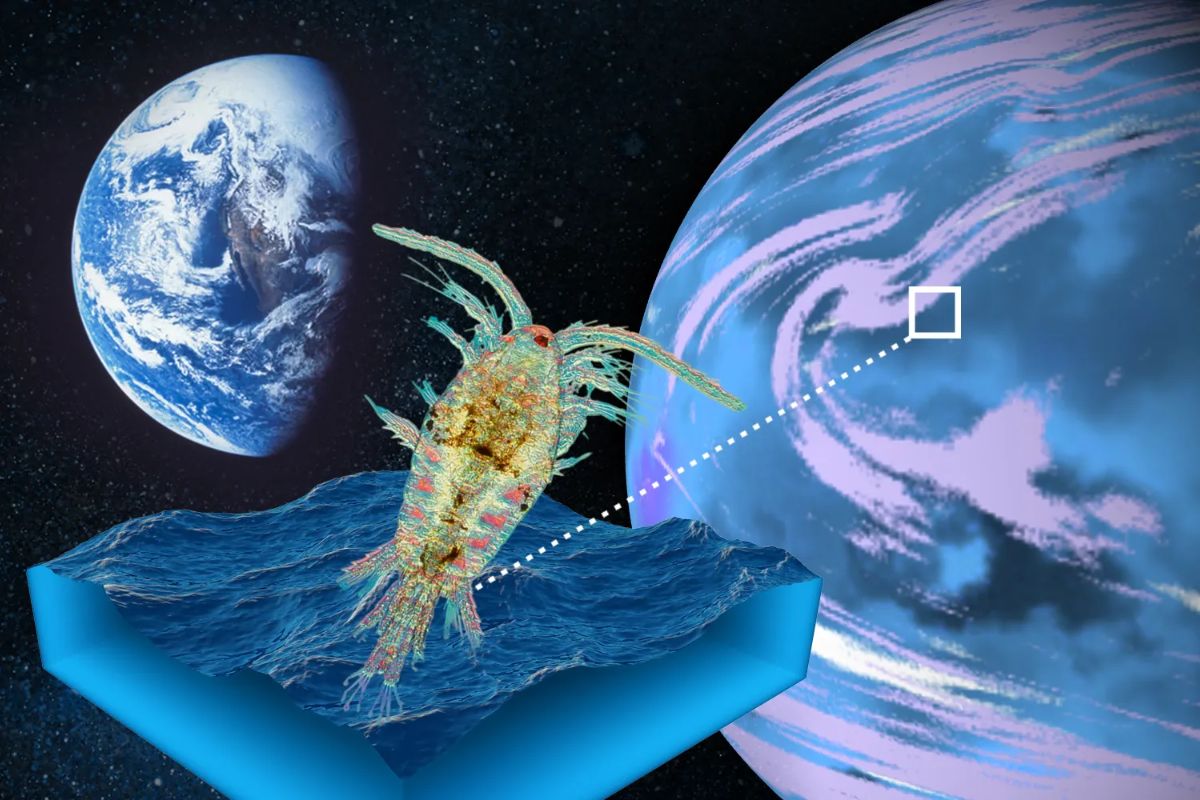
What the James Webb telescope found on the planet K2-18b is raising alarms in the scientific community: gases that on Earth only exist because of living organisms have been detected in the atmosphere of an oceanic world 124 light-years away from us.
-
Divers found a nearly intact 23-meter Greek ship on the bottom of the Black Sea, so well preserved that it seems to have been frozen in time for 2,400 years.

-
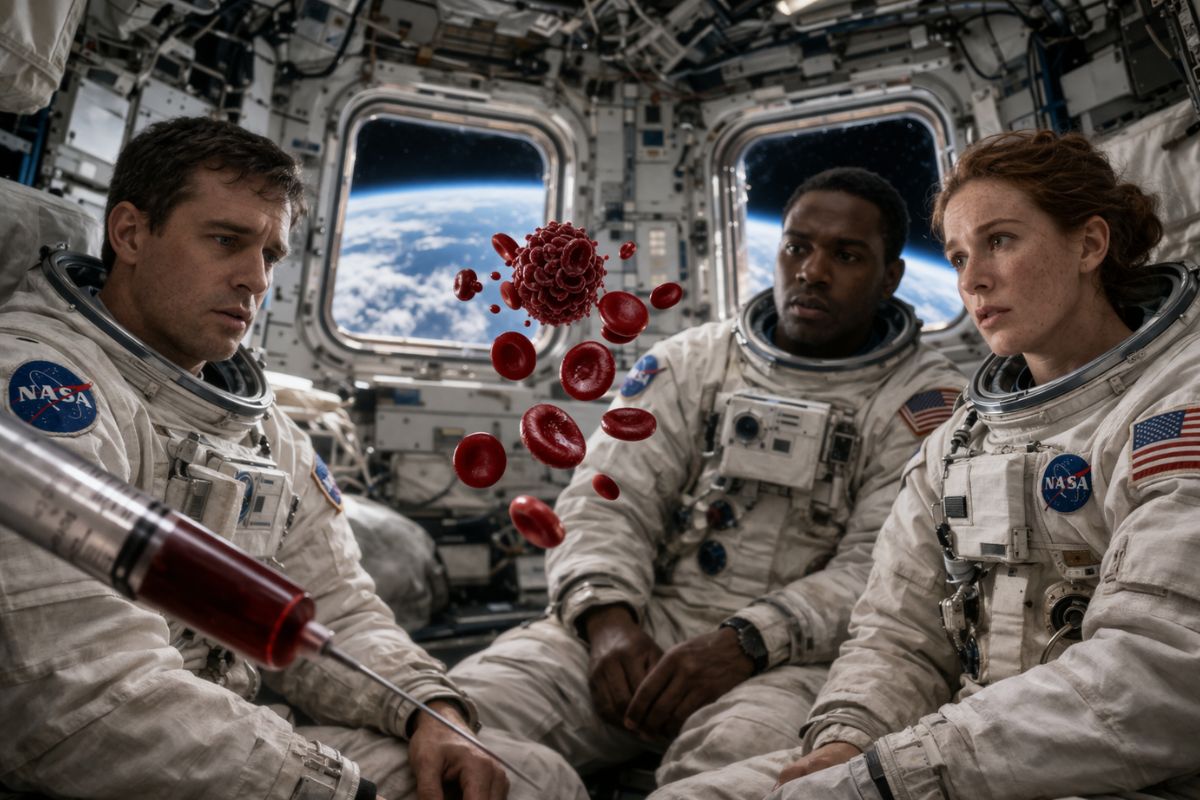
The blood of astronauts is undergoing mutations in space, coagulating too much when it shouldn’t and too little when it needs to: three recent discoveries reveal that our bodies were simply not made to live outside of Earth.
-
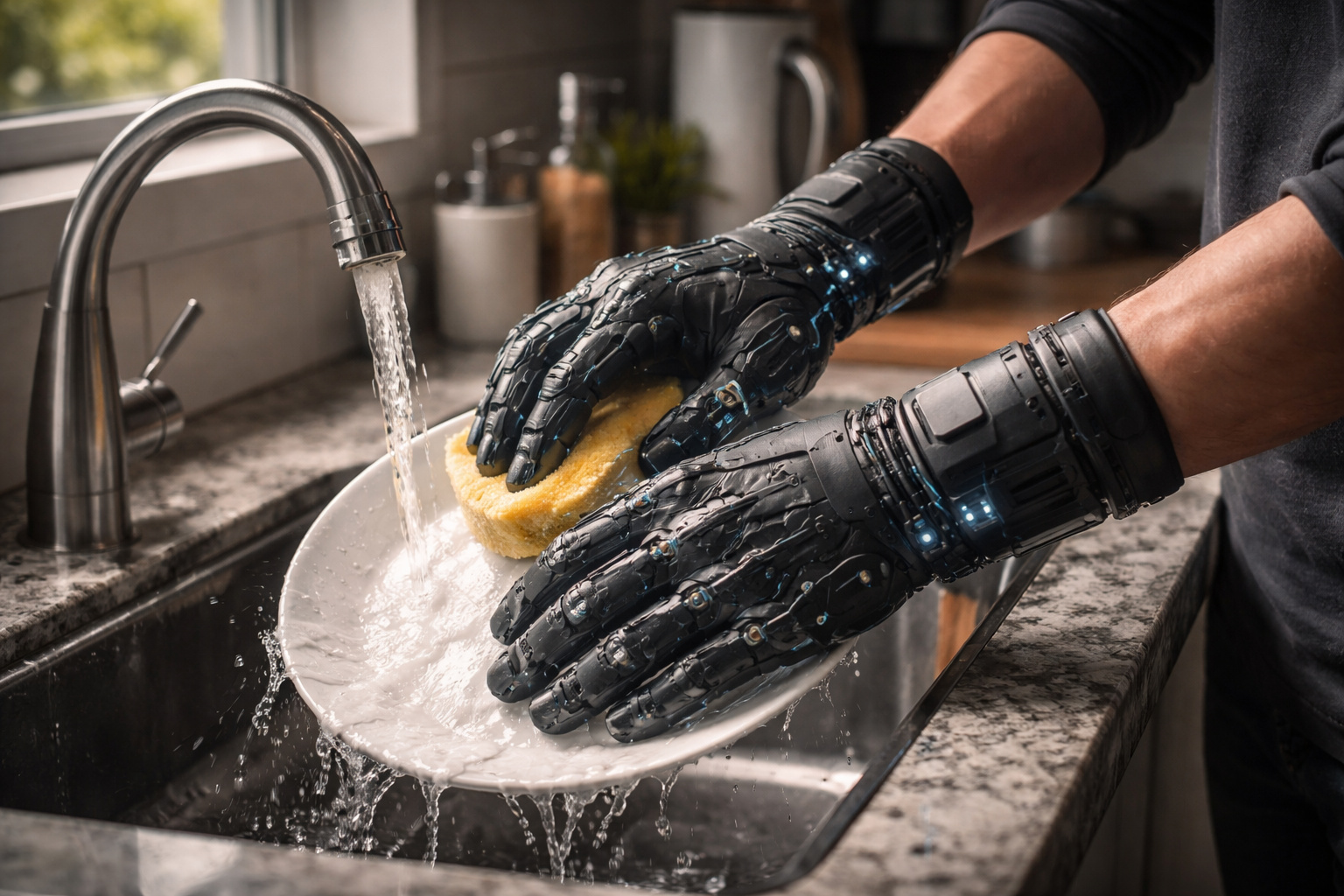
A startup sends robotic gloves for users to wear at home while washing dishes, folding clothes, and making coffee; every finger movement is recorded and sent back to train a domestic robot that has already learned 10 million real tasks without ever having entered a kitchen.

This vision presents itself as a product philosophy: to use living organisms as a design tool to solve a dual problem, that of plastic waste and the dependency on materials that hardly return to the cycle.
Mycelium becomes a natural, repeatable, adjustable, and testable “building block,” with the company claiming to work with about 100 different varieties to observe properties and applications.
From Agricultural Waste To “Microcomposite”: How Mushroom “Styrofoam” Is Born

The manufacturing starts far from a kitchen and close to a farm: wood shavings, corn stalks, or hemp that could be discarded become the base.
Then come mushroom spores and water; the mixture is compacted into molds, and the mycelium grows by feeding on this crushed waste. A little over a week later, the mold “fits” and the material is ready to ship.
The shape is not by chance. The molds are designed and produced with large sheets of recyclable plastic; heat softens the sheets so they can be molded around different products.
The result, sold as microcomposite, is described as having properties similar to Styrofoam, only biodegradable.

It May Be A Bit Heavier Than Styrofoam, with a velvety and soft touch, and the cited degradation is fast: about 30 days, while conventional Styrofoam “never completely disappears,” lasting in the environment for up to five centuries, with less than 1% already recycled.
Vertical Farms And The “Ariel”: Why 10 Days Change The Logic Of Meat And Leather

When the focus shifts from packaging to food and textile material, the process changes. The company describes the use of a substrate to inoculate sawdust, still starting from waste and spores, but transferring the growth stage to vertical farms.
In these chambers, conditions are adjusted to mimic natural soil, with an important detail: the environment is controlled for the mycelium to continue growing, instead of “breaking the ground” and forming the mushroom.
This is where the real “marshmallow” appears: a large mycelium structure called Ariel, which grows over about 10 days.
The largest chamber mentioned would have the capacity to produce up to 200,000 pounds of mycelium per year, generating industrial sheets that can reach 50 feet in length, 1.5 meters in width, and a few centimeters in thickness.
The Technical Point Is The Scale Of The Organism As Raw Material, Instead Of Relying On Fibers, Plastic Foam, Or Animal Fabric.
Licensed Leather, Sliced Bacon: When The Mushroom Becomes A Shelf Product

The transition from laboratory to market goes through licensing and proprietary lines. In 2018, the company licensed its “leather” process to Bolt Threads, presented as an alternative already used in clothing and bags.
Two years later, in 2020, came a line of mushroom-based meat alternatives called MyForest Foods, with “Mai” as the abbreviation for mycelium.
The most striking product is MyBacon, made from Ariel mycelium, sliced, seasoned, and fried until crispy.
Taste Cannot Be Confirmed Just By Report, but the proposal is to mimic the texture and experience of bacon, and the company associates this with a more “healthy” profile: high in fiber, with the same protein content as a regular slice of bacon and one-fifth of the fat.
Availability, however, appears as a bottleneck: MyBacon was noted as sold in only one supermarket in Albany, New York, with plans for expansion to more stores in 2021.
How Much This Represents And What Prevents It From Becoming A Global Standard

The numbers reflect two things at the same time: traction and distance to ubiquity. In 2020, Ecovative reportedly produced over 6 million pounds of foam alternative, but this would only account for 0.5% of cups consumed by Americans.
The scale of Styrofoam use continues to be massive: the average person would still use 75 foam coffee cups per year, totaling 25 billion.
There is also a fragmented regulatory landscape. An increasing number of cities and states have banned Styrofoam, but the United States does not have a national system of restrictions, which keeps demand and supply fluctuating by region.
And there’s the financial part: the company announced it raised a total of 100 million dollars in capital, compared to a more established brand, Impossible Foods, which reportedly raised 700 million by the cited date. In substitute materials, technology can be fast; the market, not always.
Why Bacon Becomes A Shortcut And The Mushroom Tries To Copy “Whole Cuts”

The competition for attention does not happen only in packaging, and bacon enters as a psychological and habitual argument. The meat substitute market is described as valued at about 4 billion dollars and is expected to double in the next five years.
Within this scenario, bacon is treated as a “lever point” because it would be one of the main reasons cited by those who say they will not stop eating meat.
The technical differential promised by the mushroom, via mycelium, is the ability to imitate whole cuts, instead of falling into the more common “pressed mass” format.
While many alternatives appear as burgers or sausages, mycelium protein is presented as capable of building texture in sheets and boards. If this goes to scale, it changes the conversation: the “substitute” goes out and the “new material with equivalent function” comes in.
The story of the mushroom here is not about an exotic ingredient, but about an organism being used as a factory: it grows on agricultural waste, occupies molds, becomes packaging that disappears in 30 days, and, in about 10 days, can become vegan bacon or a base for alternative leather.
The Real Challenge Seems Less Biological And More Industrial, because between a perfect prototype and a common shelf there exists logistics, cost, distribution, and habit.
If You Found In The Market A Mushroom Packaging That Disintegrates In 30 Days, Would You Trust It To Protect An Expensive Product, Such As Electronics?
And About Mycelium Bacon: What Would Weigh More In Your Decision To Try It, Texture, Price, Health, Or Environmental Impact?






Seja o primeiro a reagir!