





 Portuguese
  English
  Spanish
  5 min of reading
  0 comments


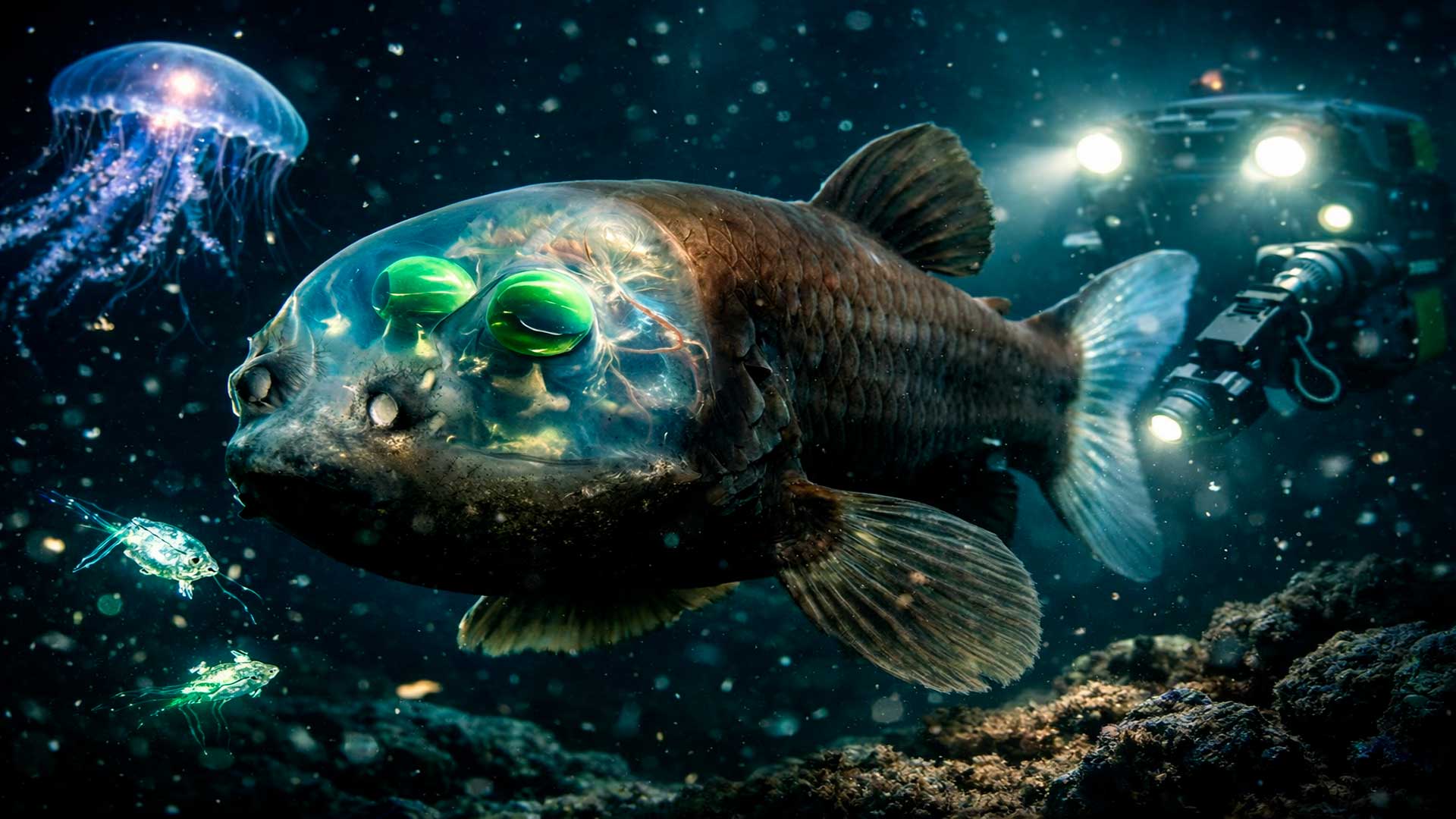
A Rare Deep-Sea Fish, The Macropinna Microstoma, Has A Translucent Dome On Its Head That Allows You To See Its Eyes And Internal Structures In Video. With ROVs And High-Definition Cameras, Scientists Capture The Animal In Its Natural Habitat And Study How It Hunts In The Dark.
In the darkness of the deep ocean, a type of fish draws attention for something almost unbelievable: a head that looks made of glass. The animal is known as barreleye and became famous for having a transparent dome that works as protection and at the same time allows one to observe what would normally be hidden inside its skull.
The main example cited by researchers is the Macropinna microstoma, a species first described in the last century that has intrigued science again as clearer images revealed details of its behavior. Instead of relying on aggressive captures, modern observation is conducted with underwater robots, which avoid the pressure shock that usually damages deep-sea animals.
The result is footage that looks like it’s from another planet, with bright eyes and a translucent “helmet.” And although not all transparent fish allow you to see the entire body, these cases help answer practical questions about how life sees, feeds, and conserves energy where there is almost no light.
-
A strong earthquake in Indonesia affects houses and schools, causes panic, triggers a tsunami alert, and records a rise in sea level of up to 30 centimeters in some areas.

-
The Argentine government celebrates the lowest poverty rate in 7 years, but experts warn that the methodology has changed, real wages have fallen, unemployment has risen, and the number of people on the streets of Buenos Aires has increased by 57% since Milei took office.

-
7.8 magnitude earthquake in Indonesia frightens the population, triggers tsunami alert, and hits an island with over 200,000 inhabitants this Thursday.

-
Google will finally let you change that embarrassing Gmail address you created in your teenage years without losing any accounts, logins, or old emails: the feature is already available in the United States.

At the same time, transparent species from shallower waters, such as the so-called glass fish, reinforce the fascination because they leave organs and bones partially visible. This amplifies scientific interest and also raises debate about the use of these animals in the aquarium trade.
Macropinna Microstoma: The Transparent-Headed Fish That Became A Symbol Of The Depths
The barreleye is often described as a deep-sea fish with a translucent dome above its face. This “dome” covers and protects the eyes, which are located inside the head and can be seen in clear images taken during scientific expeditions.
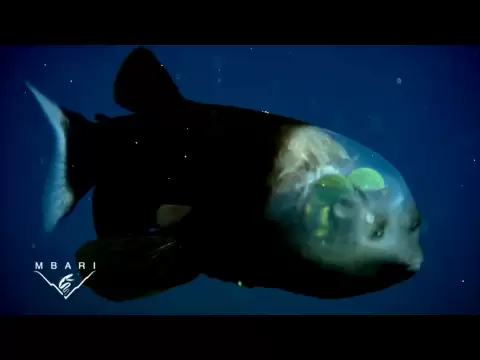

The species was described in 1939, but for decades many details remained in the realm of assumption because specimens brought to the surface suffered damage and did not show real behavior. When teams from the Monterey Bay Aquarium Research Institute released clearer images, the interpretation of the animal changed and several old hypotheses needed to be revised.
In video recordings, what seemed to be a “fixed eye” proved to be a much more sophisticated system. Transparency, in this case, is not just an aesthetic curiosity, but part of a set of adaptations to survive where food is scarce and every movement is costly.
Rotating Tubular Eyes Help Detect Bioluminescent Prey Without Spending Energy
The most discussed feature of the barreleye is its tubular eyes, which are efficient at collecting weak light. Modern observations indicate that these eyes can rotate, alternating the direction of gaze upward and forward, which is crucial for tracking luminous signals from prey in an almost totally dark environment.
Additionally, descriptions from MBARI indicate that the “little marks” on the front of the face are not the eyes, but structures connected to the sense of smell, while the eyes remain as spheres behind the face. This arrangement reinforces the idea of an animal specialized in perceiving minimal cues, taking advantage of any shimmer in the water column to locate food.
ROVs And High-Definition Cameras Changed The Study Of Transparent Fish In The Deep Ocean
The study of deep-sea fish increasingly relies on ROVs, remotely operated vehicles equipped with cameras, lights, and precise motion control. This type of technology allows filming without touching the animal, preserving behavior, body position, and interactions with other organisms.
In the case of the barreleye, videos made by MBARI teams helped clarify a “mystery” described for decades, precisely because they showed the fish alive and in natural conditions. This point is crucial, as sudden changes in pressure and temperature can distort delicate structures, especially in gelatinous species or those with weak tissues.
The evolution of onboard cameras also plays a role. MBARI itself reports historical milestones of ROVs with high-definition cameras and upgrades to better record life on the sea floor, increasing the chance of capturing rare species for longer periods and with less visual noise.
By 2025, the institute also highlighted the use of robots with 4K capture to record deep-sea animals in recent expeditions, reinforcing that modern exploration relies less on “collecting to see” and more on observing without destroying.
Thus, scientists can analyze gaze angles, posture during hunting, and the likely function of translucent structures as protection. The gain is twofold: it improves scientific accuracy and reduces the impact on species that already live on the energy edge.
Shallow-Water Transparent Fish Show Visible Organs And Raise Debate In Aquarism
Outside the deep ocean, there are the so-called glass fish, famous for having very translucent bodies. A widely cited example is the Parambassis ranga, known as Indian glassy fish, whose transparency can leave bones and organs partially visible, especially under good lighting conditions.
In these species, transparency is understood as camouflage, reducing reflections and helping the fish to “disappear” in clear water. The topic also appears in aquarium guides, which describe the animal as naturally transparent and warn against controversial practices, such as the commercialization of specimens with artificial coloring.
This is where the controversy arises: for some people, keeping a transparent fish in an aquarium is a form of education and scientific curiosity. For others, the market can encourage mistreatment when it turns a biological characteristic into a product, especially if there are manipulations to “make it more eye-catching.”
Why Transparency Interests Science And Can Inspire New Technologies
In evolutionary biology, cases like the barreleye help investigate how extreme pressures of light, food, and predators shape complex structures. The combination of protective dome and rotating tubular eyes suggests a rare solution for seeing without exposing oneself too much.
In physiology and biomechanics, transparency is also an opportunity. Even when visibility is limited to the head or parts of the body, video recording allows for studying movement, orientation, and response to stimuli without invasive procedures, which is valuable in fragile species.
In parallel, researchers and engineers draw inspiration from natural solutions to think about materials with lower reflection and structures that are resilient under difficult conditions. The logic is simple: if nature “solved” the problem of dealing with minimal light and high pressure, these principles can guide innovation in other areas, from optical design to the development of low-glare surfaces.
In the end, the transparent fish becomes more than a curiosity. It becomes evidence that life, when explaining its own rules, often does so in ways no one imagined.
What do you think, should transparent fish only be observed in nature, or does it make sense to keep them in home aquariums? Transparency is fascinating, but the exotic animal market can also encourage excesses. Share your comment with your opinion and where you would draw that line.









-

-

-

-

25 pessoas reagiram a isso.