





 Portuguese
  English
  Spanish
  4 min of reading
  0 comments



Living More Than 1,000 Meters Deep, The Devil Fish Has Ultra-Black Skin That Absorbs Almost All Light and Reveals One of the Most Extreme Adaptations of the Deep Ocean.
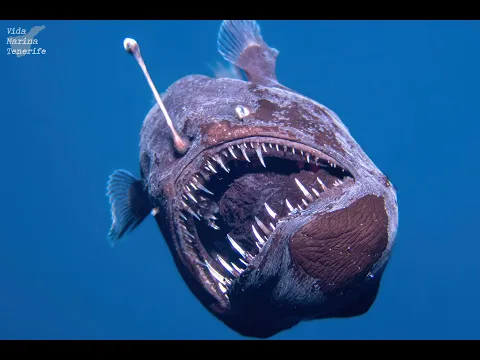
Far below the zone where sunlight can penetrate, there exists an environment where darkness is not just the absence of light, but a permanent physical condition. It is in this extreme scenario, more than 1,000 meters deep, that the Melanocetus johnsonii, commonly known as the devil fish, lives. What makes this species extraordinary is not only its appearance or hostile habitat but the fact that it possesses one of the darkest biological surfaces ever recorded by science, able to absorb about 99.9% of incident light, making it practically invisible on the ocean floor.
This characteristic is neither aesthetic nor accidental. It is a finely tuned evolutionary adaptation to the maximum limit, challenging traditional concepts of camouflage, vision, and survival in extreme environments.
Where The Darkest Fish on The Planet Lives
The Melanocetus johnsonii inhabits the bathypelagic zone of the ocean, a region that extends approximately from 1,000 to 4,000 meters deep. In this environment, the pressure can exceed 100 atmospheres, the temperature stays close to 4 °C, and sunlight simply does not exist.
-
The heatwave in Brazil that hit in March is set to end as a cold front arrives between Good Friday and Easter Sunday, causing a temperature drop of up to 6 degrees and rain in the Central-South region, according to the Easter weather forecast.

-
The U.S. Army has introduced its first new lethal grenade since the Vietnam War: the M111 kills using pressure shock waves that bounce off walls and can explode the enemy’s lungs without producing a single shard.

-
Engineers are replacing pressure valves with hydraulic microturbines within drinking water networks and are generating up to 1,100 MWh per year with in-pipe hydropower technology that harnesses energy previously wasted in urban pipelines.

-
Elon Musk focused on Brazil and lowered the price of Starlink, his internet service, but the question remains: is it worth it? An expert provides a detailed analysis of the internet that promises to connect any part of Brazil.




In this abyssal world, most organisms rely on bioluminescence, whether to attract prey, communicate, or confuse predators. The devil fish is part of this group but has taken this strategy to a radical level: besides producing light, it has also become almost entirely incapable of reflecting any external light source.
The Skin That Absorbs Almost All Light
Studies published in the journal Current Biology revealed that the skin of the Melanocetus johnsonii has a highly specialized microstructure. Instead of reflecting light, as most fish do, its skin functions as an optical trap.
Microscopically, the surface is composed of dense layers of melanophores organized irregularly. This structure causes the photons hitting the skin to be deflected repeatedly until they are completely absorbed. The result is a surface so dark that not even the light produced by other bioluminescent organisms can reflect back.
In practice, this means that even when illuminated by natural flashes from the ocean floor, the devil fish remains invisible, like an absolute shadow moving in the void.
Bioluminescence as a Hunting Weapon
Despite being almost invisible, the Melanocetus johnsonii does not rely solely on camouflage. It employs one of the most well-known strategies of abyssal fish: active bioluminescence.
At the end of a head protrusion known as an illicium, there is a luminous structure called an esca. This “live bait” emits light thanks to the action of symbiotic bacteria. In the completely dark environment of the abyss, this small luminous point serves as an irresistible beacon for unsuspecting prey.
When a smaller fish approaches, attracted by the light, the attack is quick. The mouth of the devil fish is disproportionately large, with long, inward-curving teeth that prevent any chance of escape.
Total Invisibility: A Decisive Evolutionary Advantage
The combination of ultra-black skin and bioluminescence creates an almost paradoxical effect. The Melanocetus johnsonii can emit light without revealing its own body. While the bait glows, the rest of the animal remains completely hidden.
This strategy drastically reduces the chance of being detected by larger predators, which is vital in an environment where any mistake can be fatal. Instead of relying on speed or strength, the devil fish bets on absolute invisibility and patience.
From an evolutionary standpoint, this is an extreme solution to an equally extreme problem: how to survive where there is no light, food is scarce, and environmental pressure is constant.
Modest Dimensions, Giant Adaptation
Interestingly, despite all this biological complexity, the Melanocetus johnsonii is not a large animal. Females typically measure between 15 and 20 centimeters, while males are even smaller, reaching only a few centimeters.
This extreme difference between sexes is another typical adaptation of abyssal fish. Males live only to find a female, to which they physically fuse, providing sperm throughout her life. In exchange, they receive nutrients directly from the female’s body. It is one of the most radical examples of reproductive symbiosis known in the animal kingdom.
What This Fish Teaches Science
The study of the ultra-black skin of the devil fish is of interest not only to marine biology. Engineers and physicists have been analyzing these natural structures to develop new light-absorbing materials, with applications ranging from telescopes and optical sensors to military and space technology.
The ability to absorb almost all light without resorting to complex artificial pigments paves the way for solutions directly inspired by nature, reinforcing how extreme organisms often hold answers to modern technological challenges.
A Reminder of How Unknown The Ocean Still Is
The Melanocetus johnsonii is just one of thousands of organisms that inhabit the ocean depths and that we still know very little about. It is estimated that over 80% of the deep ocean remains unexplored, hiding biological adaptations that challenge everything learned in terrestrial environments.
The fish that is darker than the abyss itself is not just a scientific curiosity. It represents the limit of evolution in extreme conditions and reinforces an uncomfortable truth: even in the 21st century, the planet still holds entire worlds that we have barely begun to understand.








-

-

5 pessoas reagiram a isso.