





 Portuguese
  English
  Spanish
 5 min of reading
  0 comments


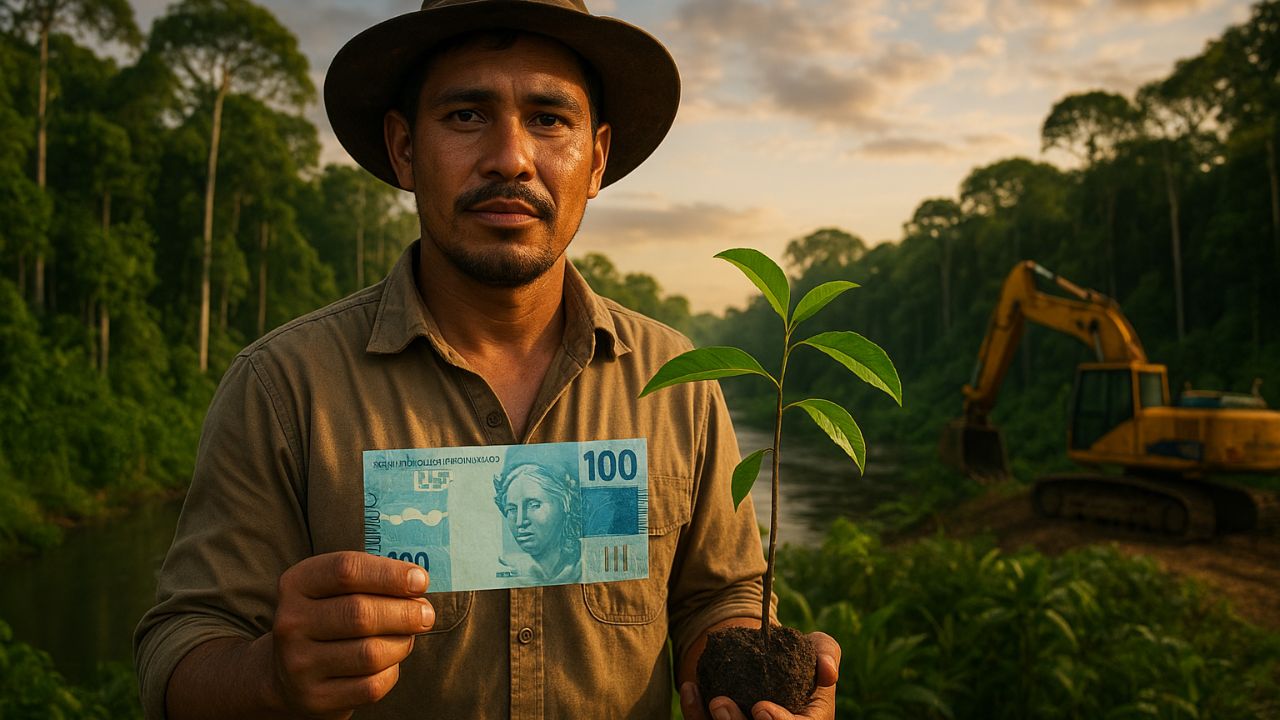
Project Floresta+ Amazon Rainforest Pays Those Who Preserve the Forest, Validating an Economic Model Where Standing Forests are Worth Seven Times More Than Deforestation.
A new economic paradigm is redefining the value of the Amazon, and its protagonists are the small farmers. Far from being seen as a threat to the forest, they are at the center of an innovative strategy that pays them directly to keep the forest standing. Initiatives like the Project Floresta+ Amazon Rainforest, from the federal government, are transforming environmental conservation into a source of income, changing a historically punitive model into one of financial incentive and productive inclusion.
The logic behind this change is supported by robust data. Maintaining the preserved Amazon Rainforest generates a minimum value of US$ 317 billion per year, according to a World Bank report. This value, derived from services like carbon sequestration and climate regulation, paves the way for a billion-dollar market, where Brazil could raise up to US$ 21.6 billion by 2030 from the sale of carbon credits, according to projections from the Earth Innovation Institute. Conservation, therefore, has ceased to be merely an environmental agenda and has become a concrete economic opportunity.
What is the Project Floresta+ Amazon Rainforest?
The Project Floresta+ Amazon Rainforest is the realization of this new economy. Led by the Ministry of the Environment and Climate Change (MMA) and implemented with the support of the United Nations Development Programme (UNDP), the program is designed to financially reward small farmers, indigenous peoples, and traditional communities who protect the native vegetation on their lands. The deliberate focus is on properties of up to four fiscal modules, reaching those on the front lines of the forest.
-
China could impose a quarantine on Taiwan without firing a shot, using the coast guard and inspections to force submission, blocking trade, raising insurance costs, and leaving the U.S. divided between reacting or accepting.

-
Millions of Brazilians over 60 years old do not know that they need a second document in addition to their ID to use exclusive parking spaces, and the infraction for not carrying it is considered very serious, with fines and vehicle towing.

-
Paraíba shoots up and has the most expensive square meter in the Northeast, and the increase in labor puts the region at the center of pressure, with Bahia recording the highest monthly increase in Brazil in construction.

-
BNDES and a Chinese bank create a billion-dollar fund of $1 billion to invest in Brazil in energy, infrastructure, mining, agriculture, and AI.

To participate, the fundamental prerequisite is to have an active and regularized Rural Environmental Registry (CAR). The CAR serves as the database that enables the project to identify and monitor conservation areas. The payment, which ranges from R$ 1,500 to R$ 28,000 per beneficiary, is calculated based on the size of the preserved area and is deposited directly into the producer’s account, without intermediaries. As detailed in the project’s official sources, the funding of US$ 96 million comes from the Green Climate Fund (GCF), a resource that Brazil received for its past results in reducing deforestation.
Why Has Keeping the Forest Standing Become a Business?
The transition from conservation to a business model is based on an irrefutable economic assessment. The World Bank report estimating the value of standing Amazon forests at US$ 317 billion annually reveals that this amount is approximately seven times greater than the profit generated from exploitation activities, such as livestock and logging. In purely economic terms, deforestation represents an immense destruction of wealth.
This value is made up of essential ecosystem services that the forest provides to the planet. The largest portion, valued at US$ 210 billion annually, comes from carbon sequestration, vital for global climate regulation. Another US$ 20 billion corresponds to regional climate regulation, such as rainfall production for South American agriculture. Biodiversity, with its potential for future scientific discoveries, is valued at US$ 10 billion, while the “existence value,” or the global population’s willingness to pay for its preservation, amounts to US$ 65 billion per year, according to World Bank data.
In Practice: How Does Money Transform Farmers’ Lives?
The impact of the Project Floresta+ Amazon Rainforest goes beyond macroeconomic numbers and directly reflects on the lives of those living in the forest. Reports from beneficiaries, documented by project communications, show that the financial incentive strengthens both the local economy and the conservation ethic. Rayana Pantoja, a young farmer from Pará, used the funds to improve her family’s infrastructure for processing açaí and cassava flour, adding value to the production.
For others, the payment serves as a reinforcement for a commitment that already existed. Manoel Ferreira, a farmer in Amazonas, stated that the project gave him “one more argument to conserve” an area he could legally deforest. The funds helped him invest in his organic fruit and vegetable production, proving that conservation and sustainable production can go hand in hand. Furthermore, the program has an explicit commitment to gender equity: in the first batch of payments, 39% of beneficiaries were women, an important step towards female empowerment in the field.
The Billion-Dollar Carbon Market: Opportunity or Risk?
The great promise of scale for this new economy lies in the carbon market, driven by the Reduced Emissions from Deforestation and Forest Degradation (REDD+) mechanism. According to the study by the Earth Innovation Institute, the states of the Legal Amazon could generate revenues between US$ 10.8 billion and US$ 21.6 billion by 2030 from the sale of carbon credits, a volume capable of financing the end of illegal deforestation. Major companies, such as Petrobras, are already investing hundreds of millions in buying these credits, signaling strong demand.
However, this emerging market faces a serious integrity crisis that threatens its credibility. Investigations indicate that a significant portion of the carbon credits sold from the Brazilian Amazon comes from projects overlapping with active mining concessions, compromising their environmental validity. The lack of proper consultation with local communities and the manipulation of methodologies to artificially inflate the amount of credits generated are other challenges that must be overcome for the carbon market to establish itself as a reliable financial engine for conservation.
A Promising Path with Challenges to Overcome
The remuneration of small farmers for the preservation of the Amazon represents one of the most important changes in Brazilian environmental policy. By transforming forest guardians into providers of environmental services, programs like Floresta+ Amazon validate a model where conservation is not a burden, but a powerful economic asset. The sustainability of this model, however, depends on building a supportive ecosystem that includes access to credit, technical assistance, and, above all, a carbon market with clear rules and high integrity.
Do you agree with this change? Do you think it impacts the market? Leave your opinion in the comments; we want to hear from those who live this experience.






Seja o primeiro a reagir!