





 Portuguese
  English
  Spanish
  4 min of reading
  0 comments


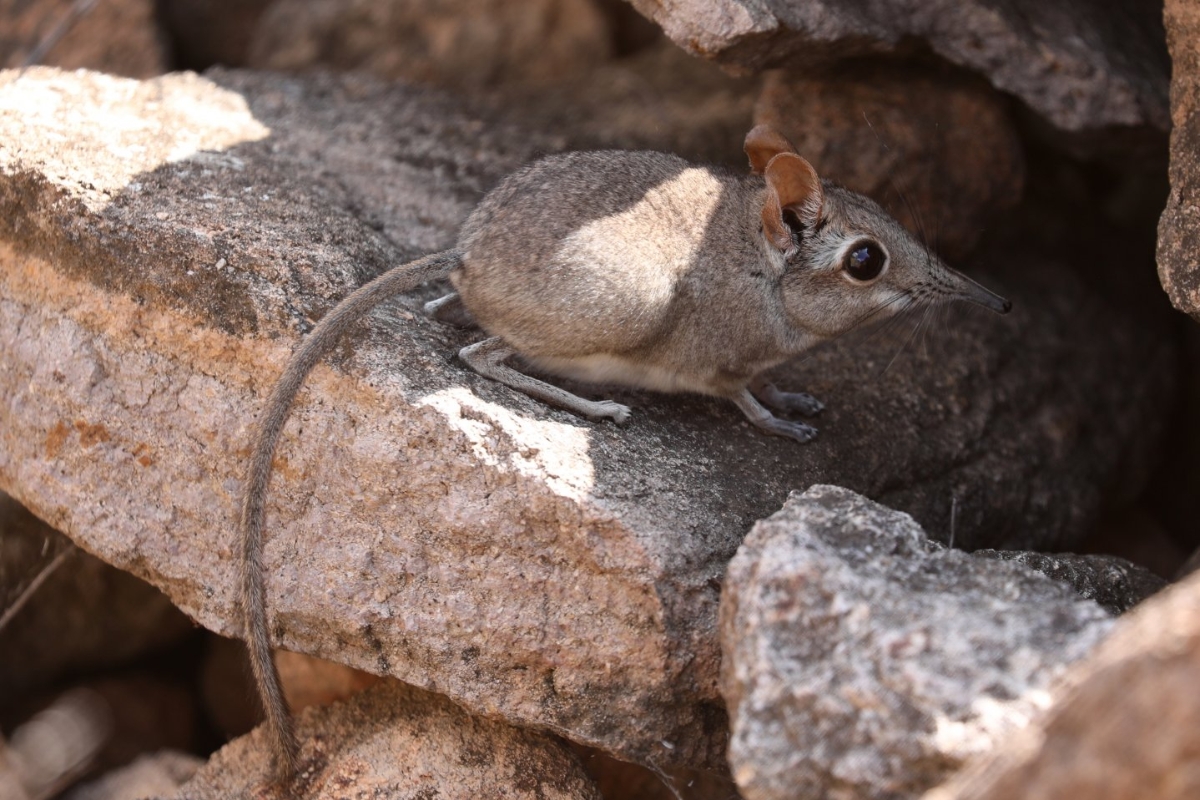
Scientists Located the Somali Sengi in Rocky Areas of Djibouti After Setting 1,259 Traps in 12 Sites, Revealing That the Small Mammal Still Lives in the Desert
A mammal the size of a hand has disappeared from scientific records for more than 50 years and was considered practically gone from nature. It is the Somali sengi, a small insectivorous animal that has been rediscovered in rocky regions of Djibouti, in the Horn of Africa.
The rediscovery took place in 2019 during an expedition that set over 1,200 traps in different areas of the country. The finding shows that the species is still alive, occupies more territory than previously thought, and reinforces the importance of investing in field research in under-studied regions.
Small Mammal Distant Relative of Elephants
The Somali sengi, known internationally as the elephant shrew, is a small-bodied mammal with an elongated snout and an insect-based diet. Despite its size being similar to that of a rat, it is a distant relative of large mammals like elephants, sharing an ancient branch of the evolutionary tree.
-
With a cost per shot close to zero, the DragonFire laser could change naval warfare in 2027 and provide British ships with nearly unlimited defense against drones.

-
A British startup creates tires that generate electricity in electric vehicles when passing over potholes, speed bumps, and cracks.

-
Scientists have created robots made with living cells that have their own nervous system, swim on their own, explore the environment, and self-organize without any genetic engineering, and now they want to do the same with human cells.

-
Students create a solar-powered ambulance that operates without a plug, without fuel, and still keeps medical equipment running in remote areas.

The first records of the animal come from specimens collected in the late nineteenth century and from subsequent observations until the 1960s. After 1968, no new confirmed records were made, and the species became an enigma for science, with very few preserved animals in museums around the world.

Half a Century of Scientific Silence
For more than half a century, the Somali sengi had no modern records in its habitat. The lack of data led the scientific community to classify the animal with insufficient information status, unsure if it still existed in the wild or had already disappeared.
In practice, this category pushed the mammal into a scientific limbo. There was formal description, scientific name, and a few old specimens, but no recent confirmation of where it lived, what its actual range was, or what environmental conditions it thrived in.
Expedition Sets 1,259 Traps in 12 Locations
The change began when researchers started to suspect that the animal might be in Djibouti, a neighboring country of Somalia. Field clues and local reports indicated the presence of sengis in rocky regions, but still without a clear link to the species that had disappeared since 1968.
In 2019, a group of scientists joined researchers from Djibouti and organized an expedition to search for the mammal. They set 1,259 traps in 12 different sites, using a mix of oats, peanut butter, and yeast to attract small mammals. Over days of work, rodents and other animals were captured until the first sengis with characteristics of the Somali sengi appeared.
Genetic Confirmation and New Area of Occurrence
The captured animals had a striking detail in their tails and physical characteristics that matched ancient descriptions of the Somali sengi. The researchers then performed morphological and genetic analyses to confirm the species identity and eliminate doubts regarding other sengis in the region.
The results showed that they were indeed the mammal that had been missing since 1968, now found in different areas of Djibouti. Studies pointed out that the species utilizes steep rocky environments with low human pressure and suggested that the geographical distribution is greater than previously thought, with the possibility of occurrence also in parts of Ethiopia.

Recent Studies Detail Genetics and Classification
According to PeerJ, an international open-access scientific journal, the genetic data indicated that the animal does not fit well in the traditional genus Elephantulus. Based on the evolutionary differences, researchers proposed a new genus for the group, adopting the name Galegeeska revoilii for the Somali sengi.
The studies also indicated that, in the sampled areas of Djibouti, the small mammal does not face intense pressure from agriculture or urbanization. Thus, the scientists suggested that the species may be in a less critical situation than feared, although it remains vulnerable to future environmental changes.
What Is a Lost Species to Science?
The case of the Somali sengi illustrates the concept of a lost species, used for animals that go decades without records and seem to have disappeared, although they may still exist in under-studied locations. In practice, science loses contact with these organisms while local communities continue to coexist with them.
Projects aiming to find lost species combine field expeditions, traditional knowledge, specific traps, and genetic analysis. The rediscovery of the Somali sengi demonstrates how this type of effort can transform an almost forgotten mammal into an important piece for understanding the biodiversity of the Horn of Africa.
Small Mammal, Giant Lesson for Conservation
For residents of rocky regions of Djibouti, the sengis have never been exactly invisible. They are part of everyday life and have their own local names, but until the recent expedition, this information did not connect with the international scientific community.
The return of the Somali sengi to formal records reinforces that there are still huge gaps in knowledge about mammals in arid and remote areas. At the same time, it indicates that investments in field research, partnerships with local scientists, and the use of hundreds of traps can reveal that species considered lost are still alive and have a real chance of continuing to exist.










-

-

-

-

9 pessoas reagiram a isso.