






 Portuguese


PET Felt Panel Uses the Equivalent of 70 Recycled Bottles per Square Meter, Eliminates Adhesives in Production, and Converts Ceilings into Acoustic Treatments.
Plastic bottles that would normally end up in waste streams are being transformed into panels that can cover ceilings and walls while also functioning as elements for acoustic control. According to Petfelt, a Brazilian manufacturer based in São Paulo, each square meter of their felt corresponds to the equivalent utilization of 70 PET bottles, with the process using eco-friendly dyes and not requiring the addition of adhesives in the material’s production.
The solution emerges as a functional competitor to traditional ceiling finishing systems, including PVC ceilings, especially in projects where the surface needs to fulfill more than one purpose. Instead of merely concealing installations or creating visual finishes, PET felt modules can be utilized as panels, clouds, grids, and suspended acoustic baffles.
The 12 mm products reported by the manufacturer have a density of 270 kg/m³, an approximate weight of 2.4 kg per m², and can contain up to 70% post-consumer recycled material, depending on the configuration.
-
End of Manual Concrete Leveling: Robot Covers Up to 3,229 Square Feet Per Hour, Adjusts Height with Laser, and Operates 10 Hours on Large Slabs
-
48 m² Eco-Brick House: Costs, Savings, and Key Considerations for Optimal Construction
-
Luciano Hang Announces Havan’s 200th Megastore, Featuring a Massive Opening with 20,000 Square Meters, Over 350,000 Items, and More
-
Supermarket Giant Plans First Store in Pomerode with Over 6,000 Square Meters, Fachwerk-Inspired Façade, and More Than 180 Parking Spaces, While Creating Over 140 Jobs, Aiming for January 2027 Opening in Brazil’s Most German City


PET Bottles Cease to Be Packaging and Become Finishing Material
The principle is relatively simple: PET used in packaging can be recycled, transformed back into fibers, and reorganized in the form of felt.
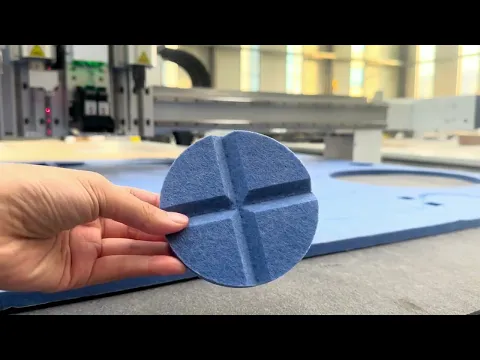
At Petfelt, this material is used as raw material for architectural cladding. The company reports that it works with 100% PET felt and that a significant portion of this content comes from post-consumer material. In lines like the Cross panels, recycled content can reach 70%.

The easiest number to visualize is provided by the manufacturer itself: 1 m² of Petfelt is equivalent to about 70 recycled PET bottles. Thus, a project with 100 m² of material would correspond, according to the equivalence reported by the company, to approximately 7,000 bottles.
This does not necessarily mean that each panel contains exactly 70 physically identifiable packages. This is the equivalence disclosed by the company between the amount of reused PET and the average number of bottles.
Material Does Not Require the Addition of Glue During Its Production
Another detail that differentiates the solution from coatings that rely on different chemically adhered layers.
In the institutional description of the process, Petfelt states that the material is produced from recycled PET bottles, eco-friendly dyes, and without the need for adhesive addition.
This specifically refers to the felt production. It does not mean that every architectural installation of the product is necessarily executed without any glue, screws, cables, or fastening systems.
Ceiling systems, for instance, may utilize cables, leveling devices, screws, and their own structures. The company itself reports that products like grids and baffles come with specific accessories for assembly.
The difference lies in the panel itself: the fibers form the material without depending on the incorporation of additional glue in the composition indicated by the manufacturer.
A 12 mm Panel Can Perform Functions That A Conventional Ceiling Does Not Offer
One of the most common configurations is 12 mm thick, with a density of 270 kg/m³ and a weight of approximately 2,400 grams per square meter, with a tolerance of 10%.
These figures make the material relatively lightweight for suspended or wall-mounted applications.
A conventional wall panel from the Cross line, for instance, can measure 1.20 meters by 2.40 meters, similar in size to many sheets used in dry construction.

The difference is that its main function is not structural. The material was developed as a finishing and sound absorption element.
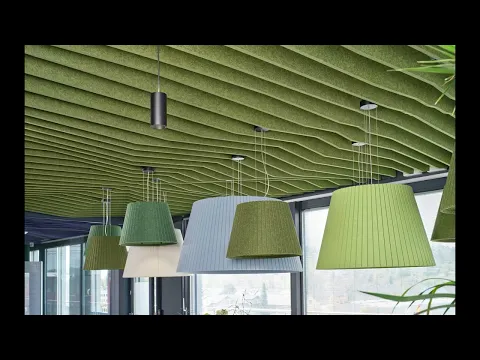
In ceilings, the same raw material can appear vertically in baffles, horizontally in clouds, or organized in three-dimensional grids.
This allows the design to leave part of the slab and installations exposed while using the modules only where acoustic and visual performance is needed.
PVC Ceiling and PET Felt Solve Different Problems
Despite the title highlighting the competition with PVC ceilings, the two materials are not perfect substitutes in every construction.
Traditional PVC is primarily used to create a continuous surface, conceal roofing and installations, ease cleaning, and provide a lightweight finish.
On the other hand, acoustic PET felt gains an advantage when the project needs to control reverberation, improve speech intelligibility, or treat environments with an excess of hard surfaces.
In offices, restaurants, meeting rooms, and large spaces, a concrete ceiling, glass walls, and hard floors can repeatedly reflect sound.
In this scenario, simply installing a smooth surface on the ceiling does not necessarily solve the acoustic problem.
PET elements work differently: they absorb part of the sound waves that reach the surface, reducing successive reflections.
It is precisely in this type of application that the material begins to compete with traditional ceiling and finishing systems.
The Ceiling Itself Begins To Work Against Echo
The main transformation lies in the function of the surface above people.
A conventional ceiling can function almost solely as a visual finish. In an acoustic project, the ceiling becomes an active part of the sound behavior in the environment.
Petfelt claims that its products absorb sound waves, reducing reverberation and unwanted noise. The goal is to improve speech clarity, auditory comfort, and concentration.
This is especially relevant in large work environments.
When multiple people talk simultaneously, reflections off walls, glass, floors, and ceilings prolong the sound. The result is not necessarily a louder noise at the source, but an environment where voices continue to reflect and mix.
Suspended baffles and acoustic clouds create additional absorption surfaces without necessarily closing off the ceiling fully.
Modular system can create three-dimensional designs in the environment
PET felt also changes the traditional appearance of ceilings.
In the Aura line, for example, modules can measure 1.20 x 1.20 meters or 1.20 x 2.40 meters, with configurable heights between about 100 and 250 mm.
The smaller module weighs approximately 3.5 kg, while the larger one reaches about 7 kg, according to the company’s technical data sheet.
Instead of forming a flat surface, the panels create suspended volumes.
Another family, named Waves, uses curves to build visual sequences on the ceiling. Meanwhile, the grids organize the felt into intersecting structures.
This opens up a possibility that traditional ceilings rarely offer: transforming the acoustic treatment itself into an apparent architectural element.
Thus, the material is no longer something hidden behind a decorative surface. The acoustic function and aesthetics use the same piece.
Fire resistance is an important requirement for indoor use
Any material applied in large ceiling areas must also be analyzed from a fire safety standpoint.
The 12 mm Petfelt products referenced in this report have a Class II-A flame spread rating, reported in accordance with the Technical Instruction No. 10 of the State of São Paulo and the norm ABNT NBR 16626.

This classification appears on product data sheets such as Cross, Waves, Aura, and various grids.
This does not mean that PET is non-flammable. The classification is related to the product’s behavior in specific flame reaction or propagation tests.
In real projects, architects, engineers, and technical managers still need to verify the requirements of the Fire Department, type of occupancy, applied area, and other criteria of the construction system.
The differentiating factor is that the product has an explicitly declared classification for this aspect, which is essential when planning to use it in offices, auditoriums, stores, and other high-traffic spaces.
Material can appear in walls, ceilings, and even between tables
Another difference compared to PVC ceilings is the possibility of using the same raw material in various architectural points.
The company offers wall panels, room dividers, table dividers, clouds, baffles, and grids.
In an open office, for example, the material can appear on the ceiling and simultaneously between workstations.
In meeting rooms, it can occupy part of the wall and create suspended elements.
In restaurants, modules can be positioned over areas with higher concentrations of people, reducing the need to cover the entire ceiling.
This modularity also means that an acoustic design can be tailored to each environment, rather than treating the entire surface exactly the same way.
Brazilian company has been working with acoustics for over 15 years
Although materials made from recycled bottles may still seem like a novelty to some residential audiences, the technology has been around for a while.
Petfelt claims to have more than 15 years of experience in the acoustics market, having been founded in 2009 in São Paulo.
Recent expansion is mainly linked to the growing use of apparent acoustic solutions in both corporate and residential architecture.
Offices with open ceilings, integrated spaces, and large glass surfaces have created a greater need for sound absorption without reverting to traditional closed ceilings.
At the same time, interest in materials with recycled content has increased demand for products capable of combining technical performance with the use of waste materials.
PET felt is positioned exactly at the intersection of these two trends.
Bottles that would last decades as waste now occupy ceilings and walls
The strength of this type of material lies in its change of function.
A PET package is designed to be used for a short time, but the polymer can persist in the environment for much longer if disposed of improperly.
By recycling it into fibers for architecture, the material gains a new useful life and new economic value.
According to the equivalence provided by Petfelt, a single square meter represents approximately 70 bottles, while the panels can contain up to 70% post-consumer recycled material.
Additionally, the production of the felt does not require the addition of adhesives, as the company states, and the finished product can receive a Class II-A flame propagation classification in lines intended for interior use.
The result is an alternative that competes not only aesthetically with PVC ceilings.
In environments that require acoustic control, the ceiling is no longer simply a surface placed to hide what exists above. It actively absorbs sound, creates architectural volumes, and incorporates recycled plastic into its own finish.
The change lies in the ability of the designer to replace a surface that served almost a single function with a modular system that combines finishing, architecture, sound absorption, and waste recycling in a single solution.


