





 Portuguese
  English
  Spanish
  3 min of reading
  0 comments


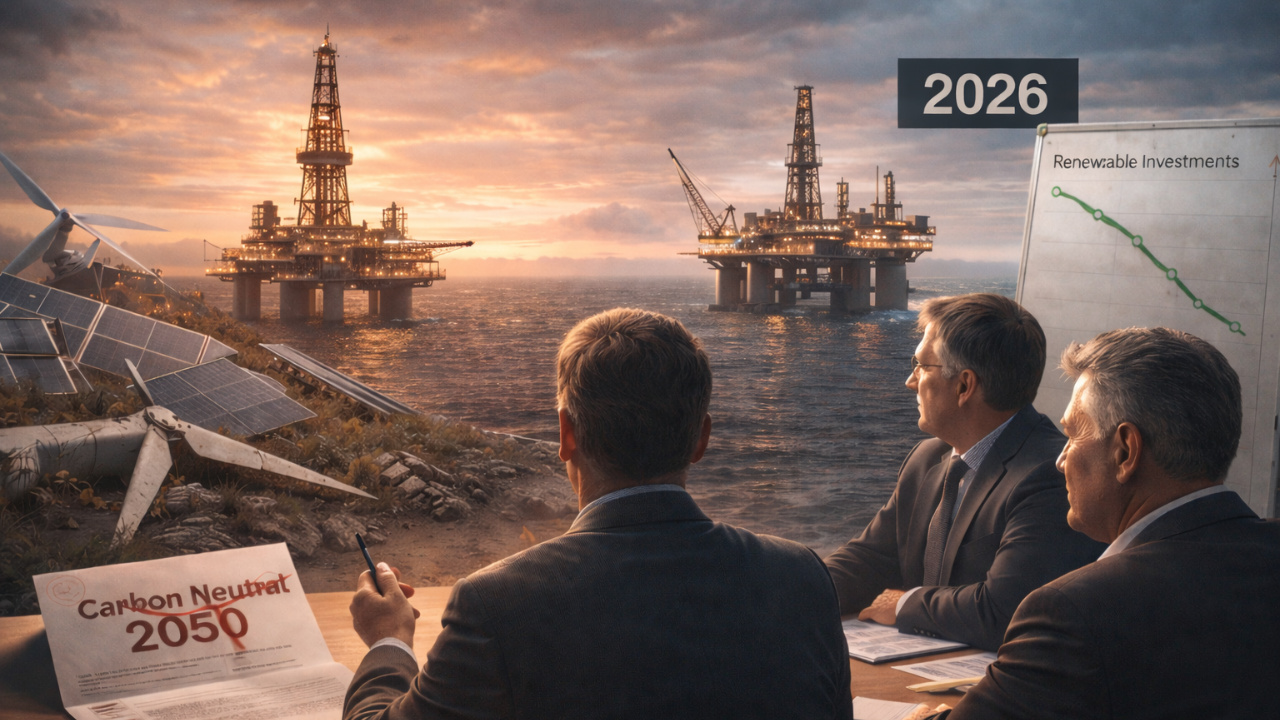
Oil Industry Begins 2026 with More Conservative Strategies, Lower Appetite for Renewables, and Focus on Energy Security, Says GlobalData Report.
The global oil and gas industry is entering 2026 under a climate of greater caution. Despite the increase in climate disasters and international pressure for emission cuts, major oil companies have begun adopting more cautious strategies in the energy transition.
This is the main conclusion of the report “Energy Transition in Oil and Gas”, prepared by GlobalData. The study indicates that, although corporate rhetoric continues to align with decarbonization, the practice reveals a clear slowdown in large-scale investments in clean energy.
At the same time, CO₂ emissions related to energy continue to hit record levels. This data reinforces the permanence of fossil fuels as the foundation of the global energy matrix.
-
Lula reveals a masterstroke by Petrobras to undo a deal made by Bolsonaro, which involves the return of an important refinery that currently produces less than half of what was expected and makes Brazil dependent on international diesel.
-
A study confirms that the natural gas sector will reduce greenhouse gas emissions in Brazil by 0.5% and accelerate the energy transition by 2026.

-
Petrobras implements a severe adjustment and confirms a 55% increase in the price of aviation kerosene with a proposal for installment payments for the companies.

-
The rise in oil prices could ensure an extra revenue of R$ 100 billion for the Federal Government, indicates a recent economic study.


Climate Goals Remain, but with Limited Execution
According to the report, many oil companies maintain carbon neutrality targets by 2050 and intermediate goals for 2030. However, the execution of these targets has become conditioned by external factors.
The volatility of markets, combined with political uncertainty in various regions, has reduced the appetite for faster structural transformations. The scenario has changed significantly following the disruptions in global markets starting in 2022.
Ravindra Puranik, an analyst at GlobalData, notes that the momentum observed in recent years has not translated into deep changes. “Innovation continues, but large-scale implementation of low-emission projects remains dependent on market evolution and public policies,” he states.
Energy Security Resumes Setting Priorities
The report points out that the fear of energy supply failures has weighed on strategic decisions. Instead of accelerating the transition, companies have prioritized energy security and financial discipline.
This movement has resulted in significant adjustments. Some companies have reinforced investments in oil and gas exploration and production while reducing exposure to renewable projects deemed less profitable in the short term.
BP is cited as an example of a company that increased investments in conventional activities and pulled back on renewable energy initiatives. Shell has suspended the construction of a renewable fuels unit in Rotterdam, citing deteriorating market conditions.
Financial Discipline Gains Ground in the Sector
According to GlobalData, these movements reflect a broader shift in the sector. The valuation of traditional businesses and strict cost control have begun to guide decisions.
High inflation, the reduction of public incentives—especially in the United States—and regulatory uncertainties have contributed to cooling large-scale renewable projects.
Still, the report emphasizes that decarbonization has not been abandoned. Oil companies continue to invest in already available technologies and emerging solutions.
Carbon Capture and Hydrogen Remain on the Radar
Among the alternatives under development, carbon capture and storage stand out as a tool for mitigating emissions. There are also ongoing investments in hydrogen, solar, wind, and low-carbon fuels.
In addition, companies in the sector maintain research in batteries and energy storage systems, considered essential for enabling a more robust transition in the future.
Nonetheless, according to Puranik, the current pace is far from what was initially projected. “Innovation continues, but large-scale implementation of low-emission projects remains dependent on market evolution and public policies,” the analyst reiterates.
In conclusion, the report states that as it enters 2026, the oil and gas industry opts for a more calculated path. Rather than abrupt changes, the sector favors gradual adjustments, attentive to profitability, the political environment, and the stability of global energy supply.







-

-

-

3 pessoas reagiram a isso.