





 Portuguese
  English
  Spanish
  3 min of reading
  0 comments


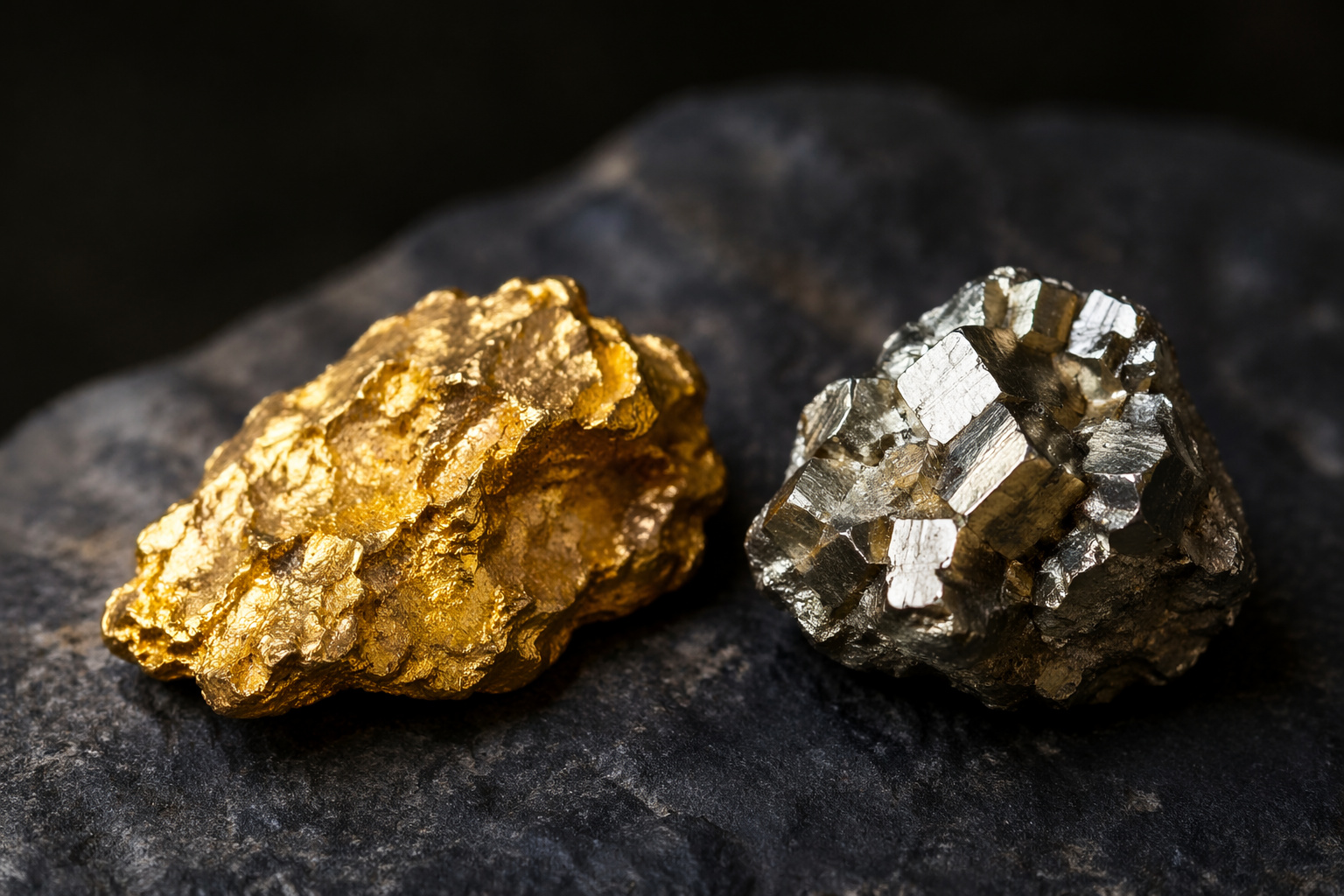
Mineral with a shine similar to gold confused explorers throughout history and now contributes to advanced geological studies
A misleading mineral substance has marked the history of mining and remains relevant in modern science.
The pyrite, known as “fool’s gold”, has confused prospectors for centuries due to its intense metallic luster and golden color.
This recurring mistake primarily occurred between the 18th and 19th centuries, during periods of mineral exploration, as described by studies from the Geological Society of America.
-
The largest volcanic event in Earth’s history may have changed everything beneath the Pacific: a study shows that eruptions 110 to 120 million years ago reshaped the oceanic plate of the Ontong Java Plateau, the largest oceanic plateau on the planet.

-
The world’s largest acid geyser awakens in Yellowstone and reaches record heights after years of dormancy.
-
Tiny robots reveal the hidden chemistry of the depths and uncover secrets of low-oxygen dead zones in the ocean.

-
Scientists use a nearly 10-kilometer fiber optic cable to monitor and record the detachment of 56,000 icebergs in real time.

Despite the visual similarity, pyrite has no significant economic value, unlike real gold, which has led to historical frustrations and losses.


Physical differences explain the historical deception
The distinctions between the two materials are clear when analyzed scientifically.
While gold is a noble and malleable element, pyrite is a iron disulfide, being rigid and brittle.
Additionally, pyrite can scratch glass, unlike gold, which is softer.
When heated, it also releases a characteristic sulfur odor, a property documented in chemical studies since the early 20th century.
Even without significant commercial value, pyrite had practical applications in the past.
It was used to produce sparks for starting fires, especially before the popularization of matches in the 19th century.
Properties of pyrite aid in geological analysis
These physical and chemical characteristics not only differentiate the mineral from gold but also contribute to geological studies.
The behavior of pyrite is used as a basis to understand more complex processes.
This principle appears, for example, in the analysis of volcanic rocks.
During this process, scientists observe how minerals react under different conditions.
Formation of magma and the challenge of “crustal noise”
When magma moves from the Earth’s mantle to the crust, its composition undergoes changes.
This occurs due to interaction with other materials along the way.
This phenomenon is known as “crustal noise”, a term established in modern geology since the late 20th century.
This process complicates the identification of the original characteristics of the magma.
Therefore, understanding the origin of this material requires increasingly precise techniques.
Modern techniques reveal the origin of magma
To overcome this challenge, researchers have begun to study microstructures of crystals.
One of the main techniques used is secondary ion mass spectrometry, applied more frequently since the 1990s.
Studies conducted in the Sunda Arc have brought significant advances in this field.
Research conducted by institutions such as the Australian National University has demonstrated that the analysis of oxygen isotopes in minerals allows for the identification of the origin of magma.
With this, it is possible to differentiate material originating from the Earth’s mantle from contamination from the crust.
These discoveries expand the understanding of the planet’s internal processes.
Pyrite, which once confused explorers in the past, now connects indirectly to relevant scientific advancements.
This contrast between past and present reinforces the importance of minerals in the evolution of geological knowledge.
In light of this, the reflection remains: how many other materials can still reveal deep secrets about the Earth?





Seja o primeiro a reagir!