





 Portuguese
  English
  Spanish
  4 min of reading
  1 comment


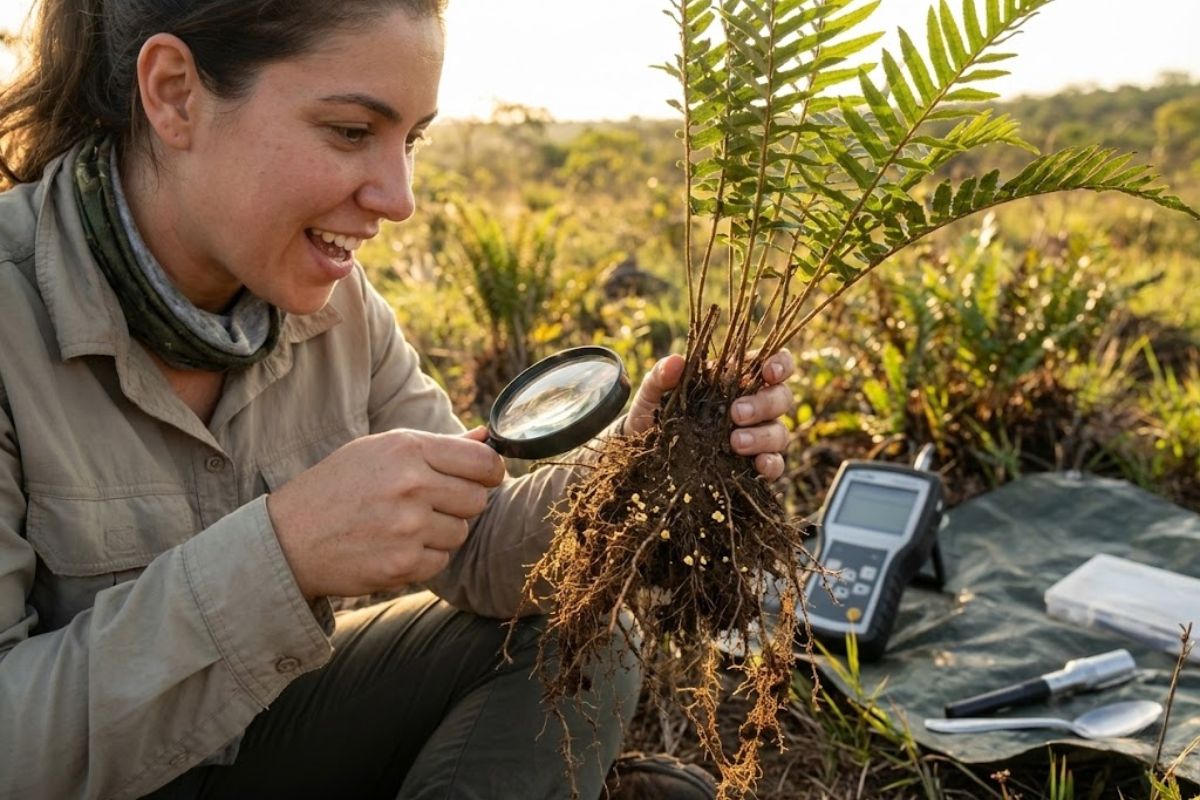


The Phytoremediation Technique Uses Common Plants in Brazil and Other Hyperaccumulator Species to Pull Metals from the Soil and Store Them in Leaves and Stems, Including as Nanoparticles. After Harvesting, Burning Generates Bio-Ore, Which Can Turn into Nickel Sulfate. The Method Aims to Reduce Waste, Deforestation, and Energy in Mining.
The interest in common plants in Brazil gained momentum when phytoremediation began to be seen not only as a way to clean contaminated areas but also as a method of metal extraction without excavation. In naturally rich soils, hyperaccumulator species can concentrate gold, nickel, and other metals within their own tissues.
In practice, mining changes its logic: instead of opening a pit, harvesting becomes the central stage of the process, with controlled burning to recover the metal. The promise is to produce raw material with less waste and with productive use of arid lands or lands unfit for agriculture.
What Phytoremediation Does to the Soil

Phytoremediation begins by selecting naturally metal-rich soils.
-
China creates hypersonic engine that can make planes and missiles fly more than 6 times the speed of sound with less weight, more range, and without system change.

-
Mysterious object on Mars divides NASA and Harvard after Curiosity image reignites suspicions about what was really found on the planet.

-
Giant structures 14 meters beneath Egypt are revealed by satellites and expose a millennia-old secret buried in Buto.

-
Children have been making clay pieces for 15,000 years in Southwest Asia, and fingerprints preserved on 142 ornaments helped archaeologists prove this.

The common plant in Brazil is a candidate when the ground has a metallic composition and allows the roots to pull elements and store them in leaves, stems, or shoots.
Throughout the cycle, the plant itself turns into a biological reservoir of metal.
By mapping this behavior, approximately 700 species have been identified with the ability to accumulate metals in large quantities.
Among them, there are species that concentrate nickel, zinc, copper, cobalt, rare earths, and even gold, maintaining growth even with these elements circulating in their systems.
Why the Metal Doesn’t Turn into Poison for the Plant
The central technical point is that, for hyperaccumulator species, metals do not act as toxins in the way one would expect.
In many cases, accumulation functions as a defense against insects, fungi, and predators.
Part of this stock can appear in the form of nanoparticles within the tissues.
This detail explains why the common plant in Brazil can remain active while concentrating metal, and also why the process depends on the correct choice of species and soil.
Efficiency does not lie in a single harvest but in the repetition of the cultivation, cutting, and material recovery cycle in mining.
From Environmental Cleanup to Economic Use
The basis of phytoremediation started in the 1980s, focusing on removing metals and contaminants from areas affected by industrial or nuclear activities.
A landmark case in the history of the method was the use of plants to remove radioactive cesium from areas impacted by the Chernobyl disaster.
In the 1990s, the same logic advanced: instead of discarding the absorbed material, efforts shifted to recover metals and redirect them to the industry.
That was when phytoremediation began to be seen as an alternative to mining, including the prospect of gold and nickel without the excavation stage.
Practical Example with Nickel and Bio-Ore
In areas of Europe and the Balkans, farmers cultivate species from the Odontarrhena genus, known for accumulating large amounts of nickel.
After harvesting, the plants are dried and burned. The residue becomes bio-ore, an ash concentrated in metal.
This ash is washed, treated with sulfuric acid, and transformed into nickel sulfate, a raw material used in the production of large batteries, with applications especially linked to electric cars.
On average, up to 2% of the dry weight of the plant can be converted into usable nickel.
Emissions, Waste, and the Clash with Traditional Mining
Traditional mining is associated with deforestation, large volumes of toxic waste, and high energy consumption.
In the case of nickel, conventional production can generate between 10 and 59 tons of CO2 per ton of extracted metal, a level that helps explain the search for alternative routes.
With phytoremediation, part of the impact is reduced as the crops capture carbon during growth.
Even with CO2 release during the burning of the plants, the final emissions balance is described as close to zero.
Additionally, there is the possibility of applying the method to arid or unproductive lands, reducing pressure on new fronts of mining.
Why the Common Plant in Brazil Joins the Discussion
In Brazil, the common plant in Brazil frequently appears in areas of metallic soils, placing the country on the radar of phytoremediation.
The current focus of the technique is nickel, a metal whose demand is projected to double by 2050, driven by the expansion of electric vehicles and batteries.
Today, much of the nickel supply comes from mines concentrated in Indonesia, with Chinese control present in various operations.
In this scenario, the common plant in Brazil can become a strategic path: expanding productive use of the land, reducing the impact of mining, and diversifying the mineral economy.
For those following mining and energy transitions, the practical point is to observe where phytoremediation manages to deliver metal predictably: the right soil, the right species, organized harvesting, and industrial recovery of bio-ore.
It is in this technical fit, and not in easy promises, that the common plant in Brazil can gain scale.
It is worth monitoring how phytoremediation advances in areas of metallic soil and how the common plant in Brazil enters the agenda of nickel, gold, and mining with less excavation.
Do you believe that a common plant in Brazil can become a viable path for nickel and gold mining using phytoremediation?







Qual é a planta comum brasile?