





 Portuguese
  English
  Spanish
  4 min of reading
  0 comments


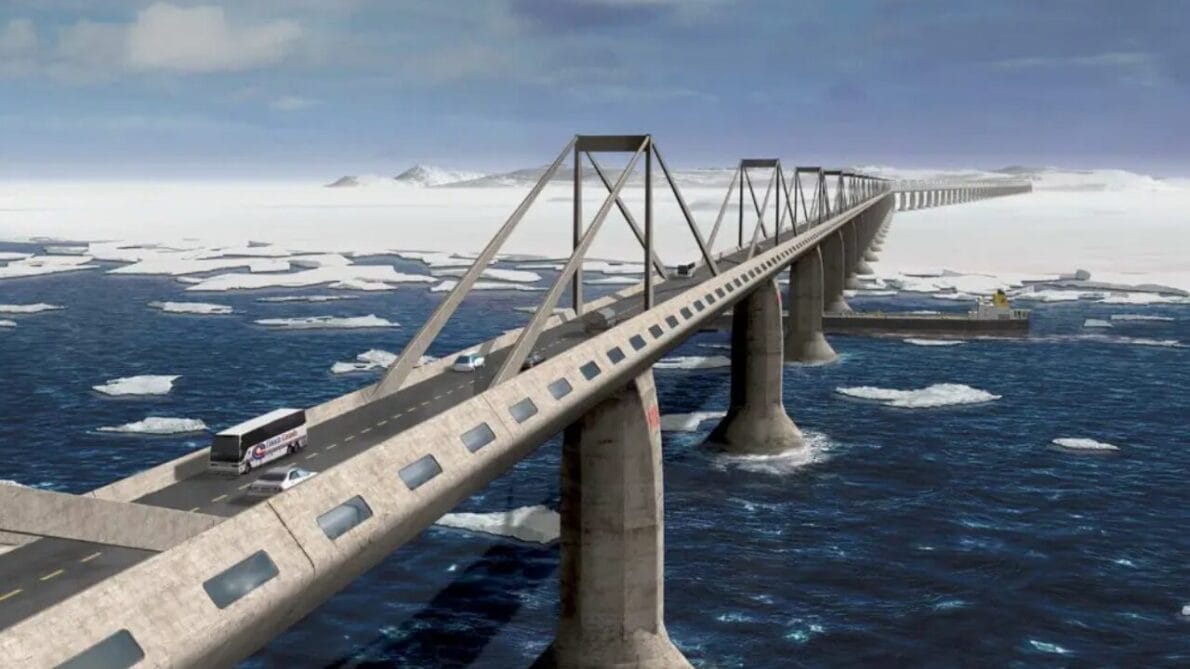
Russia and China Lead Initiative to Build a 103 km Bridge in the Bering Strait, Connecting America and Eurasia.
A land communication route between America and Eurasia could be conceived by crossing the ocean, establishing a physical connection between these distant continents. The possibility of building a bridge or tunnel through the narrow water passage that separates Russia and Alaska presents an undertaking of colossal proportions. For years, discussions have been held about this venture, but its realization has always been blocked due to the logistical complexities involved. However, with Russia and China now considering the project, it could finally become a reality.
Historic and Modern Proposals from Russia and China
The idea of establishing a connection in the Bering Strait was initially proposed in 1892, when American engineer Joseph Strauss presented the first proposal for a bridge. His idea was submitted to the Russian Empire but was rejected.
In 1904, a group of American railroad magnates presented the first design for a bridge.
-
Iran authorizes the passage of ships with essential goods in the Strait of Hormuz, requires coordination and protocols; UN postpones resolution to reopen the oil route, while China, France, and Russia reject the use of force.
-
The Ukraine war exposes the strength of the M113 armored vehicle amid modern warfare with military drones.

-
Maritime geopolitics: China and the USA compete for strategic ports in Peru.
-
Iran shoots down two US aircraft: F-15 fighter crashes in mountainous area, one crew member is rescued and another is still missing; second crash in the Persian Gulf exposes still active air defense, says US intelligence.


A year later, Russian Tsar Nicholas II approved the proposal, but Russian authorities discussed the project for some time before ultimately rejecting it in 1907.
Despite various tumultuous events, the concept was set aside until it was reintroduced in 1958 by Chinese-American engineer Lin Teng.
He suggested constructing an 85 km bridge over the ocean, exceeding the current record-holder, the Hong Kong-Zhuhai-Macau Bridge, by 30 km.
Tang hoped that this connection would promote trade and understanding between the peoples of China and Russia.
However, the complexity of the project caused it to be forgotten in the subsequent years, especially after Tang’s passing in 2003.
The Link TKM Project
In 2007, Russia presented the Link TKM project, also known as the Intercontinental Link, which involved a 6,000 km railway and a pipeline connecting the region of Komsomolsk-on-Amur and Yakutsk in Russia to Alaska.
This would include a 103 km bridge across the Bering Strait, with ventilation structures on the intermediate islands.
If this bridge were completed, its length would be more than twice that of the underwater section of the English Channel between the UK and France.
In 2008, Vladimir Putin, then Prime Minister of Russia, approved the Link TKM project. Subsequently, the Russian government officially endorsed the project in 2011. In 2014, transport specialists from China presented their own 21st-century concept based on the same idea.
They proposed constructing a high-speed railway of 10,000 km, connecting northeastern China to the United States, including a submarine tunnel through the Bering Strait.
This project, in its various manifestations, involves coordination between China, Russia, the United States, and Canada, and could cost between 65 and 105 billion dollars, with a timeframe of 10 to 15 years for completion.
Technical and Logistical Challenges for Russia
If a tunnel or bridge were built across the Bering Strait, engineers would face various challenges, despite the proven technical feasibility of the construction.
The region does not present icebergs but has ice flows due to thin layers of floating ice.
These flows can generate considerable forces, reaching up to 44 mega-newtons on a bridge pillar, representing a significant structural challenge.
Additionally, the exposed steel of the structure would become brittle in extremely cold temperatures. To address this, engineers would likely need to coat the entire structure with concrete.
The area around the Bering Strait, especially on the Russian side, lacks developed infrastructure.
There are no railways for over 3,200 km, and the nearest highway, still under construction, is over 400 km away.
On the American side, there are no railways or highways for almost 1,000 km. This would require the construction of extensive railway networks on both sides, resulting in significant logistical challenges for transporting workers and materials to the construction site of the bridge, which would inevitably delay the project and substantially increase costs.
The cost of the bridge itself is estimated at around 12 billion dollars, with the remaining investments being directed mainly towards building a complete transportation infrastructure.
Uncertainties for the Construction of the Bridge Connecting Asia to America
In addition to these concerns, the different railway gauges used by the United States and Russia could create logistical problems when goods need to be transferred.
Moreover, Canada’s position on the project remains uncertain, which creates uncertainty about international support for the project.
Even if the bridge and railway are built, it would still be faster to travel by plane between the United States and Asia.
Therefore, the bridge would mainly be used for freight transportation, providing a cheaper and quicker way to move cargo between the two continents.
This project could be a vital step towards uniting the world in a future of international cooperation and mutual understanding.
However, only time will tell if this colossal undertaking will truly be realized.









-

Uma pessoa reagiu a isso.