





 Portuguese
  English
  Spanish
  8 min of reading
  0 comments


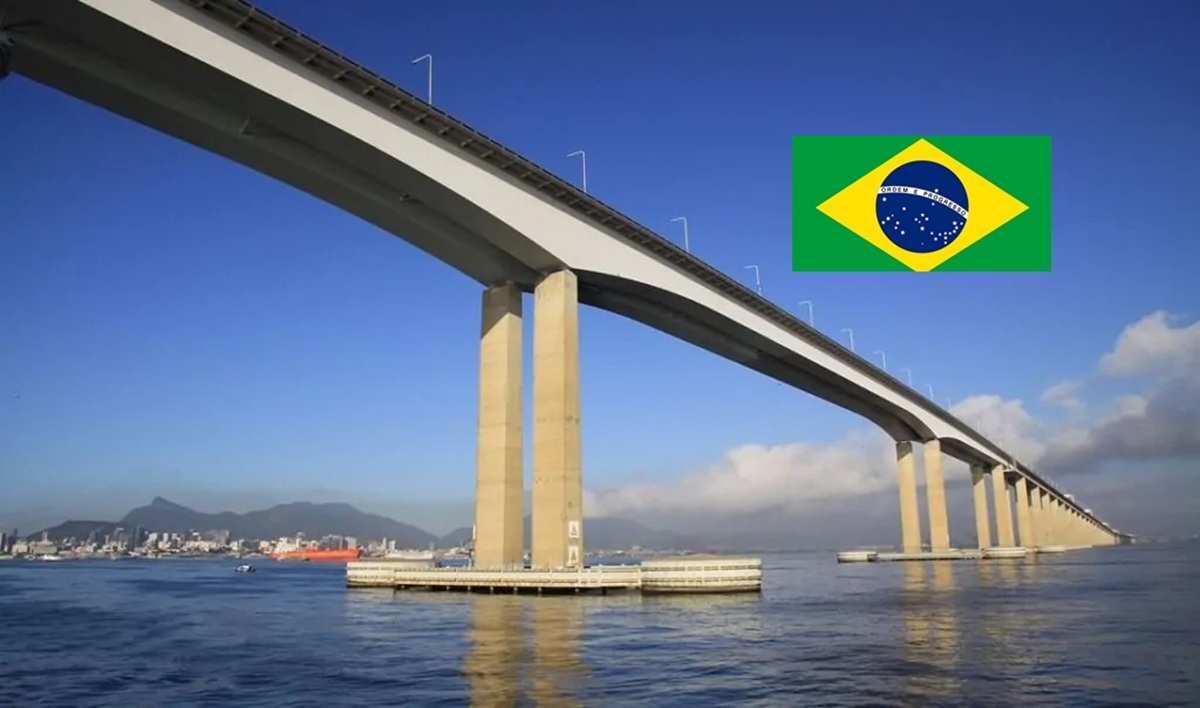
From Suspended and Stressed Structures to Double Helix Bridges with Fire Effects, Meet Seven Giants of Global Engineering That Challenge the Limits of Construction — Including the Colossal Rio-Niterói, Which Connects Rio de Janeiro to Niterói.
Just looking at any of the current bridges makes you think that the concept of this engineering marvel is only two or three centuries old.
But that’s not quite true. Bridges have existed since time immemorial. One of the oldest bridges is the Arch Bridge, built in the Mycenaean period in Greece (c. 1300-1190 BC).
Since then, bridge engineering has evolved drastically, pushing the boundaries of engineering. Today, they are not just a means of crossing a river or a road, but a symbol of the artistic vision of architects and designers.
-
He started running at 66 years old, broke records at 82, and is now a subject of study for having a metabolic age comparable to that of a 20-year-old, in a case that is intriguing scientists and inspiring the world.

-
Oldest tree on the planet reappears after 130 years of searches: Wattieza, 385 million years old, was 10 meters tall and had no leaves or seeds; Gilboa fossils in New York solved the mystery in 2007.

-
A 48-square-meter house assembled in hours with 4,000 bricks made of recycled plastic that does not absorb moisture, has natural thermal insulation, and costs less than 90,000 reais in a complete kit.

-
Luciano Hang revealed that Havan’s air fleet has already accumulated more than 20,000 landings, 10,000 flight hours, and 6 million kilometers traveled, and he says that without the planes, the company would never have grown so quickly.

Types of Structures
Before we analyze these giant structures, here’s a foundation you need to understand the basic principles of modern bridge design and engineering.
Suspended bridges use cables strung between towers to the deck via vertical hangers.
Famous examples include the Golden Gate and the Akashi Kaikyo.
Stressed bridges, on the other hand, have their decks directly supported by cables from the towers. They feature diagonal cables, efficient for medium to long spans, such as the Øresund Bridge in Sweden.
Arch bridges rely on compression to transfer loads along a curved path to supports at each end.
Based on an ancient design principle, they are highly effective for medium spans, where the arch can be positioned above or below the deck.
The Sydney Harbour Bridge is a good example of this type. Beam bridges, in turn, are supported by piers and are commonly used for shorter distances.
They can incorporate various materials, including steel, concrete, or composite structures. Most road viaducts utilize this type of structure.
Another model is the truss bridges, which use triangular structures to distribute loads, making them strong and economical.
Many railway bridges are built with this type of structure. Cantilever bridges have overhanging beams supported at one end, eliminating the need for temporary supports and allowing longer spans without intermediate piers.
A classic example is the Forth Bridge in Scotland. Finally, movable bridges incorporate mechanical systems that allow parts of the structure to move, accommodating both vehicle traffic and maritime navigation. The Tower Bridge in the UK is the most iconic example of this category.
Now that we understand the main types of bridges, it’s time to explore some of the most impressive creations in the world — works that combine cutting-edge engineering with aesthetic genius.
Millau Viaduct, France
Designer: Norman Foster and Michel Virlogeux
Location: Millau, Aveyron, France
Length: 2,460 meters (8,071 feet)
Type: Multi-span Stressed Bridge
Taller than the Eiffel Tower, the Millau Viaduct is an impressive example of the landmarks that human engineering can achieve.
Soaring 343 meters above the Tarn Valley, this bridge was designed to withstand speeds of up to 250 km/h, making it extremely safe for heavy road traffic.
Furthermore, it employs aerodynamic features inspired by aircraft design to minimize wind resistance, ensuring efficiency and stability even in adverse weather conditions.
The construction of the Millau Viaduct required revolutionary techniques, including the use of precision hydraulic systems to launch the deck over the valley.
This innovative approach was essential in raising a structure of this magnitude in just three years.
In total, about 290,000 tons of materials were used in the project, which had a total investment of €394 million.
Today, the Millau Viaduct is not only a marvel of modern engineering but also a tourist landmark and a symbol of French technological advancement.
Henderson Waves Bridge, Singapore
Designer: IJP Corporation and RSP Architects
Location: Singapore (Southern Ridges)
Length: 274 meters (899 feet)
Type: Steel Pedestrian Bridge with Wavy Structure
The Henderson Waves Bridge is an example of mathematics applied to structural design. Architect George Legendre designed it entirely based on three-dimensional algebraic equations, making it one of the first bridges where mathematics directly determined the architectural design. At 36 meters above Henderson Road, it holds the title of the highest pedestrian bridge in Singapore.
The bridge stands out for its elegant and functional design. Its curved sections rise above the deck level, creating protected niches perfect for resting and gathering. Meanwhile, the sections that dip below the deck provide structural continuity and stability.
At night, the wooden ribs are illuminated by LED systems, creating a charming atmosphere and making Henderson Waves an icon of architectural innovation and urban landscaping in Singapore.
The Rolling Bridge, London
Designer: Thomas Heatherwick Studio
Location: Paddington Basin, London, England
Length: 12 meters (39 feet)
Type: Kinetic Curling Movable Bridge
The Rolling Bridge is perhaps one of the most creative movable bridges ever designed. Unlike traditional linear-opening bridges, it consists of eight triangular steel sections that curl up to form a perfect octagon in just two to three minutes. This unique movement transforms the bridge from a simple crossing structure into a spectacle of dynamic engineering.
The design of the Rolling Bridge was inspired by how a dinosaur’s tail would curl, merging natural aesthetics with modern technology.
When coiling, the bridge changes its structural behavior, moving from a traditional truss to a cantilever system. All details were designed to provide functionality and beauty in equal measure.
Operating every Friday at noon, the Rolling Bridge becomes a true show of movement, attracting tourists and curious onlookers to the Grand Union Canal to witness the engineering spectacle in action.
Gateshead Millennium Bridge, England
Designer: WilkinsonEyre Architects and Gifford Engineers
Location: River Tyne, between Gateshead and Newcastle, England
Length: 126 meters (413 feet)
Type: Tilt Bridge for Pedestrians and Cyclists
Specifically designed for pedestrians and cyclists, the Gateshead Millennium Bridge earned the nickname “The Blinking Eye” due to its innovative tilting mechanism.
It is the first bridge in the world to rotate as a complete unit, rather than rising or swinging in sections. This feature ensures smooth and safe movement, as well as impressive aesthetics.
The bridge features two elegant parabolic arches — one forming the pedestrian deck and the other serving as structural support. Both rotate together around common pivot points, creating a 40-degree tilt in just four minutes.
This tilting occurs more than 500 times a year, allowing Royal Navy and private vessels to pass through to Newcastle’s marina.
The structure also features an intelligent self-cleaning system: during tilting, debris naturally slides toward collection traps, ensuring simple maintenance and continuous efficiency.
Øresund Bridge, Sweden
Designer: Jørgen Nissen, Klaus Falbe Hansen (Ove Arup & Partners)
Location: Between Denmark and Sweden, across the Øresund Strait
Length: 7,845 meters (4.88 miles) of bridge section
Type: Combined Stressed Bridge and Tunnel System
The Øresund Bridge is a monumental engineering project that combines a bridge, tunnel, and artificial island to seamlessly connect two nations: Denmark and Sweden. Considered one of the most ambitious transportation projects in the world, the bridge features a four-lane highway and a double-track railway, all supported by extremely sturdy concrete piers.
The project was carefully planned to withstand extreme conditions. The bridge can resist ship collisions, aircraft impacts, earthquakes, and strong winds. Just the bridge section weighs about 82,000 tons, with bearings reaching up to 20 tons each.
The structure can support a vertical load of up to 96,000 kilonewtons, demonstrating its impressive robustness.
In addition to revolutionizing transport between Scandinavia and mainland Europe, the bridge plays a crucial role in the region’s digital infrastructure, serving as a backbone for internet data transmission.
Rio-Niterói Bridge, Brazil
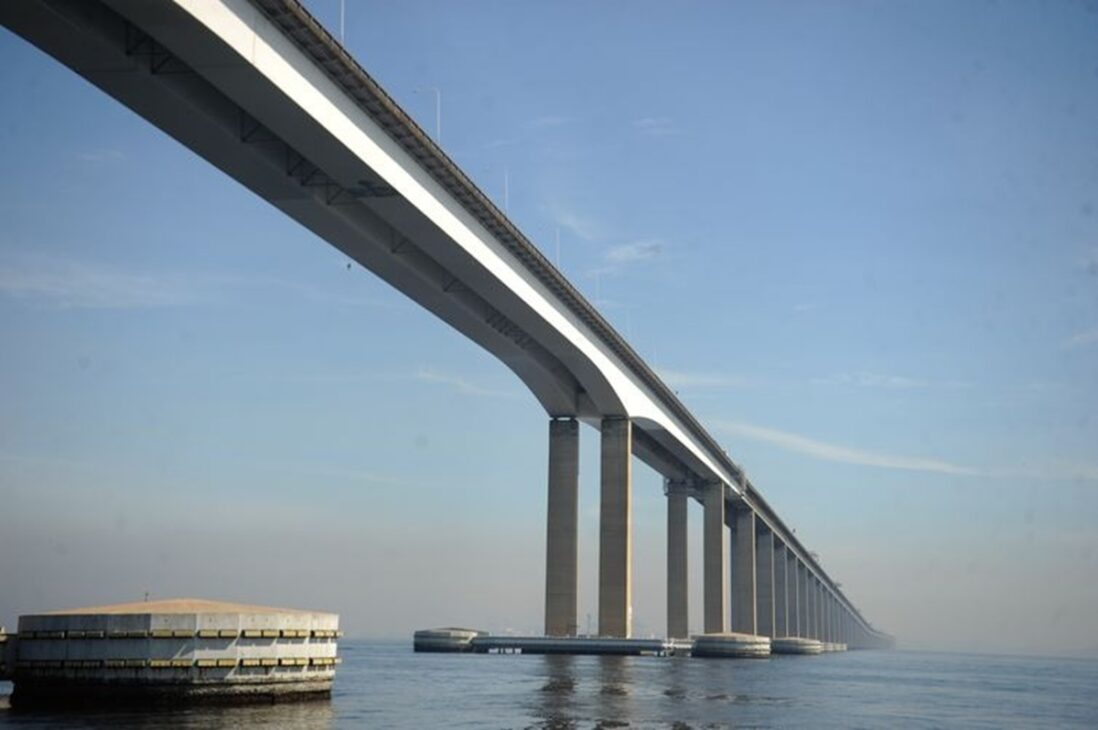
Inaugurated on March 4, 1974, the President Costa e Silva Bridge — nationally known as the Rio-Niterói Bridge — represents a milestone in Brazilian engineering and one of the continent’s most ambitious infrastructure projects.
Connecting the cities of Rio de Janeiro and Niterói over Guanabara Bay, the structure shortened the distance between the state capital and the Lagos Region and the east of the state by more than 100 kilometers, playing a strategic role in transportation, economy, and urban integration in the country.
With a total length of 13,290 meters — approximately 8.8 kilometers over water — the bridge is part of federal highway BR-101 and ranks among the largest bridges in the Southern Hemisphere.
Its width of about 26.6 meters accommodates eight traffic lanes, four in each direction, allowing a daily flow varying between 140,000 and 150,000 vehicles.
This intense traffic confirms its importance as an essential transport hub for passengers and freight in the Metropolitan Region of Rio.
The central span of the structure, measuring 300 meters in length and with a clear height of 72 meters, was designed to allow the passage of large vessels, including oil tankers and freighters accessing the ports of Guanabara Bay.
The project, conceived to meet the state’s urban and industrial growth, ensured the continuity of navigation without compromising road traffic safety and fluidity.
Dragon Bridge, Da Nang, Vietnam
Designer: Ammann & Whitney Consulting Engineers with Louis Berger Group
Location: Da Nang, Vietnam (crossing the Han River)
Length: 666 meters (2,185 feet)
Type: Combined Arch, Beam, and Steel Cable Bridge with Dragon Sculpture
The Dragon Bridge in Da Nang looks like it came out of a fantasy movie — and its operation reinforces this impression. Combining advanced engineering and visual spectacle, the bridge literally breathes fire and water jets. Every Saturday and Sunday, crowds gather to watch the dragon’s pyrotechnic show, which shoots flames and releases water three times via 18 specially designed nozzles.
Built with an investment of US$ 88 million, the bridge features over 15,000 lights that transform it into a shimmering golden serpent at night.
Beyond its aesthetic function, it plays a fundamental role in urban mobility, offering the shortest route between Da Nang International Airport and the beaches to the east of the city, with six traffic lanes. Inspired by Vietnamese mythology, the bridge represents the harmony between traditional culture and modern innovation, integrating structural engineering, hydraulic systems, and pyrotechnic safety measures.
Helix Bridge, Singapore
Designer: Cox Architecture, Architects 61 and Arup Engineers
Location: Marina Bay, Singapore
Length: 280 meters (918 feet)
Type: Pedestrian Bridge with Double Helix Structure
The Helix Bridge in Singapore represents a perfect synthesis of science and architecture. Inspired by the structure of DNA, it mimics the double helix — the fundamental building blocks of life — and spans Marina Bay as a functional and visually impactful bridge. One of the most remarkable features of the design is its structural efficiency: the bridge uses only one-fifth of the steel normally employed in similar constructions, thanks to advanced computational design.
In addition to its crossing function, the bridge incorporates five observation platforms integrated into its curved structure, allowing pedestrians to enjoy panoramic views of the city skyline. At night, LED-lit helical patterns transform the bridge into a brilliant sculpture that reflects in the waters below.
The design of the Helix Bridge goes beyond aesthetics and symbolizes Singapore’s identity as a modern, interconnected city looking toward the future.
From simple stone arches to structures that breathe fire, humanity has come an extraordinary way in the art and science of building bridges. Today, these works not only connect places but also people, cultures, and ideas.
They represent the best of human ingenuity — the capacity to transform functionality into art and turn challenges into opportunities.
Each of these bridges proves that modern engineering goes far beyond utility. It is about creating lasting monuments that inspire and connect, symbolizing collective progress and the limitless imagination of our species.
When crossing them, we do not only traverse rivers or valleys — we also cross through history, creativity, and the vision of a future built on solid foundations of innovation.








-

-

-

-

4 pessoas reagiram a isso.