





 Portuguese
  English
  Spanish
  9 min of reading
  0 comments


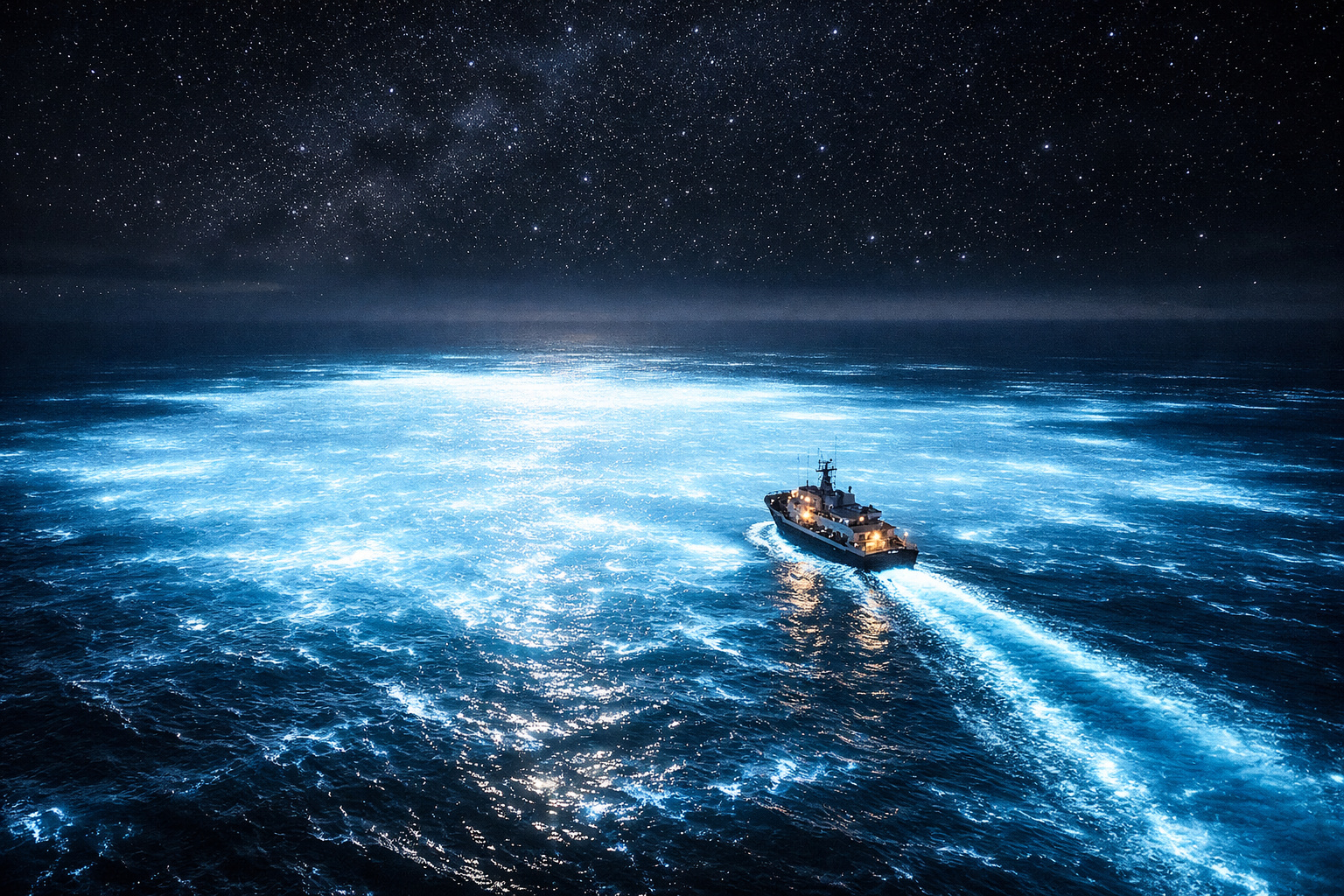
Milk Seas: Rare Phenomenon Makes the Entire Ocean Shine at Night. NOAA Satellites Recorded Areas of Up to 100,000 km² Illuminated by Bioluminescent Bacteria.
The phenomenon known as milk seas has intrigued sailors and scientists for centuries. In January 1849, Captain Kempthorne was sailing the Moozuffer through the Arabian Sea when he recorded in his log a sight he could not explain. According to him, the ocean appeared to have transformed into an endless plain of snow or a sea of liquid mercury, reflecting a uniform brightness that did not come from the moon or any storm. That night, there was no moonlight or electrical activity in the sky. Still, the entire ocean emitted a constant, silent, and homogeneous white light that stretched to the horizon in all directions. For hours, the ship sailed through a sea that seemed incandescent, as if the water was shining from within.
Kempthorne was not the first to document milk seas, nor would he be the last. For over four centuries, sailors from different countries reported nearly identical experiences in logbooks, travel accounts, and maritime expedition records. The phenomenon received this name—milk seas—and has crossed generations of navigators. For centuries, however, the term was treated merely as nautical curiosity. Without photographs, samples, or reliable scientific records, the phenomenon remained cataloged among the great mysteries of the ocean. This situation began to change only in the 21st century, when satellites began to record entire regions of the ocean glowing in the dark from space.
What Are Milk Seas and Why Did the Phenomenon Take Centuries to Be Explained?
Before understanding the most recent scientific data, it is important to comprehend why milk seas remained for so long in the territory between myth and science. The phenomenon does not resemble any other known type of marine bioluminescence, which made its identification difficult for a long time.
-
In a flooded well, archaeologists found a 1,700-year-old Roman egg that still contains clear and yolk intact inside the very thin shell.

-
Something is happening around the Earth: Inside the huge explosion of fireballs in 2026

-
A hot air bubble coming from Argentina expands over Brazil, causing thermometers to exceed 38 degrees with a thermal sensation of 40 degrees in late March, affecting 6 states at once.

-
The radish leaf that almost everyone throws away has more polyphenols, flavonoids, and fiber than the consumed root, and a 2025 study showed that the leaf contains compounds that protect the intestine, combat inflammation, and may inhibit the growth of cancer cells.


The most common bioluminescence in the ocean is caused by organisms called dinoflagellates, microalgae that emit flashes of blue light when the water is disturbed. This effect can be observed on beaches around the world when someone stirs the water at night. The glow appears briefly and disappears shortly after.
In milk seas, the behavior is completely different. The luminosity does not appear in flashes and does not depend on movement. Instead, the entire ocean seems to emit a continuous, uniform, and stable light that can extend for tens of thousands of square kilometers.

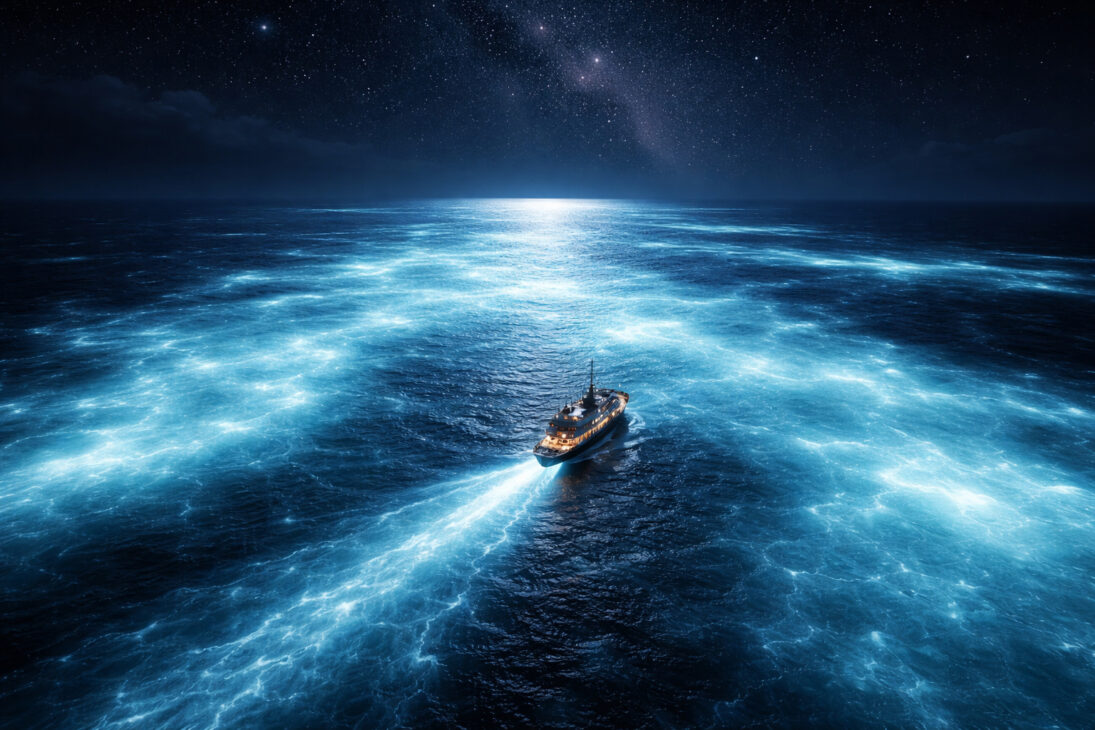
Diverse historical accounts describe how the bow of ships sailing in a milk sea created a dark line over the shining water, as if the vessel were cutting through a solid surface of light. In many cases, the glow disappeared at dawn, and the ocean returned to its normal appearance during the day.
This intriguing behavior caught the attention of writers and scientists throughout history. Herman Melville described the phenomenon in Moby Dick, published in 1851. Jules Verne also attempted to explain milk seas in 20,000 Leagues Under the Sea. Between 1915 and 1993, at least 235 formal sightings were recorded, primarily in the northwest part of the Indian Ocean, in the region between Somalia and the Arabian Sea.
Even so, something essential was missing to turn accounts into science: physical evidence.
The First Scientific Sample of a Milk Sea Collected in 1985
The first opportunity to study a milk sea directly occurred only in 1985, when a research vessel from the United States Navy was sailing through the Arabian Sea and accidentally crossed paths with the phenomenon near the island of Socotra in Yemen.
Unlike previous expeditions, this time there were scientists aboard and appropriate equipment for sample collection. The researchers collected surface water from the luminous sea and took the material for laboratory analysis.
The result revealed the presence of a bacterium called Vibrio harveyi, accompanied by colonies of a microalga known as Phaeocystis.
From these observations, the first consistent scientific hypothesis emerged to explain milk seas. According to this interpretation, large blooms of Phaeocystis would form a layer rich in organic matter on the ocean’s surface. When these algae die and decompose, they release organic compounds that serve as food for the explosive growth of the bacterium Vibrio harveyi.
This bacterium has a special characteristic: it emits light only when its population reaches an extremely high density.
How Bacterial Communication Can Illuminate the Entire Ocean
The luminous behavior of Vibrio harveyi is linked to a biological mechanism called quorum sensing, a chemical communication system used by many bacteria. In this process, each cell releases signaling molecules into the environment around it.
When the concentration of these molecules reaches a certain threshold, the bacteria detect that they are present in large numbers and begin to act collectively. In the case of Vibrio harveyi, the collective response is the emission of light.
A single bacterium does not shine alone. To activate bioluminescence, the concentration needs to reach around 100 million cells per milliliter of water. This means that a milk sea can represent a gigantic event of bacterial communication occurring simultaneously on an oceanic scale.
The Great Scientific Problem of the Milk Sea Hypothesis
Despite being elegant, this explanation presents an important problem. In open ocean, Vibrio harveyi typically appears in extremely low concentrations, usually around 10 cells per milliliter of water.
To reach the level necessary to produce light, the bacterial population would have to increase 10 million times. This raises a series of questions that still do not have definitive answers.
Scientists still do not know exactly under what conditions the ocean can create a sufficiently stable and nutrient-rich environment to allow this explosive multiplication. It is also unclear at what stage of the algae’s decomposition this process is triggered and why it occurs only in certain regions and times of the year.
Another intriguing detail from the 1985 sample is that the luminous bacteria were concentrated at the water surface, not distributed throughout the ocean column. This helps explain why the passage of a ship can momentarily extinguish the glow: the movement disrupts the superficial layer where the bacteria are concentrated.
Still, this is only a single set of data. In science, conclusions based on a single event need to be treated with caution.
The First Photograph of a Milk Sea Taken by Satellite
The first visual confirmation on a planetary scale occurred only in 1995, when the British merchant vessel SS Lima crossed a milk sea in the northwest part of the Indian Ocean, about 150 nautical miles off the coast of Somalia.
The captain carefully recorded the time, position, and duration of the phenomenon. Years later, scientist Steven Miller from the United States Naval Research Laboratory analyzed files from military satellites from the DMSP (Defense Meteorological Satellite Program).
By comparing the nighttime records from that period with the ship’s account, Miller found a perfect match. In the satellite images, an area of approximately 15,400 square kilometers, comparable to the size of the state of Connecticut, appeared glowing in the ocean for three consecutive nights.
This was the first visual evidence obtained from space of a milk sea. The result was published in 2005 in the journal PNAS, confirming that the phenomenon was not just a maritime legend.
The Gigantic Milk Sea Recorded by Satellite in 2019
A new phase in research began with the launch of the Suomi NPP satellite in 2011. The satellite has a sensor called Day/Night Band, part of the VIIRS system, capable of detecting light levels up to 10 million times weaker than daylight.
This sensor allows for the observation of extremely subtle phenomena, such as auroras, atmospheric glow, and potentially, milk seas. In 2021, Steven Miller and his team analyzed ten years of VIIRS data, from 2012 to 2021. During this period, the researchers identified 12 milk sea events.
The largest of these occurred in 2019, south of the island of Java in Indonesia. The event began in late July and remained visible for more than 40 consecutive nights. At its peak, the luminous area exceeded 100,000 square kilometers, approximately the size of Iceland.
Even so, something fundamental was still lacking: direct witnesses.
The Encounter of the Yacht Ganesha with the Largest Milk Sea Ever Recorded
The field confirmation came unexpectedly through a sailing vessel. On the night of August 2, 2019, Dutch captain Johan Lemmens was sailing the 16-meter yacht Ganesha during a trip around the world. The vessel was sailing between Lombok, Indonesia, and the Cocos-Keeling Islands when the crew encountered a completely illuminated ocean.
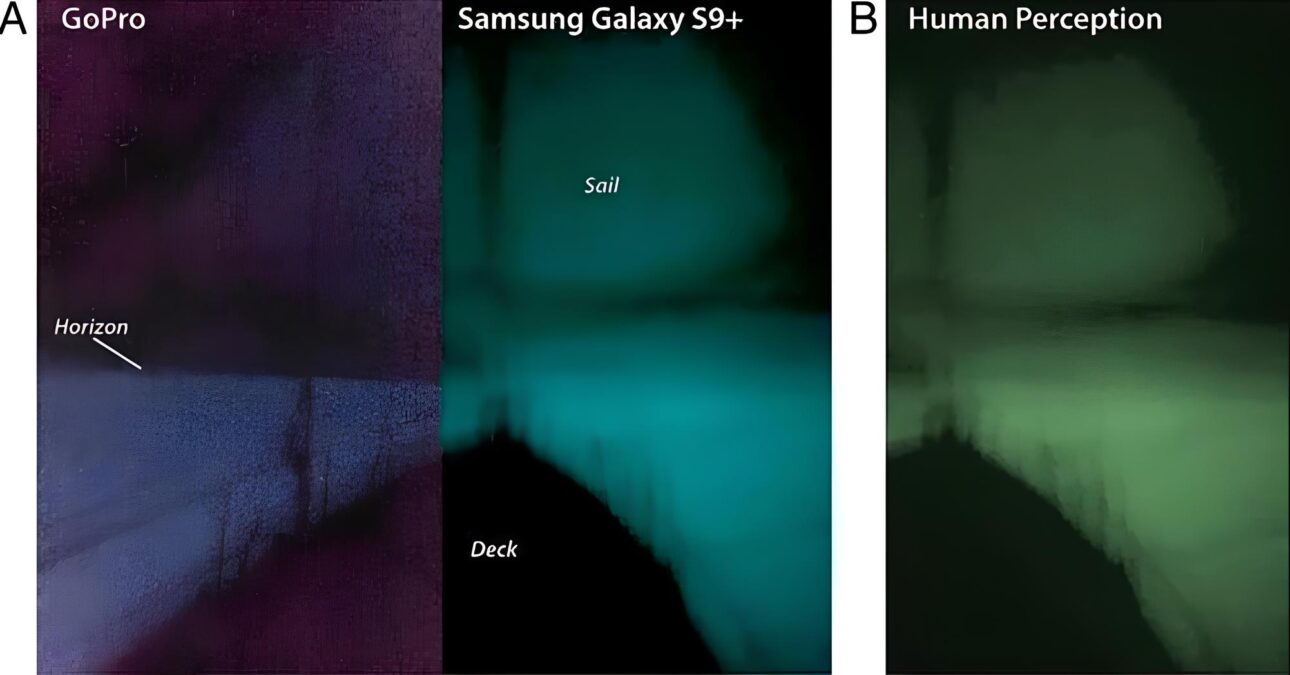
According to the team’s account, the sea emitted a uniform neon-green light that seemed to come from about 10 meters deep. The bow of the boat created a dark shadow as it moved forward, and the sail itself reflected the light coming from the water.
The crew spent the whole night observing the phenomenon, not understanding what was happening. Weeks later, one of the crew members, Naomi McKinnon, read news about satellite detections of milk seas. Upon contacting the researchers, it was discovered that the Ganesha had crossed exactly the same event recorded by the VIIRS satellite.
The photographs taken with a Samsung Galaxy S9 smartphone became the first surface images of a milk sea ever recorded in history and were published in 2022 in the journal PNAS.
The Largest Database of Milk Seas Ever Compiled
In 2025, researcher Justin Hudson, a Ph.D. student at Colorado State University, published the largest database ever compiled about milk seas in the scientific journal Earth and Space Science.
The survey includes 415 historical records, covering a period from 1600 to the present. The data were collected from various sources, including old logbooks, records from the Marine Observer Journal, which gathered systematic accounts from sailors for decades, and modern observations made by satellites.
The analysis revealed important geographic patterns. About 62% of the events occurred in the northwest Indian Ocean, in the region between Somalia, Yemen, and the island of Socotra. Another 19% occurred in what is known as the Maritime Continent, a tropical area connecting the Indian and Pacific Oceans around Indonesia.
The data also indicate relationships with climatic phenomena such as the Indian Ocean Dipole and El Niño, which influence the intensity of monsoons and the occurrence of ocean upwellings—currents that bring cold, nutrient-rich water from the seabed to the surface.
These nutrient-rich regions may favor large blooms of Phaeocystis, which would subsequently feed the population explosion of Vibrio harveyi.
What Science Has Yet to Explain About Milk Seas
Despite advancements, many questions remain unanswered. To this day, no scientific expedition has managed to reach a milk sea while it was still active.
Almost all available data comes from observations made by satellites or from subsequent accounts by sailors. This means that there are still no detailed direct measurements of water chemistry, bacterial density, or current dynamics during an ongoing event.
Milk seas are unpredictable, rare, and tend to occur in remote areas of the ocean, which significantly complicates organizing real-time research expeditions.
The database compiled by Justin Hudson may change this scenario. By identifying geographic and climatic patterns, scientists hope to be able to predict occurrence windows and plan expeditions that can study the phenomenon directly on site.
Why Milk Seas May Indicate Changes in Ocean Health
Beyond scientific curiosity, milk seas may have important implications for understanding the health of the oceans. The bacterium Vibrio harveyi is not only luminescent; it is also known to cause diseases in fish and other marine organisms.
If the increase in the frequency of these events is related to environmental changes—such as warming waters, acidification, or excess nutrients in the ocean—milk seas may represent more than a visual spectacle.

They may be a sign that large biological processes are occurring on the surface of the oceans. The ocean covers 71% of the Earth’s surface, and less than 26% of the seabed has been mapped in high resolution. Phenomena such as milk seas show that there are still continental-scale processes occurring in the ocean that science has only begun to understand.
When an area the size of Iceland shines alone in the middle of the ocean for 40 consecutive nights, the planet is showing something extraordinary. The challenge now is to find out exactly what this glow means.






Seja o primeiro a reagir!