





 Portuguese
  English
  Spanish
  6 min of reading
  0 comments


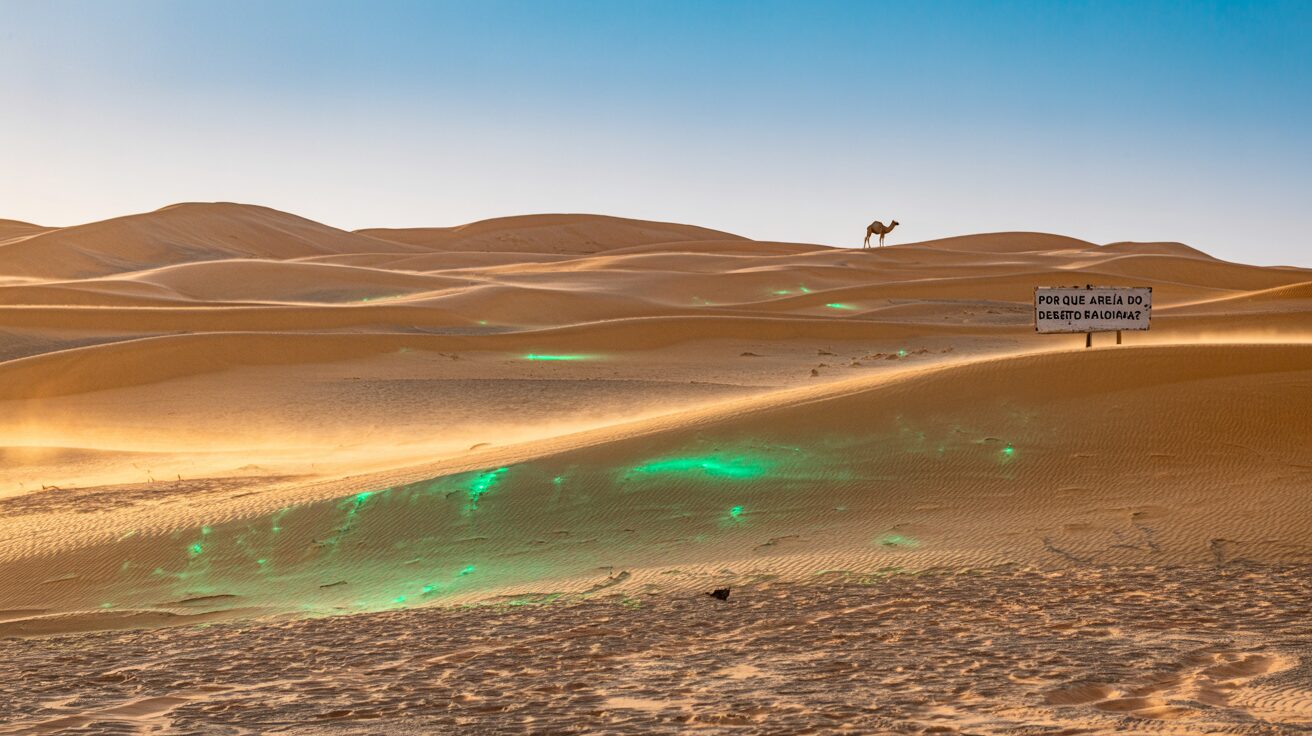
Natural Phenomenon Intrigues Scientists and Raises Doubts About the Effects of Radiation in One of the Most Extreme Environments on the Planet. After All, Why Is the Sand of the Sahara Desert Radioactive? Understand What Lies Behind This Discovery.
The Sahara Desert is the largest hot desert on the planet, covering approximately 9 million square kilometers, an area almost equivalent to that of the United States. With landscapes that seem to have come from another world and temperatures exceeding 50 °C, the Sahara has always attracted the interest of researchers, explorers, and the curious.
But beyond the extreme heat and the vastness of the dunes, a little-known detail catches the attention of the scientific community: the sand of the Sahara Desert is radioactive. Yes, you read that right. This seemingly harmless soil contains elements that emit natural radiation.
Why Is the Sand of the Sahara Desert Radioactive?
The radioactivity of the Sahara sand is explained by the presence of naturally radioactive chemical elements, such as uranium, thorium, and potassium-40. These materials have been present in portions of the Earth’s crust since the planet’s formation and are responsible for emitting ionizing radiation at varying levels.
-
Few remember, but the submarine that disappeared in 1968 with 52 crew members was found after 51 years at the bottom of the sea at more than 2,000 meters, intriguing the entire world.
-
With 1,200 tons suspended, the Japan mega-structure in a grid shape with a floating sphere from Fuji TV features two 25-story towers connected by elevated walkways, titanium panels, and impresses the world with its ability to reduce wind impact.

-
The village where two rivers run side by side without mixing in Santarém and Alter do Chão reveals some of the most beautiful freshwater beaches on the planet.

-
Brazil’s nuclear submarine with a speed 5 times greater than normal advances after nearly 50 years and R$ 40 billion spent.




In the case of the Sahara, geological studies indicate that natural processes occurring over millions of years have caused these elements to accumulate in certain rock formations. Over time, the erosion of these rocks generated sediments that mixed with the sand.
It is important to highlight that radioactivity is not evenly spread across the desert. Certain areas show higher concentrations, especially in regions where the rocks are rich in radioactive minerals.
The Role of Sandstorms in the Dispersion of Radioactive Particles
One of the most curious aspects of the sand of the Sahara Desert is its ability to travel long distances through sandstorms. These natural events are common in the region and occur when strong winds lift fine particles of sand and dust, transporting them thousands of kilometers.
Studies indicate that particles from the Sahara have been detected in Europe, South America, and even the Caribbean. Along with these particles, traces of naturally radioactive elements can also travel.
But does this mean that other continents are being contaminated? The answer, according to scientists, is no. Although these particles contain detectable levels of radiation, the amounts are so small that they do not pose a danger to human health or the environment.
Does the Radioactivity of the Sand in the Sahara Pose Risks?
The question about the effects of radioactivity raises legitimate concerns. After all, the term “radioactive” is often associated with danger and severe contamination. However, when we talk about the sand of the Sahara Desert, the context is completely different.
According to experts in geoscience and radiation protection, the amount of radiation emitted by the minerals present in the Sahara sand is much lower than the levels considered dangerous by the World Health Organization (WHO) and the International Atomic Energy Agency (IAEA).
To give you an idea, natural radiation is present in various environments, such as mountains, beaches, and even in the soil of cities. Humans coexist with this radiation daily without it posing a real risk to health.
In the Sahara, even in areas with higher concentrations, radiation levels do not exceed the safe limit for occasional human exposure. Only prolonged and localized exposure could raise some concerns, which is rare due to the low population density of the desert.
Impact on the Fauna and Flora of the Sahara
Another point that intrigues researchers is whether the radioactivity of the sand in the Sahara Desert affects the animals and plants that inhabit the region. The answer, based on scientific observations, is that there is no significant impact on the local fauna and flora.
The animals living in the Sahara, such as camels, lizards, scorpions, and rodents, are highly adapted to the extreme conditions of the environment. Natural selection has shaped their organisms to withstand heat, scarcity of water, and apparently even small doses of radiation.
Moreover, most of the desert’s vegetation is found in oases or areas less affected by radioactivity, reinforcing the idea that the presence of radioactive elements does not compromise the desert’s ecosystems.
And Humans? Are There Real Risks?
The majority of the population living around the Sahara is located in urban settlements or agricultural areas near the desert, such as along the banks of the Nile River or the Atlantic coast of Morocco. In these regions, the presence of radioactive sand is practically nonexistent.
Furthermore, the population density in the interior of the Sahara is extremely low. Nomadic communities, such as the Tuaregs, are in constant motion, which further reduces prolonged exposure to any radiation that may exist in mineral-rich regions.
According to the IAEA, there is no evidence of negative health effects on local populations caused by the radioactivity of the sand. Therefore, the risks are considered extremely low or nonexistent.
Comparisons with Other Deserts Around the World
The radioactivity of sand is not exclusive to the Sahara. Several other deserts around the planet also contain traces of radioactive minerals in their composition, such as:
- Namib Desert (Africa): has regions with natural uranium.
- Gobi Desert (Asia): features areas with granite that emits radiation.
- Atacama Desert (South America): known for its mineralized soil.
However, the Sahara stands out as the largest hot desert in the world and for its ability to spread dust over long distances. This makes it an interesting case for science, but not necessarily more dangerous than others.
The Importance of Scientific Monitoring
Even though the sand of the Sahara Desert is radioactive in some areas, scientists continue to study the region to understand how this radiation interacts with the environment and living beings.
Satellites, monitoring stations, and field missions are used to measure radiation levels in different areas, especially in zones with older rock formations rich in minerals like granite, which tend to have higher concentrations of uranium and thorium.
This monitoring is important to ensure that radiation remains at natural and safe levels, as well as to aid in the understanding of the geochemical cycles that shape the planet.
Curiosity: The Dust from the Sahara Fertilizes the Amazon Rainforest
An interesting fact related to the Sahara Desert is that its dust, besides containing radioactive traces, is rich in phosphorus and mineral nutrients. Studies show that some of this dust reaches the Amazon Rainforest, helping to fertilize the region’s nutrient-poor soil.
In other words, despite its aridity, the Sahara plays a fundamental role in the ecological balance of the planet, feeding tropical forests thousands of kilometers away.
This relationship between desert and forest demonstrates that nature is complex, interconnected, and full of surprises — and the natural radioactivity of the sand is just one piece of this big puzzle.
Radioactive Sand, but Harmless
The fact that the sand of the Sahara Desert is radioactive may seem alarming, but it is, in fact, a common natural phenomenon in various parts of the planet. The presence of uranium, thorium, and potassium-40 in the soil composition has occurred for millions of years and does not pose a relevant risk to human or environmental health.
Science has already shown that the levels of radiation are low, exposure is limited, and the impacts are minimal. Even the particles that travel by wind to other continents carry radiation in absolutely safe doses.
Therefore, although the phrase “radioactivity in the Sahara” may cause fright, the phenomenon is natural, known, and monitored. And it reinforces, once again, how deserts — far from being empty — are full of mysteries that still fascinate science.






Seja o primeiro a reagir!