





 Portuguese
  English
  Spanish
  4 min of reading
  0 comments


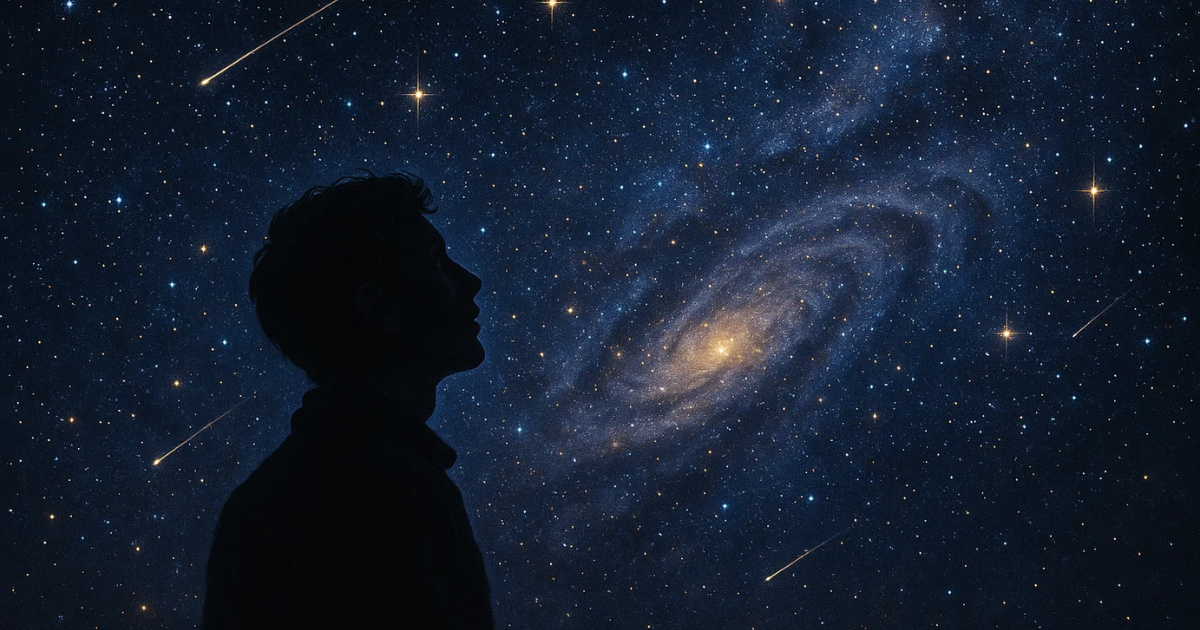
Even After Their Death, Some Stars Still Shine in the Night Sky Thanks to the Light They Traveled for Thousands of Years to Earth, Revealing a Cosmic Story That Challenges Our Perception of Time and Reality in the Universe.
When you observe the night sky, you may be looking at stars that no longer exist.
This is one of the most fascinating realities of astronomy and reveals how the universe operates differently from what we perceive in our daily lives.
The light from stars does not reach Earth instantly.
-
Rare frog thought to be extinct after only appearing in fossils reappears, becoming a ‘living relic’ of evolution and gaining a real path to spread after combating introduced predators.

-
House without a door and without a window: a resident lives high in the mountains, says he enjoys the “free life,” mentions that the cat comes and goes hunting bats and rats, and that when it rains he wakes up with wet feet.

-
Satellite images show that Morocco became so green in 2026 that the country looks different from space: two months of heavy rains transformed arid land into dense vegetation for the first time in a decade.

-
Archaeologists were excavating the foundation of a historic house in Russia when they discovered a buried treasure with gold coins, left behind in the final days of the Russian Empire and now valued at over R$ 2.8 million.


On the contrary, it takes time to traverse the immense space to reach our eyes.
And this time can vary from a few years to millions — or even billions — of years.
Therefore, it is possible that many of the stars visible today in the night sky may have exploded or ceased to exist a long time ago.
But the light they emitted is still on its way and remains visible here from Earth.
The Speed of Light and the Cosmic “Time Machine”
The explanation for this phenomenon lies in the speed of light, which is about 300,000 kilometers per second.
Despite being extremely fast, this speed is not enough to render the view of cosmic objects instantaneous.
For example, sunlight takes approximately 8 minutes and 20 seconds to reach us.
In other words, when you look at the Sun (with proper protection), you are seeing it as it was more than 8 minutes ago.
With more distant stars, this time increases significantly.
The light from the closest star to the solar system, Proxima Centauri, takes over 4 years to reach Earth.
Stars in the Milky Way can be thousands of light-years away, meaning that we are seeing the past of these stars.
In other words, looking at the sky is like observing a kind of “historical archive of the universe.”
Many Stars We See Have Already Ceased to Exist
If a star exploded 500 years ago in a galaxy 5,000 light-years away, we will still see its light as if it is still alive for another 4,500 years.
This phenomenon is real and occurs because the light emitted before the explosion continues traveling through space until it reaches Earth.
Supernovae — explosions of massive stars — are clear examples of this.
Some of the supernovae that we observe through telescopes today occurred thousands of years ago.
The brightness we see today is just the reflection of what happened in the past, traveling towards us.
Light as the Messenger of the Universe
In astronomy, light is the primary tool for understanding the cosmos.
By analyzing the light that arrives on Earth, scientists can study the chemical composition of stars, their temperature, motion, and age.
This process is known as spectroscopy.
Even if a star has ceased to exist, the light it left behind continues carrying valuable information about its existence.
For this reason, astronomers often use the term “seeing the past” to describe the act of observing celestial objects.
The Illusion of Time in the Universe
In the universe, present and past mix at all times.
For us, inhabitants of the Earth, time seems linear.
But in the cosmos, distance and the speed of light create the illusion that everything is happening now — when, in fact, it may have occurred millions of years ago.
This concept may seem difficult to grasp, but it is one of the pillars of modern physics.
Albert Einstein demonstrated in his Theory of Relativity that time and space are interconnected.
Thus, when we look at a distant star, we are literally seeing how it was at an earlier point in time.
This Applies to Galaxies, Nebulae, and Even Black Holes
It’s not just stars that show us the past.
Other celestial bodies, such as galaxies and nebulae, also emit light that takes millions or billions of years to reach us.
The Andromeda Galaxy, for example, is about 2.5 million light-years from Earth.
This means that we are seeing Andromeda as it was 2.5 million years ago — when the first humans didn’t even exist yet.
Even black holes can be “seen” indirectly through the light around them.
Seeing Dead Stars Is Not Illusion, It’s Science
It’s not a theory or belief: it’s pure and proven science.
This temporal perception of light is one of the foundations of modern astrophysics.
Large telescopes, such as Hubble and the new James Webb, were designed precisely to “look into the past” of the universe.
They capture infrared light that traveled billions of years before being recorded, allowing scientists to study the origins of the cosmos.
Therefore, it is scientifically correct to assert that many of the stars we see today no longer exist.
What we see is merely the trace of what they were — a sort of “luminous echo” traversing space-time.
A Sky Full of History
Observing the sky is more than admiring bright points.
It is witnessing records of a distant past, captured by the light that travels for thousands or millions of years.
It is like opening a window to the history of the universe, where each star is a living memory of a time that has passed.
The next time you look at the stars, remember: many of them have already ceased to shine, but their light continues to tell their stories.






-

Uma pessoa reagiu a isso.