





 Portuguese
  English
  Spanish
  6 min of reading
  0 comments


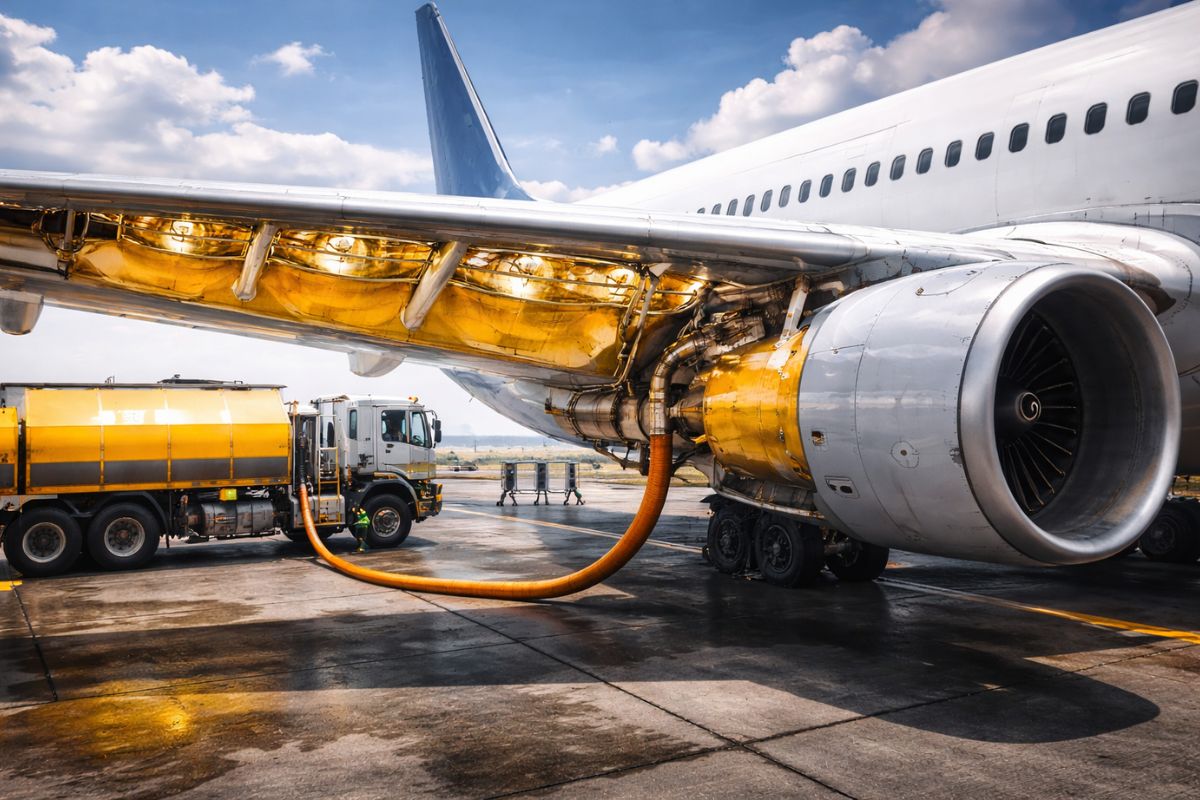
Understand Why Storing Fuel in the Wings Seems Dangerous at First Glance, but Reduces Structural Effort, Improves Stability, Saves Weight, and Increases Safety in Every Flight.
When you look out the airplane window and see those giant wings, the last thing you think about is that they are filled with fuel. But that’s exactly what happens: commercial airplanes carry thousands of liters of fuel in the wings, right there in the structure that keeps the aircraft flying. At first glance, this seems contradictory. Fuel is flammable, and wings are essential for lift. Instinctively, many people think it would be safer to store all that fuel inside the fuselage, protected in the “core” of the airplane.
What aerospace engineering shows is exactly the opposite. Placing fuel in the wings is not a “risky shortcut,” but rather a carefully calculated decision. This choice helps alleviate structural efforts, improves the airplane’s balance, makes better use of available space, and creates additional layers of safety. What seems strange to the layman is, in practice, a highly optimized solution that is part of the reason why flying has become one of the safest means of transportation in the world.
The Idea of Having Fuel in the Wings Seems Dangerous, but It Is Not

The first reaction of many people is simple: if there is a “dangerous” place to store fuel, that place would be the wings.
-
With a cost per shot close to zero, the DragonFire laser could change naval warfare in 2027 and provide British ships with nearly unlimited defense against drones.

-
A British startup creates tires that generate electricity in electric vehicles when passing over potholes, speed bumps, and cracks.

-
Scientists have created robots made with living cells that have their own nervous system, swim on their own, explore the environment, and self-organize without any genetic engineering, and now they want to do the same with human cells.

-
Students create a solar-powered ambulance that operates without a plug, without fuel, and still keeps medical equipment running in remote areas.

They move, flex, are the most exposed to wind, rain, ice, and even possible impacts with birds or debris. Wouldn’t it be better to concentrate everything in the middle of the airplane, away from the edges?
Here comes the logic of safety. Keeping the fuel in the wings keeps it away from the passenger cabin and many critical systems inside the fuselage.
In an extreme scenario, having the fuel lateralized, in dedicated compartments, helps isolate risks and better distribute the impact of any damage.
The tanks are integrated into the structure, have compartmentalization, valve systems, pumps, and sensors that monitor flows, pressures, temperatures, and potential anomalies.
Moreover, the fuel in the wings is not there “loosely” or improvised. The wing design is conceived to be both a lift structure and a fuel reservoir.
The entire aircraft design takes into account that this liquid mass will be part of the system from takeoff to landing, gradually changing in quantity as it is consumed during the flight.
Fuel in the Wings Helps Relieve Structural Effort

Now comes one of the most elegant points of this engineering decision. The wings are responsible for generating lift, the force that “pulls” the airplane up during flight.
This lift primarily acts on the wings, pushing them upward, while the weight of the aircraft, concentrated largely in the fuselage, passengers, cargo, and engines, pulls everything down.
If all the fuel were concentrated in the fuselage, you would have a large block of weight at the center of the airplane, and the wings would suffer from a much greater bending moment in the area where they connect to the fuselage.
In simple terms, it would be like holding a heavy shelf only from the middle, putting too much stress on the joint and requiring much more material to prevent it from breaking.
By storing fuel in the wings, the weight of that fuel acts downward exactly where the lift acts upward. This causes some of the forces to balance right there, reducing the effort at the roots of the wings.
It’s as if the fuel itself helps “hold” the wing in place, reducing the need for even more robust and heavier structures at the joint with the fuselage. The result: more efficient wings, a lighter aircraft, and better use of structure without losing strength.
Wings Are the Perfect Space, Fuselage Is Noble Space
Another important argument is purely practical. The fuselage is the most valuable space in the airplane. It’s where passengers, luggage, cargo, cockpit, and a series of electronic and control systems are located.
Every cubic centimeter of this region is designed to generate value: more seats, more cargo, more comfort, more technology.
If the fuel were stored in the fuselage, it would compete for space with all of this. Either the airplane would carry fewer passengers and cargo, or it would need a larger and heavier fuselage, which would lead to more cost, more consumption, and less efficiency. In both cases, the result would be a worse airplane from an economic and operational standpoint.
In the wings, the situation is different. By design, they have a large internal hollow volume, intended specifically to function as an integrated tank.
It’s a space that wouldn’t be used for passengers or cargo and, therefore, can be utilized without compromising the commercial capacity of the aircraft. Filling this volume with fuel is an intelligent solution for something that already exists in the very geometry of the wing.
Center of Gravity: Stability in All Flight Phases


The center of gravity is the point where we can imagine all the weight of the aircraft is “concentrated.”
Keeping this point within an appropriate range is essential for the airplane to be stable and controllable. If the center of gravity is too far forward or too far back, the pilot and automatic systems need to work harder to keep the aircraft balanced.
When the fuel is distributed in the wings, it helps maintain the center of gravity in a more predictable position, both laterally and longitudinally.
As fuel is consumed during flight, the fact that it is spread across tanks in the wings (and, in some cases, supplemented by central tanks) allows the fuel management system to transfer this liquid from one point to another, maintaining the overall balance of the aircraft.
Having fuel in the wings is not just a matter of where to store the volume; it is an active part of stability control. Throughout a flight, the airplane goes through different phases such as takeoff, climb, cruise, descent, and landing.
In each stage, the amount of fuel changes, but the goal is always the same: to keep the center of gravity within the safe range specified by the design.
Safety: Extra Layer, Not Free Risk
The question that keeps lingering in your mind is inevitable: but, in the end, is fuel in the wings really safe? The engineering answer is that it is not only safe but also that this solution incorporates safety concepts from the very first sketch of the design.
The tanks integrated into the wings are designed as part of the structure itself, with reinforcements, internal divisions, drainage systems, and detection systems.
Instead of imagining the fuel as a “foreign body” strapped to the outside, the airplane’s design treats this liquid as a structural component that needs to be controlled and monitored at all times.
Moreover, having the fuel away from the cabin, distributed across more than one tank, and accompanied by systems monitoring pressures, temperatures, and flows creates redundancy.
In the event of an incident in one part of the aircraft, this configuration provides pathways to isolate sections of piping or tanks, preserving the rest of the system.
When the Strange Solution Is Actually the Smartest
If someone asked you, without context, where to store a flammable liquid in a machine that flies, you would probably not answer “in the wings.”
The brilliance of aerospace engineering lies precisely in going beyond intuition and seeing the complete picture: aerodynamics, structural strength, space utilization, center of gravity, stability, and safety.
Putting fuel in the wings addresses all these issues simultaneously. It relieves effort at the roots of the wings, utilizes a volume that already exists, frees up the fuselage for passengers and cargo, helps maintain the airplane’s balance, and creates a safe configuration when analyzed as a complete system.
What seems like a risky idea is, in fact, the result of decades of refinement and a design philosophy in which every choice needs to justify itself on multiple levels at the same time.
The next time you look out the window and see the airplane wing gently swaying, remember that inside it is not just the metal generating lift. There is also the fuel that helps to balance, alleviate, and protect the aircraft throughout the entire flight.
And you, have you ever stopped to think that storing fuel in the wings might be exactly what makes your flight more stable and safer, or do you still think it would be better to concentrate it all inside the fuselage?






-

-

-

9 pessoas reagiram a isso.