





 Portuguese
  English
  Spanish
  6 min of reading
  0 comments


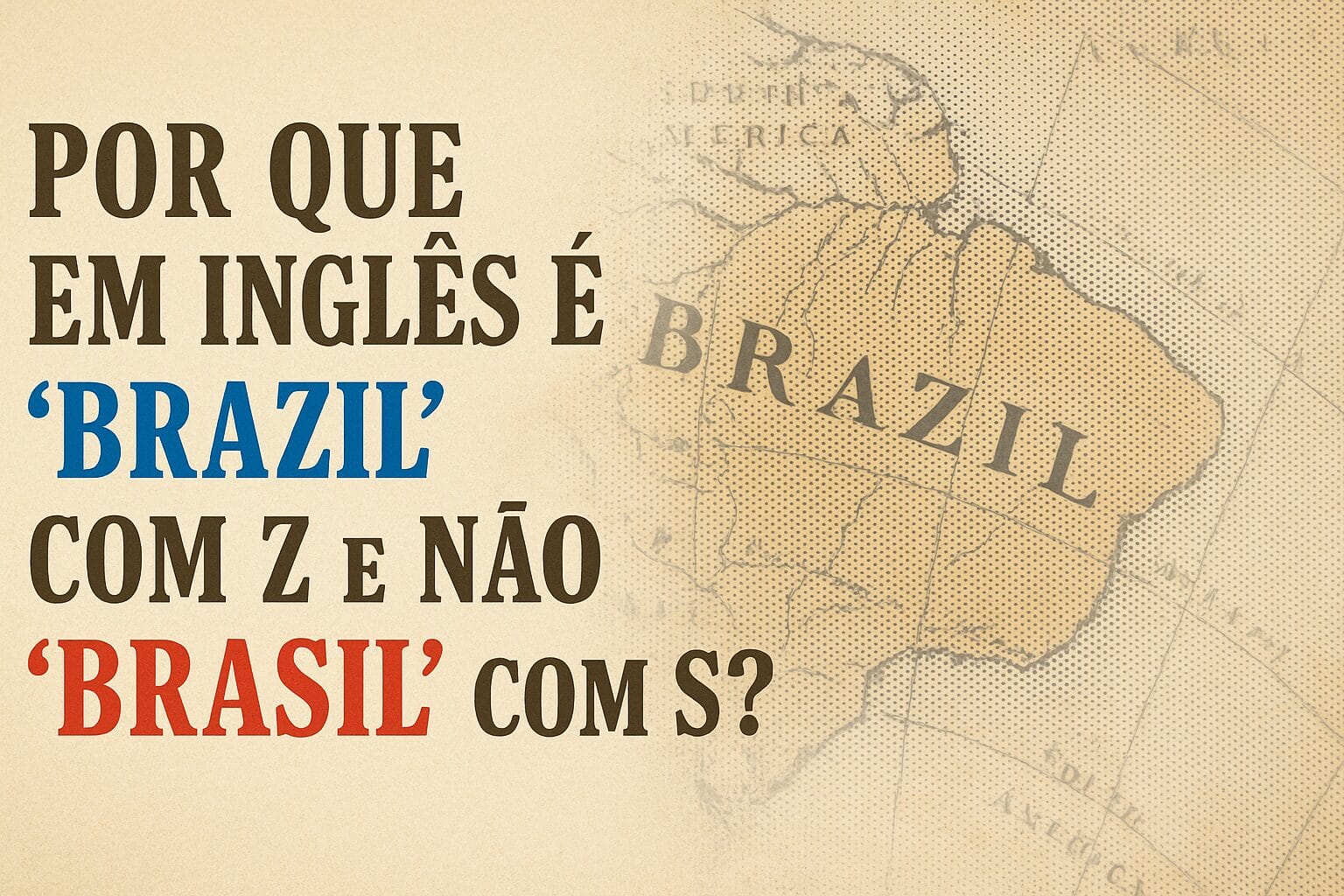
If You Have Ever Wondered Why English Speakers Write “Brazil” With Z, While In Portuguese We Use “Brasil” With S, The Answer Is Not Just In The Translation — It Is In The History Of The Portuguese Language And In The Evolution Of European Languages. Believe It: The Very Brazil Was Once Officially Called “Brazil.” Understand Why In English It Is “Brazil” With Z And Not “Brasil” With S?
For those who think that the use of “Z” in “Brazil” is just a simple choice of the English language, the reality is much more interesting. The word “Brazil” was once the official spelling of the country’s name in Portuguese as well, used for centuries, from the colonial period to the Empire. The change to the form with “S” — “Brasil” — is relatively recent. It occurred only in the 20th century as part of a spelling reform promoted by Getúlio Vargas, becoming mandatory through Decree No. 20,108, dated June 15, 1931.
From “Brazil” To “Brasil”: How The Spelling Changed Officially — Why In English It Is “Brazil” With Z And Not “Brasil” With S?
During the colonial period and throughout the Empire of Brazil, the spelling with “Z” was the dominant form in official documents, coins, maps, and diplomatic correspondence. This writing was aligned with archaic Portuguese, which had different spelling rules than today.


The form “Brazil” was used not only in Brazil but also in documents from Portugal, France, England, and other countries. It was not a foreignism, but rather the official way the country’s name was spelled until the 19th century.
-
These living root bridges and ladders are over 700 years old and help indigenous people survive in one of the rainiest regions in the world.

-
From sertanejo star to international investor: Ana Castela invests millions in a mansion in the USA, creates a themed accommodation in Orlando, and shows that the “boiadeira” also wants to grow away from the stage.

-
The 10 most stunning motorhomes in the world: a $3 million trailer with a rooftop nightclub and garage for a Ferrari, “palaces on wheels” with Italian marble, private cinema, and five-star hotel luxury for billionaires.

-
Trump wanted to spend $400 million on the White House, but the courts prohibited the million-dollar construction.


It was only in 1931 that the Brazilian government determined, by decree, the official replacement of the letter “Z” with “S”, as part of an effort to modernize and unify the Portuguese language.
The change, however, faced resistance from the press, publishers, and parts of the population, especially in the early years. The effective application of the new spelling only began to happen more broadly starting in the 1940s.
Why Was The “Z” Used In Ancient Portuguese?
The spelling “Brazil,” with “Z,” originated from orthographic traditions of archaic Portuguese and Galician-Portuguese, where the letter “Z” represented certain sounds that, over time, came to be represented by “S.”
Ancient Portuguese used “z” in several words that today are written with “s.” This happened with words such as:
- Realizavam → Realisavam
- Analyzar → Analisar
- Civilizaçaõ → Civilização
This pattern was common until the arrival of the first major orthographic reform in the early 20th century and also reflected influence from Latin and Spanish of the time.
The word “Brazil” came from the term “pau-brasil,” the native tree that gave rise to the name of the country. In ancient Portuguese, this name was sometimes recorded as “pau-brazil,” and thus the country’s name also began to be spelled that way.
When Did The “S” Become Mandatory?
The definitive change occurred with Decree No. 20,108, dated June 15, 1931, signed by then-president Getúlio Vargas. The decree established new spelling rules for the Portuguese language, aiming to simplify writing and standardize spellings in all official documents.
Although the decree was signed in 1931, the transition was not immediate. In Portugal, for example, the spelling with “S” was only officially adopted in 1940, and in Brazil in 1943, after new adjustments and agreements with the Brazilian Academy of Letters and Portuguese linguistic authorities.
These reforms were part of a larger movement aiming to unify the Portuguese language among Portuguese-speaking countries, a process that would culminate decades later in the Orthographic Agreement of the Portuguese Language, in 1990.
Why Did English Keep “Brazil” With Z?
English kept the original form — “Brazil” with Z — because this was the internationally recognized spelling until the early 20th century. When Brazil began to officially adopt the “S,” English speakers did not follow the change.
Additionally, the English language already has a pattern of using “Z” in words that in Portuguese use “S”, such as:
- Civilização → Civilization
- Análise → Analysis
- Realização → Realization
Therefore, the spelling “Brazil” fit perfectly into the English spelling system and was maintained for historical, phonetic, and international standardization reasons.
And In Other Languages? How Is “Brasil” Written?
The spelling of the country’s name changes subtly in various languages. See how the name of Brazil appears around the world:
- Spanish: Brasil
Example: Brasil es famoso por su carnaval y fútbol. - French: Brésil
Example: Le Brésil est un pays magnifique. - Italian: Brasile
Example: Il Brasile ha delle spiagge meravigliose. - German: Brasilien
Example: Brasilien ist bekannt für den Amazonas-Regenwald. - Polish: Brazylia
Example: Brazylia to kraj pełen kolorów i rytmu. - Turkish: Brezilya
Example: Brezilya, dünyadaki en büyük ormanlara sahiptir.
Note that most of the languages derived from Latin maintained the “S” or a similar phonetic variation, while Germanic or Slavic languages adapted the name with their own phonemes, but without using the “Z” as in English.
Does “Brazil” Still Appear Officially?
Although “Brasil” with S has been the official spelling since 1931, it is still possible to find the term “Brazil” in the names of old institutions, historical documents, and brands that chose to maintain the classic spelling for tradition or international identity.
Some examples:
- “Imperial Brazil” is used in history books to refer to the imperial period.
- The name of the semiprecious stone “Brazilianite” is with Z, derived directly from the old name.
- Exporting companies use “Brazil” on packaging and international contracts, due to the familiarity of the term abroad.
The Cultural Influence Of The Spelling “Brazil”
Even after the official change, the term “Brazil” continues to exert strong cultural and symbolic influence, especially outside the country. The name “Brazil” is present:
- In movies and songs (like the cult classic “Brazil,” by Terry Gilliam);
- In international brands associated with the country;
- In tourist slogans from decades past.
This frequent use helps maintain Brazil’s association with a tropical, exotic, and global identity — even if written with a “Z.”
Curiosities About The Name Brazil
- The name “Brasil” comes from the tree pau-brasil, whose red heartwood was used to dye fabrics.
- Before being called Brazil, the territory was named “Land of the Holy Cross” and “Island of True Cross”, among other variations.
- The name “Brazil” with Z appears in Renaissance maps and nautical charts from the 16th century.
- Some documents from the Portuguese monarchy still used the form “State of Brazil” even after 1822.
It Is Not A Mistake, It Is Heritage
The use of “Brazil” with Z in English is not a translation error. It is a historical record of an old spelling, which was maintained by English speakers and other Germanic languages while Portuguese evolved and adopted new spelling rules.
Understanding why in English it is “Brazil” with Z and not “Brasil” with S is a way to better comprehend how languages evolve, interact, and preserve traits of the past. This small orthographic difference tells a big story — of colonization, linguistic reforms, international diplomacy, and cultural identity.
And above all, it shows how even a single letter can carry centuries of linguistic transformations.








-

Uma pessoa reagiu a isso.