





 Português
  Inglês
  Espanhol
  4 min de leitura
  0 comentários


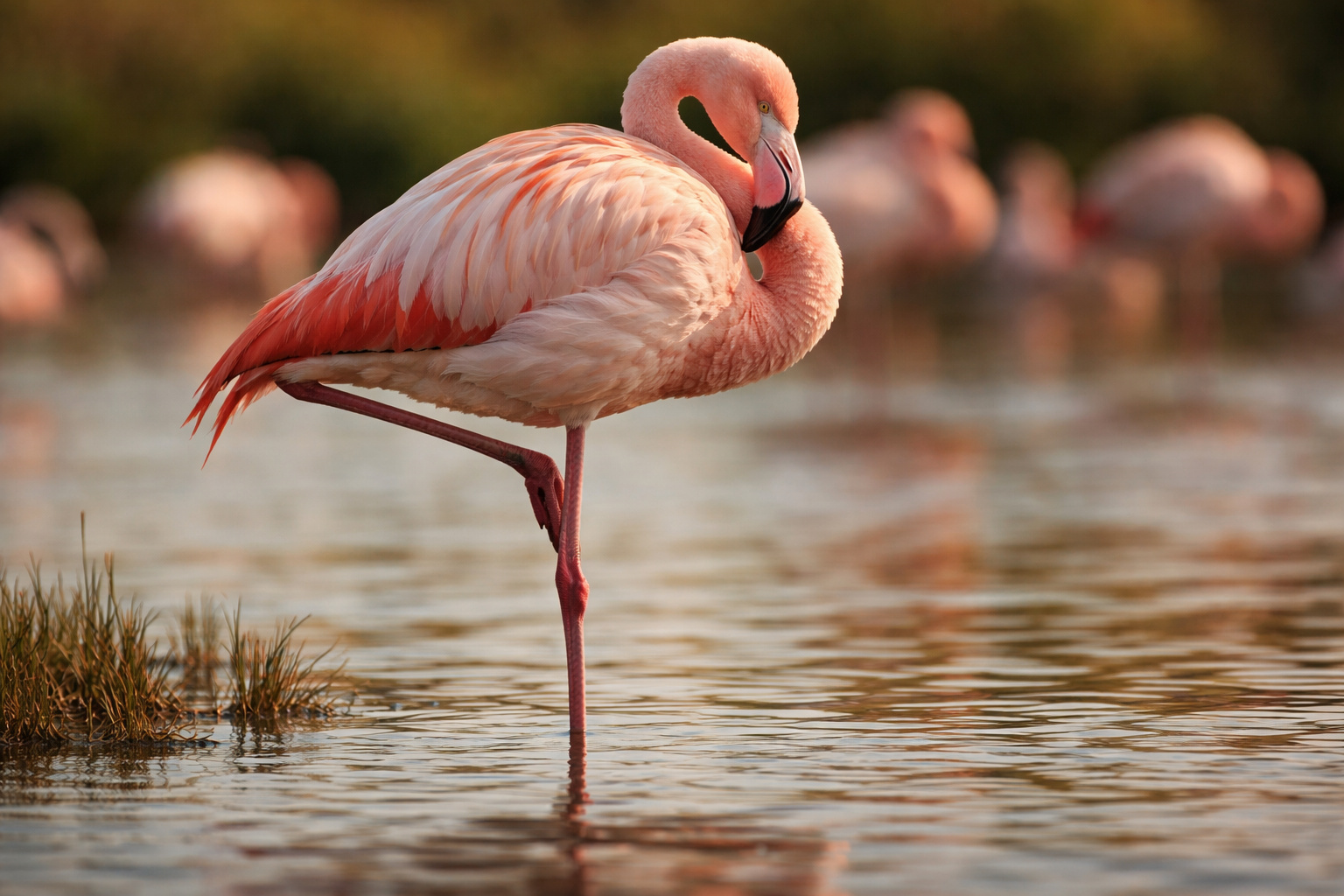
The Anatomy Of Flamingos Reveals A Natural Stability Mechanism That Allows Efficient Rest, Metabolic Energy Conservation, And Thermal Control In Aquatic Environments
Observing nature, above all, reveals curious behaviors that challenge human logic regarding energy expenditure.
Among these phenomena, the habit of flamingos sleeping on one leg stands out, a striking characteristic of these pink birds.
Over the past few decades, researchers have begun to investigate this behavior with greater scientific attention.
Studies conducted by scientists at the Georgia Institute of Technology (Georgia Tech), published in the 2010s, helped explain this biological mechanism.
According to researchers, the balance occurs thanks to a passive system in the joints, which eliminates the need for constant muscle contractions.
Thus, the flamingo is able to remain stable during rest while reducing energy consumption.
-
The world’s first octopus farm wants to open in the Canary Islands and is already provoking an international reaction: the plan aims to produce 3,000 tons per year.

-
Drought may be creating stronger superbugs in the soil and helping antibiotic resistance reach hospitals, warns a study highlighting a problem that could grow alongside extreme weather.

-
The biggest scam in history: Napoleon’s France deceived the United States by selling them a territory that was Spanish.

-
Why is the Danakil Desert so dangerous? It has unstable terrain and how extreme temperatures and toxic gases turn the region into one of the most hostile environments on Earth.

This behavior, therefore, is not only curious.
In fact, it represents an extremely efficient evolutionary adaptation, refined over thousands of years.
The Biomechanical Secret That Allows Sleeping On One Leg
First, the process begins when the flamingo raises one of its legs.
Then, the animal carefully positions the center of gravity over the supporting leg.
Shortly after, a natural mechanism in the joints activates.
At this moment, the body weight presses on the knee joint, which mechanically locks the movement.
This lock acts as a passive support.
Thus, the bird remains balanced without significant muscular effort.
Researchers have also observed something surprising.
Balancing on two legs requires more muscle effort than remaining supported on just one during deep sleep.
The process occurs in three main stages:
• Initial Positioning: the flamingo lifts one leg and adjusts its body balance.
• Activation Of The Bone Lock: the body weight passively locks the joint.
• Deep Rest: the bird remains stable while conserving metabolic energy.
Thus, the flamingo is able to rest efficiently and safely.
Natural Engineering: How The Anatomy Of Birds Favors Balance
In addition to mechanical balance, the physiology of flamingos has also been optimized for aquatic environments.
Therefore, these birds’ legs have bones and ligaments that fit together with great biomechanical precision.
This structure significantly reduces fatigue during long periods of inactivity.
Consequently, the flamingo can remain motionless without physical wear.
At the same time, this posture also aids in the body’s thermal regulation.
This happens because birds easily lose heat through their unprotected extremities.
Thus, by tucking one leg against its feathers, the flamingo reduces heat loss.
This detail becomes important in frequently cold waters.
Among the main benefits of this posture are:
• Reduced Energy Expenditure During Rest.
• Less Heat Loss In Aquatic Environments.
• Mechanical Stability Guaranteed By Gravity And Bone Anatomy.
• Ability To React Quickly To Predators Even While Resting.
Therefore, the resting posture represents a combination of energy efficiency and environmental adaptation.
Sleeping On One Leg Improves The Biological Efficiency Of The Species
Furthermore, this posture directly influences the biological efficiency of the flamingo.
By avoiding unnecessary muscle contractions, the bird preserves energy for essential activities.
These activities include, for example, foraging for food or longer movements.
Thus, this behavior contributes to the species’ survival.
Researchers highlight that the mechanism mainly functions during deep sleep.
At this stage, energy expenditure becomes minimal.
A comparison between rest states demonstrates this difference:
Bird State — Muscle Effort — Energy Expenditure
One Leg (Sleep) — None, passive mechanism — Minimum
Two Legs (Alert) — Active and constant — Moderate
Therefore, over evolution, natural selection favored the most efficient resting method.
Gravity As An Ally Of Balance
While humans need to make constant muscular adjustments to remain upright, flamingos utilize gravity to their advantage.
When the bird correctly positions its body, the force vector passes directly through the locked joints.
Thus, a natural support pillar is formed.
As a result, body weight maintains balance without additional effort.
Thus, gravity does much of the supporting work.
This mechanism demonstrates how evolution found an efficient solution to a complex biological engineering problem.
Other Birds Also Exhibit Similar Mechanisms
Although the flamingo is the best-known example of this behavior, other wading birds also exhibit similar adaptations.
However, researchers state that the precision of the flamingos’ bone lock is among the most efficient ever documented by modern biology.
Consequently, this mechanism has become an important example in animal biomechanics studies.
Understanding this behavior helps reveal the complexity of adaptations present in fauna.
Thus, when observing a flamingo resting peacefully on one leg, an inevitable reflection arises: how many other natural engineering secrets remain hidden in animal behavior?









-

-

-

4 pessoas reagiram a isso.