





 Portuguese
  English
  Spanish
  5 min of reading
  0 comments


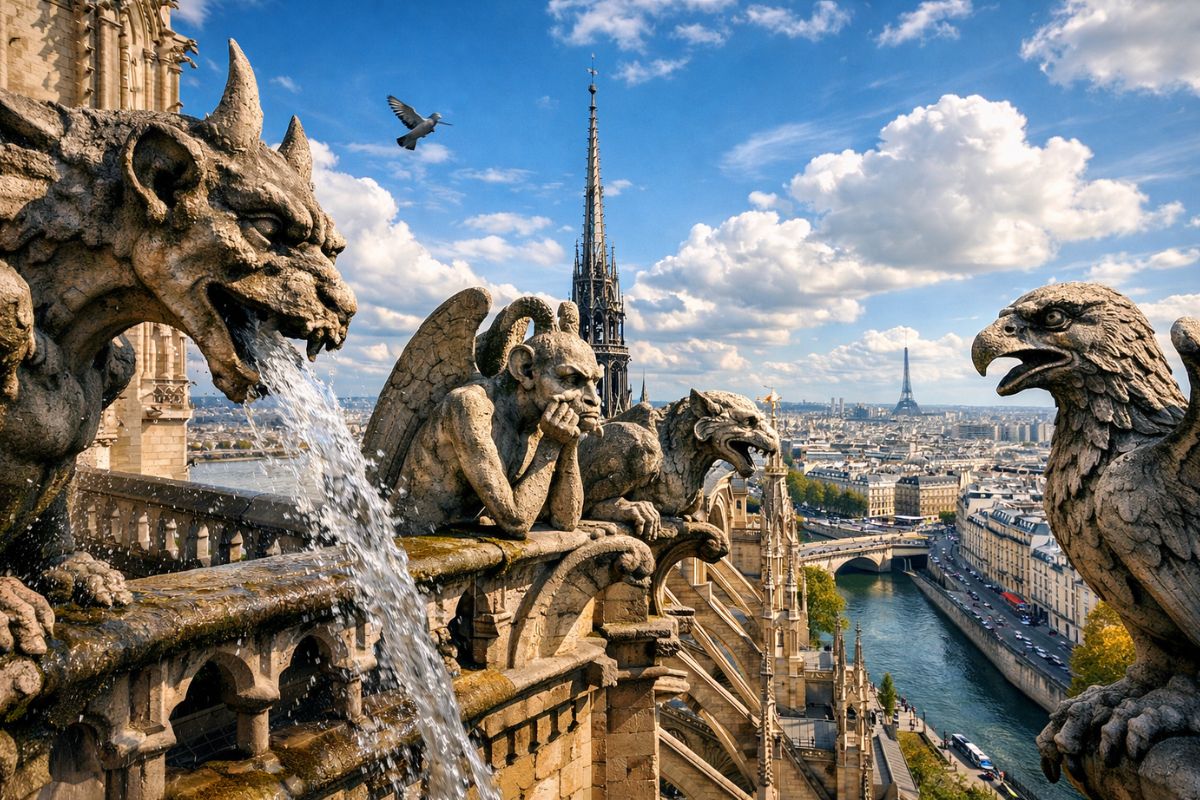
They Drain Water To Protect The Stone From Erosion, Gained Spiritual Interpretation In The Middle Ages, And In Paris, Several Iconic Sculptures Came From 19th Century Renovations, Not The Medieval Period
In winter, when the rain and humidity tighten, that doubt returns that always appears in front of ancient cathedrals: why are there gargoyles, why do they look like monsters, and why does everyone say that they drain water?
The answer is more complete than it seems, because these sculptures are not just for decoration. They drain water away from the façade, became a symbol of protection against evil, and also functioned as a pedagogy of fear, and in Notre-Dame many of the most famous figures are not functional gargoyles, but decorative neo-Gothic chimera.
The Most Practical Reason: Gargoyles Drain Water To Save The Building

The most direct function is simple and very concrete: gargoyles drain water. The water collected on the roof runs through gutters, is channeled to the piece, and then is thrown away from the structure, preventing it from running down the façade and accumulating where it should not.
-
He started running at 66 years old, broke records at 82, and is now a subject of study for having a metabolic age comparable to that of a 20-year-old, in a case that is intriguing scientists and inspiring the world.

-
Oldest tree on the planet reappears after 130 years of searches: Wattieza, 385 million years old, was 10 meters tall and had no leaves or seeds; Gilboa fossils in New York solved the mystery in 2007.

-
A 48-square-meter house assembled in hours with 4,000 bricks made of recycled plastic that does not absorb moisture, has natural thermal insulation, and costs less than 90,000 reais in a complete kit.

-
Luciano Hang revealed that Havan’s air fleet has already accumulated more than 20,000 landings, 10,000 flight hours, and 6 million kilometers traveled, and he says that without the planes, the company would never have grown so quickly.

It is a drainage system designed to preserve the masonry: over time, water seeps in, wears down mortar, causes erosion, and compromises the building’s stability.
Even the name helps to understand. The word comes from an idea of “throat,” as if the sculpture were a gullet through which the water flows out.
In other words, before any symbolism, gargoyles drain water with an engineering objective, not a fantasy one.
This explains why they appear so much in Gothic architecture, starting from the 12th century: they are structures with more exposed frameworks, like flying buttresses and supports, which creates more moisture-sensitive points.
The more surface and structural detail exposed, the greater the need to get the water out of the way, so it makes sense that gargoyles become more present in these monuments, precisely because they drain water effectively away from the stone.
Why Monsters: When They Drain Water And Also “Scare” Away Evil
If the goal were just to drain water, a discreet pipe would suffice. So why create such strange creatures?
One of the important interpretations is the apotropaic function, that is, objects made to ward off evil. The logic is almost intuitive: use terror to repel terror.
Monstrous creatures outside the building suggest protection of the sacred internal space against external evil forces.
It’s as if the very construction were saying, with a stern face and bared teeth: “there’s order inside, out here is chaos.”
This type of symbol appears in many places and epochs. There are parallels with grotesques, with ancient scary masks, and with hybrid figures associated with temples and palaces.
The idea repeats: a fierce image serves as a warning and as a shield, even when, at the same time, those mouths and throats continue doing the main job of always, because they drain water.
The Pedagogical Use: Fear As A Tool, While They Drain Water From The Outside

In addition to symbolic protection, there is the pedagogical side related to what has been called the “pastoral of fear.” Here, the creatures would not be “scaring demons,” but reminding the faithful of the danger of sin, hell, and the constant presence of temptation.
The gargoyles stay outside: they visually mark a threatening “out there” and a safe “in here,” reinforcing the church as a refuge.
Many people sum this up by saying that the church was a “stone bible” because the population was illiterate.
This explanation may even touch on a real point, but it does not depend on that to function. The image communicates for itself, with or without text: architecture and art continue to shape emotions and behavior even today.
Not everyone within the Christian tradition itself liked these figures. There have been recorded criticisms of the presence of hybrid and monstrous creatures in monastic spaces, as if they distracted and shifted the devotional focus.
Yet, while the symbolic debate existed, the gargoyles continued to fulfill the hard and daily function: they drain water to prevent the stone from “suffering” over time.
The Less Obvious Layer: Tradition, Cultural Inertia, And Resignification While They Drain Water
An important point is that these spiritual and pedagogical readings may not have been the “initial cause” of the use of gargoyles.
Before Christianity, there were already drainage structures with heads and figures in various architectural traditions.
When regions become Christianized, many elements of the visual and technical repertoire remain, only gaining new interpretations.
In other words, it is quite possible that, at first, the impulse was a continuation of an already known aesthetic and architectural practice.
Later, over time, came the explanations: protection, fear, morality, hell, demon. The result is this hybrid object of function and symbol: they drain water, but they also tell a story.
Why In Notre-Dame Not Everything Is A Gargoyle, Even If It Seems They Drain Water
This is the part that confuses almost everyone. In many cases, with more effective drainage solutions, such as internal vertical pipes, the practical function of gargoyles declines. They cease to be necessary to drain water and come to survive mainly as aesthetics and symbol.
Thus appear figures that look like gargoyles but do not have the “throat work,” do not throw water. These sculptures are called grotesques or chimera.
In Notre-Dame de Paris, many of the most famous figures, those that many people recognize from images and popular adaptations, are not medieval: they were added in 19th century renovations, in the context of neo-Gothic, which recovers the appearance of medieval Gothic without relying on the original function.
This does not mean that Notre-Dame does not have functional gargoyles; it does. The difference is that the visual “celebrities” that remained in the imagination often do not exist to drain water, but to compose atmosphere, grandeur, and narrative.
Have you noticed that in Notre-Dame, some of the most famous sculptures look like gargoyles but don’t drain water for real? Which one caught your attention the most?








-

Uma pessoa reagiu a isso.