





 Portuguese
  English
  Spanish
  8 min of reading
  0 comments


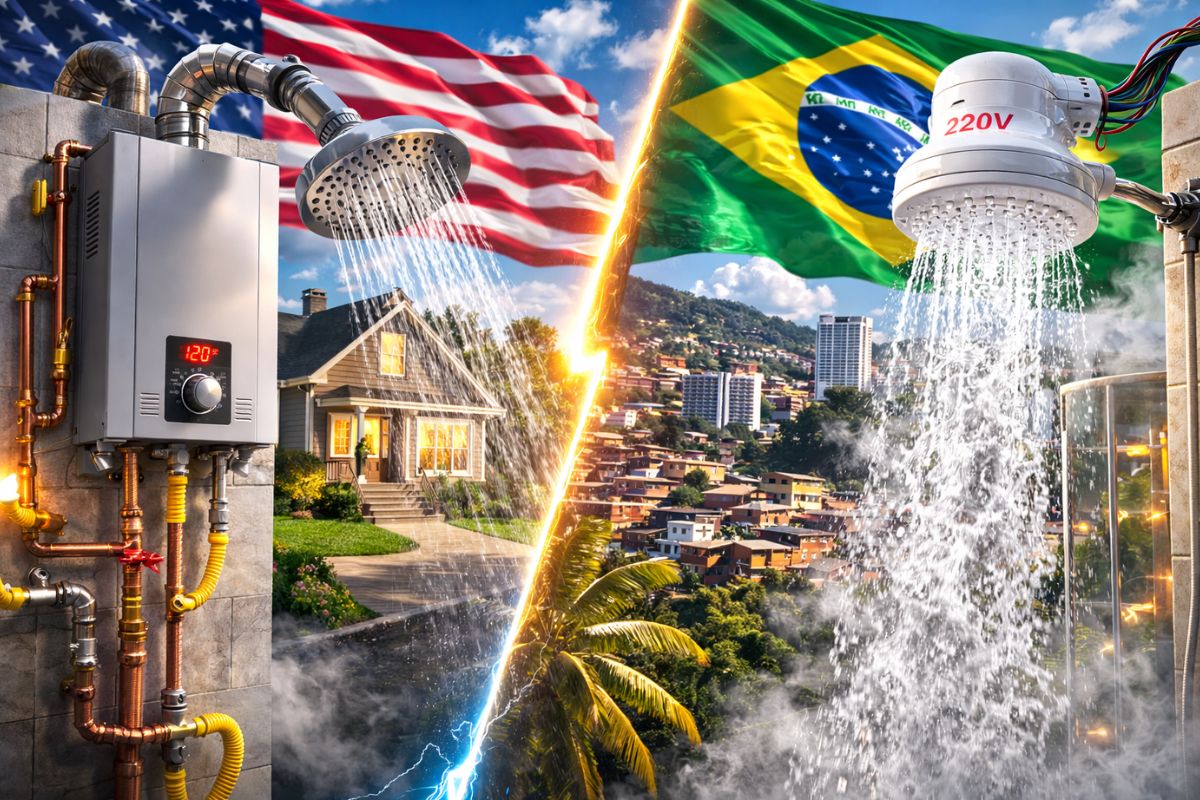
While The Electric Shower Dominates Hot Bathing In Brazil, The United States Prefers Gas And Discusses The Ground Wire In The Shower, Creating Very Different Bathing Cultures.
In the United States, the electric shower is virtually nonexistent in bathrooms. There, hot water comes from gas or storage heaters, with metal piping and systems designed to keep electrical energy far away from the shower, which feeds the fear of shock and the reputation of our equipment as a supposed “shower of death”.
In Brazil, the story took a different path. A Brazilian inventor created the electric shower with built-in resistance, legislation allowed its popularization, and the result was cheap hot bathing in almost any home, even in places without gas. This led Brazilians to take an average of 14 showers a week, double the American average of 7 showers, and transformed hot bathing into part of the daily routine.
From Roman Baths To Gas: How The World Heated Water
Long before anyone heard of the electric shower, hot bathing was a privilege. It started in Roman baths, luxurious collective spaces reserved for the wealthy, with water heated by furnace systems.
-
Residents of Australia woke up to a sky completely red like blood before the arrival of Cyclone Narelle, which hit the coast with winds of 250 km/h, tearing off roofs and lifting iron dust in a scene they described as apocalyptic.

-
New 100% clean fuel produced in Brazil could retire diesel.
-
Plastered walls become a trend and end up being the perfect choice for finishing; the secret of the 2 coats that prevent waste in painting.
-
With 333 meters and equivalent to a 20-story building: China launches a supertanker that transports 2 million barrels, has 540,000 m² of area, and saves $5 million per year.


Through the centuries, those with money continued to enjoy bathtubs and barrels, while servants carried buckets of hot water to the owners’ rooms.
Everything changes when gas is distributed through pipes to homes. Gas made from coal, known as “lighting gas”, allowed for the creation of flow and storage heaters to heat water and environments continuously.
First, radiators and heaters appeared that passed gas flames through coils. Later, storage heaters emerged, similar to current boilers, which stored a volume of already heated water.
In rural areas, far from gas piping, the solution was different. Families managed with wood stoves and copper coils, allowing water to circulate through pipes wrapped around the chimney to gain temperature.
It was a labor-intensive hot shower, dependent on firewood and manual labor, still far from the practicality of turning on a faucet and having hot water instantly, as is done today with an electric shower.
Metal, Electricity And The Fear Of Shock In The USA
When piped gas and water reach American and European homes, the construction industry is in the steel and cast iron era.
The internal piping is entirely metal, with pipes, connections, and valves made of materials highly conductive to electricity. In such a scenario, any contact between electrical wiring and metal piping creates a real risk of shock.
Therefore, building codes in the United States and much of Europe evolved with a simple principle: keep electrical energy and water as separated as possible, especially within the bathroom.
The solution that becomes consolidated is the gas flow or storage heater, with two piping systems: one cold water line and one hot water line, both reaching the shower mixer.
In practice, the American turns on the mixer, combines hot water coming from the boiler with cold water, and takes a shower without any electrical resistance inside the shower.
The result is an installation standard where the heating equipment is kept away from the user, and any idea of placing an electric shower inside the stall raises suspicion and fear of shock.
The First Concept Of Shower And The Blind Resistance
Before Brazil embraced the electric shower, Europe was already flirting with the concept of shower bathing. In the early 1800s, simple, almost improvised devices emerged: basically a kind of perforated pot that water was poured over for a quick wash. Water still needed to be heated outside the equipment.
The next leap comes with the use of blind resistances. These are heating elements where the electrical part does not come into contact with water, as it is protected within an insulating shell, but thermally conductive, often filled with materials like magnesium oxide.
These devices met European standards, but with lower power, delivering more lukewarm water than a hot high-flow shower.
Even with this technical advancement, in countries that already had piped gas and metal piping, the logic of heating water away from the user prevails.
Thus, the electric shower doesn’t gain the prominence it later achieved in Brazil, precisely because the construction system and safety culture push the solution towards boilers, tanks, and external heaters.
The Brazilian Who Created The Electric Shower As We Know It
It is in Brazil that the story of the electric shower gains a decisive chapter. In the 1930s, a Brazilian inventor, Francisco Canhos, in the interior of São Paulo, conceived the electric shower with built-in resistance that became popular throughout the country.
The idea is simple and brilliant: cold water passes through the shower body, where an electric resistance heats the water instantly, without needing to mix hot and cold water from separate pipes.
This solution only becomes viable because Brazilian legislation was more flexible in allowing the use of electric showers directly at the point of consumption.
As a result, any house with water and electricity supply could have hot showers, even without piped gas or sophisticated installations.
The electric shower democratized cheap hot bathing, reducing installation costs and allowing virtually any family access to this comfort.
Brazilian companies bought patents, refined designs, and created models with different power levels and temperature ranges.
Showerheads with multiple positions emerged, popularly nicknamed and incorporated into daily life. What was an engineering curiosity transformed into a mass product.
Shock, Ground Wire And The Real Safety Of The Electric Shower
With the electric shower spread throughout the country, the fear of shock was born. The nickname “killer shower” circulates jokingly, and many Americans view the equipment with distrust.
At the same time, Brazilians recall small shocks when turning on the faucet or touching the shower with a wet body.
The difference lies in the installation. Severe shock cases with electric showers are rare, and when investigated, they are usually linked to installation errors, such as wiring in contact with metal piping or lack of a ground wire.
If a stripped wire touches a metal pipe or a metallic valve, the user may receive a shock when handling the equipment.
On the other hand, when everything is set up correctly, the risk decreases significantly. The ground wire, connected to the electric shower, creates a preferred path for current in case of a failure.
If there is an internal problem, electricity tends to follow the ground wire, not the water or the person’s body. Pure water, by itself, is not a good conductor.
Pure water virtually does not conduct electricity. What conducts are the salts and minerals dissolved in treated water, which explains the light “shock” in imperfect installations, but not a strong discharge in a well-made system.
PVC, CPVC, PEX And The Evolution That Favored The Electric Shower
Another factor that increased the safety of the electric shower in Brazil was the change in piping materials.
Until the mid-20th century, metal pipes dominated installations, with cast iron and steel in nearly the entire internal water network. This required specialized labor, threads, welds, and made the system more expensive.
Starting in the 1950s, PVC came onto the scene. Plastic pipes, cheaper and easier to install, reduce the risk of an improperly placed wire finding a direct path through metal to the user.
With plastic piping, the chance of wiring failure turning the entire plumbing system into a conductive path diminishes.
In the United States, materials such as CPVC emerged, capable of withstanding temperatures around 85 to 90 degrees, and PEX systems, flexible hoses that resist temperatures close to 93 degrees.
These materials further facilitate the installation of central heating systems and make the combination of boiler and mixer the standard solution, instead of the electric shower in the stall.
Inside The Electric Shower: Resistance And Temperature Control
When opening a modern Brazilian electric shower, it is possible to understand why, despite the fear, it works in a relatively simple way.
Water enters through a chamber that needs to reach a certain pressure to activate the system. Inside is the resistance, wrapped in an insulating body that withstands high temperatures.
This resistance is divided into parts, which allows different heating levels according to the position selected on the temperature control.
When the water reaches the working pressure, an internal mechanism pushes metallic contacts that touch copper terminals, completing the electrical circuit.
Depending on the selected position, more or less of the resistance is activated, which increases or decreases the generated heat and, consequently, the water temperature.
In parallel, the ground wire is directly connected to an internal part that comes into contact with the water, to offer the easiest path for current in case of a failure.
This set of technical solutions shows that the electric shower is not an improvised device, but a product designed to operate safely within specific limits, provided that the correct installation and grounding conditions are respected.
Hot Bathing, Culture And The Difference Between Brazil And The USA
With the electric shower being cheap and accessible, hot bathing has become almost an acquired right in the Brazilian imagination.
Turning on the faucet and having hot water at the moment, without gas, boiler, or major renovations, became the standard even in simple houses.
This convenience helps explain why Brazilians take an average of 14 showers a week, practically two a day, while Americans have around one shower daily.
Hence the myth that Americans “don’t take showers”. In practice, they do, but at a different frequency and with a different cultural relationship with the shower.
Work routine, climate, and housing standards influence the habit. In Brazil, heat, humidity, and the very availability of electric showers in practically every home make hot bathing a ritual repeated several times a day by many people.
The nickname “shower of death” that some foreigners use to refer to our equipment ignores this context.
With proper installation, ground wire, and appropriate piping, the electric shower proves to be an efficient, safe, and, above all, democratic solution to ensure thermal comfort in bathing.
And you, knowing this whole story, would you have the courage to defend the Brazilian electric shower, or do you still think it is indeed a “shower of death”?






-

-

-

-

-

31 pessoas reagiram a isso.