





 Portuguese
  English
  Spanish
  6 min of reading
  0 comments


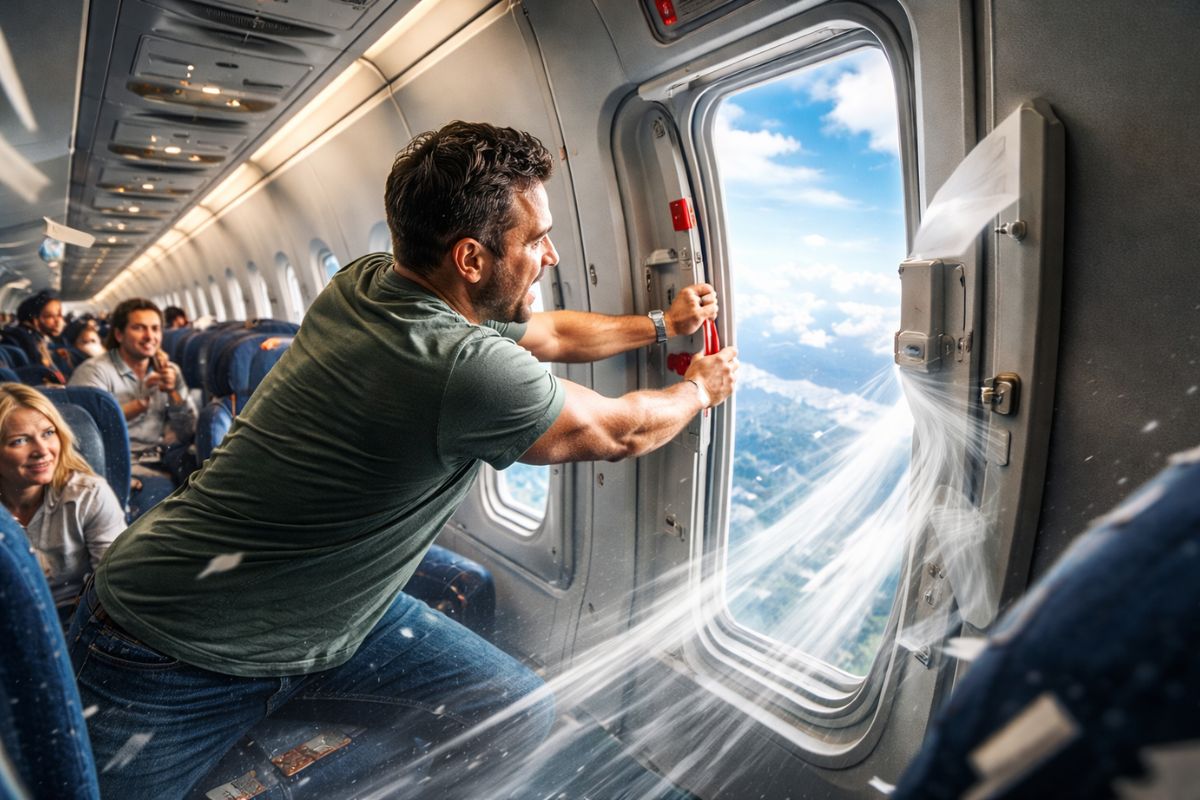
The Commercial Airplane Keeps The Door Locked By The Internal Pressure Of The Aircraft, Preventing Opening During Flight.
The explanation lies not just in reinforced locks or some hidden secret in the aircraft’s system. What prevents the door of an airplane from being opened during flight is, above all, the combination of pressure difference, structural design of the door, and safety mechanisms working together. Once this logic is understood, fear loses strength and gives way to a technical understanding of what really happens.
What Prevents The Door Of An Airplane From Opening Mid-Flight

The most straightforward answer is simple: no one can open the door of a pressurized commercial airplane at cruising altitude. And this happens because of physics.
-
The coldest seawater ever recorded in Earth’s history was hidden under extreme ice 717 million years ago and reached an impressive -15°C.

-
China has launched the world’s first floating artificial island, a scientific structure designed to face open seas, test equipment weighing hundreds of tons, and reach depths of 10,000 meters.
-
China accelerates global science and may surpass the United States in 2 years with increased public investment, continuous growth, and direct impact on the global technological competition.

-
Scientific studies indicate that drought may be strengthening a much greater silent threat: more resistant superbugs.


When the airplane flies at high altitude, the air outside is too thin for normal human respiration. Therefore, the cabin is pressurized to maintain a much safer internal condition for passengers and crew.
This difference between internal and external pressure creates a tremendous force pushing the door against the structure of the aircraft.
In practice, the door is compressed against the frame. The greater the pressure difference, the more firmly it stays closed.
This means that, before opening outward, it would need to be pulled inward against a gigantic force. It is precisely at this point that opening becomes physically unfeasible for anyone.
The Force Of Pressure Turns The Door Into An Almost Impossible Barrier To Move
The comparison used in the explanation helps to understand the phenomenon well. Trying to open a door of an airplane at pressurized altitude is like trying to push against a force that is pushing back at full intensity towards you.
In the cited example, a commercial airplane door measuring about 1.80 meters high by 1.10 meters wide can have thousands of square inches of surface area.
With the pressure difference acting over this area, the internal thrust can reach a level equivalent to almost 13 tons of force. In other words, it’s like having an immense weight pressing that door inwards all the time.
That’s why it’s not about courage, momentum, or physical strength from a passenger. It’s about an objective limitation imposed by the very operation of the airplane.
The internal pressure seals the door with a level of resistance that no standard human action can overcome at cruise flight.
The Design Of The Airplane Door Also Helps Lock The Structure
In addition to pressure, there is another decisive point: the way the door is constructed. In most modern commercial aircraft, the door operates on a system known as plug door. This means it is designed to move inward first and only then outward.
This engineering detail makes all the difference. As the cabin pressure pushes the door against the fuselage, the design of the system harnesses physics in favor of safety. The greater the internal pressure, the more the door is fitted and sealed.
The comparison with a pressure cooker helps visualize this mechanism. The lid stays so secure because the internal pressure pushes it against the opening.
With the airplane door, the logic is similar. The structure is designed so that pressurization increases sealing instead of weakening it.
Electric Locks Add Another Layer Of Protection


Physics is the central factor, but it doesn’t act alone. The system also includes electric locks that engage automatically when the airplane reaches takeoff speed.
According to the explanation provided, these locks start to operate when the aircraft surpasses certain operational parameters and can only be deactivated under specific conditions.
This shows that safety does not rely on a single resource. There is redundancy in design, something essential in aviation.
The door structure, the pressure difference, and the automatic mechanisms form a system designed specifically to prevent unauthorized openings during flight.
That’s why, when news comes out about someone trying to tamper with an airplane door, it is most common for the person to simply pull the lever, try to force the mechanism, and be stopped before achieving any real effect on the structure.
The 2023 Case Only Happened Because The Airplane Was At Low Altitude

The 2023 episode mentioned in the database often causes confusion precisely because, at first glance, it seems to contradict all this.
A passenger managed to open an emergency door on an Airbus A321 just before landing when the flight was approaching the ground.
But the key to understanding the case lies in the altitude. The airplane was about 200 meters from the ground, already in the final minutes of approach.
In this condition, the pressure difference between the cabin interior and the outside was very small. The cabin was practically equalized with the external environment.
This information changes everything. Without the significant pressure difference that exists at cruising altitude, the force that kept the door sealed almost disappears. Added to this is the fact that the emergency exit over the wing is smaller and lighter than the main doors.
It was this combination that allowed the door to open at that specific moment, rather than a failure in the aircraft’s safety logic during pressurized flight.
The 1971 Case Involved Another Type Of Airplane And Another Cabin Condition
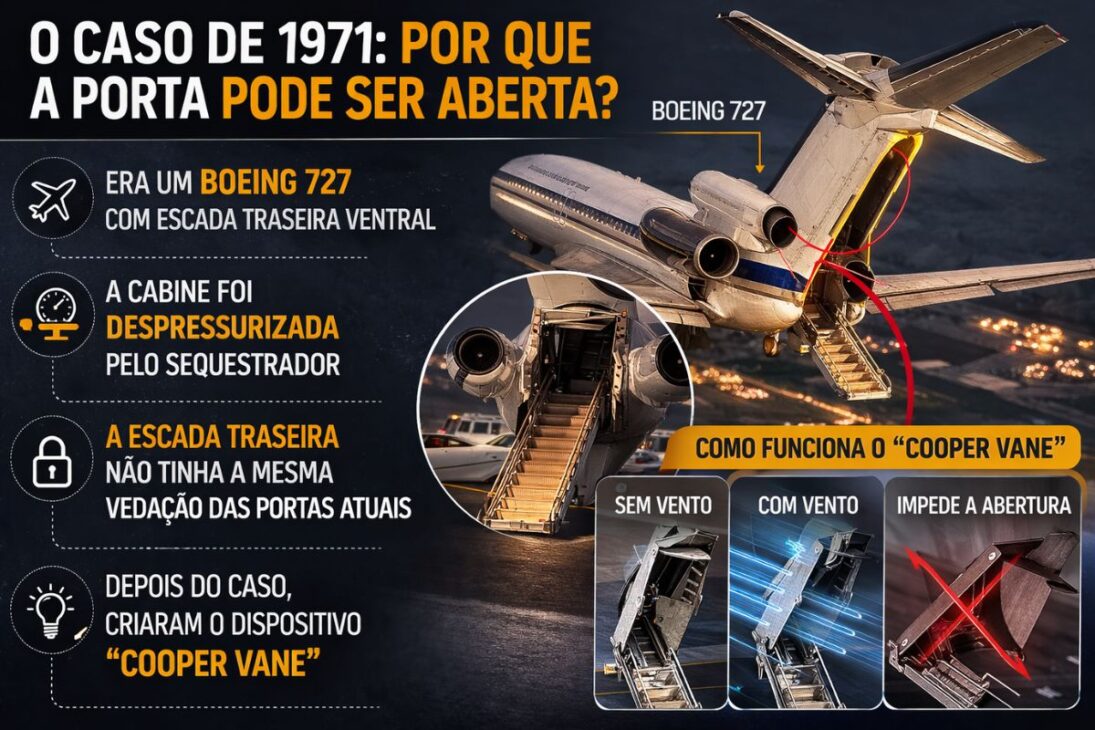
The story of Dan Cooper in 1971 is also frequently recalled when discussing door openings in flight. However, technically, the situation was very different.
The case occurred on a Boeing 727, a model that had a rear ventral stairway positioned behind the engines. Additionally, the cabin was depressurized at the hijacker’s demand.
This means that the operational scenario did not have the same sealing condition as a commercial airplane pressurized at normal cruising altitude.
Another important point is that the specific opening did not operate in the same way as modern doors locked by internal pressure.
After the incident, a device known as a Cooper vane was adopted, a mechanism that uses relative wind to prevent the rear stairway from opening in flight.
This solution shows how aeronautical engineering directly responded to the vulnerability identified at that time.
The Case Of The 737 Max Was Not A Door Opening By A Passenger
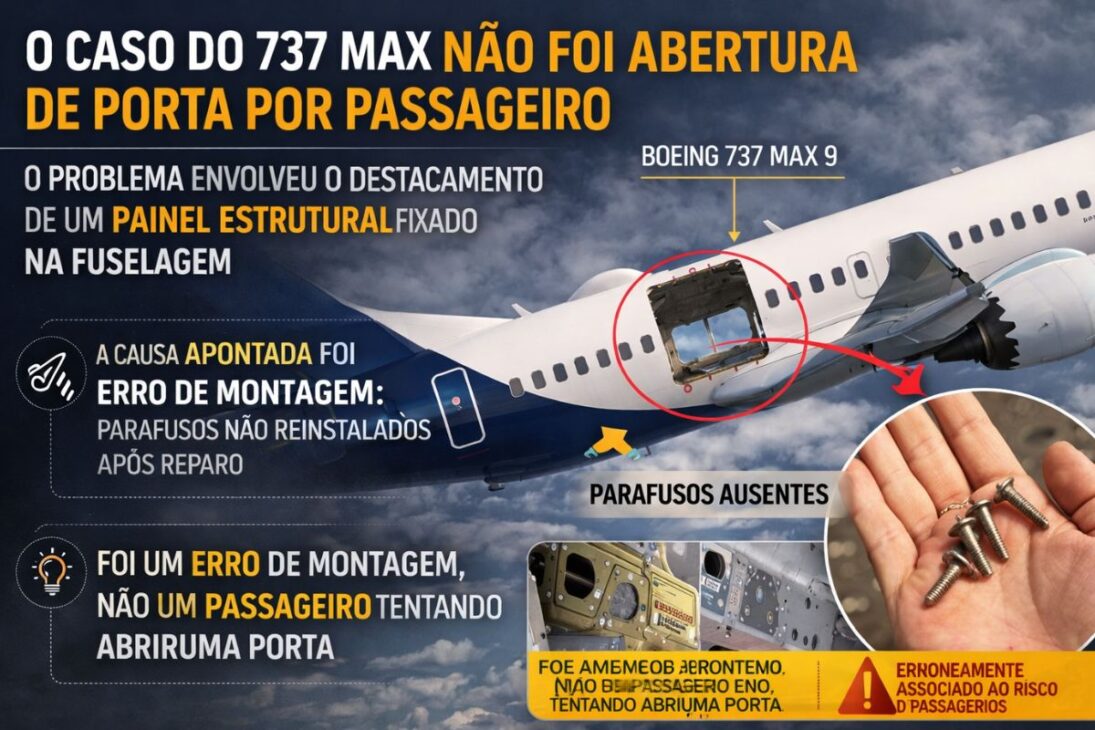
It is also important to separate a third episode that often comes up in this conversation. In the case of the Boeing 737 Max 9 mentioned in the database, what was dislodged in flight was not a door operated by a passenger, but a structural panel attached to the fuselage.
According to the provided explanation, the investigation concluded that there was an assembly error related to screws that were not reinstalled after a repair.
In other words, it was not about someone opening the door of the airplane during flight, but a manufacturing and assembly structural issue.
This distinction is important because often different news gets mixed up with the same perception of risk.
When this happens, it creates the feeling that any airplane door can be opened at altitude by human action, which does not correspond to the normal functioning of the aircraft.
The Airplane Door Is Practically One Of The Safest Parts Of The Structure At Altitude
After understanding the real cases and the differences between them, the conclusion becomes clearer. At altitude, with a pressurized cabin, the airplane door is one of the safest parts of the entire structure. It is not just closed. It is sealed by the very nature of operation.
This does not eliminate the need for protocols, crew vigilance, and redundant systems. But it helps put fear into perspective.
The idea that an ordinary passenger can simply stand up and open the door during cruise flight belongs much more to popular imagination than to the technical reality of aviation.
When incidents arise involving doors, emergency exits, or structural panels, it is important to carefully observe the context.
Altitude, pressurization, type of opening, and configuration of the airplane completely change the interpretation of the fact. Without this context, fear grows. With it, the explanation appears.
Have you ever been afraid of being on an airplane and hearing news like this, or does understanding the physics behind the door make the journey more peaceful?







Seja o primeiro a reagir!