





 Portuguese
  English
  Spanish
  6 min of reading
  2 comments


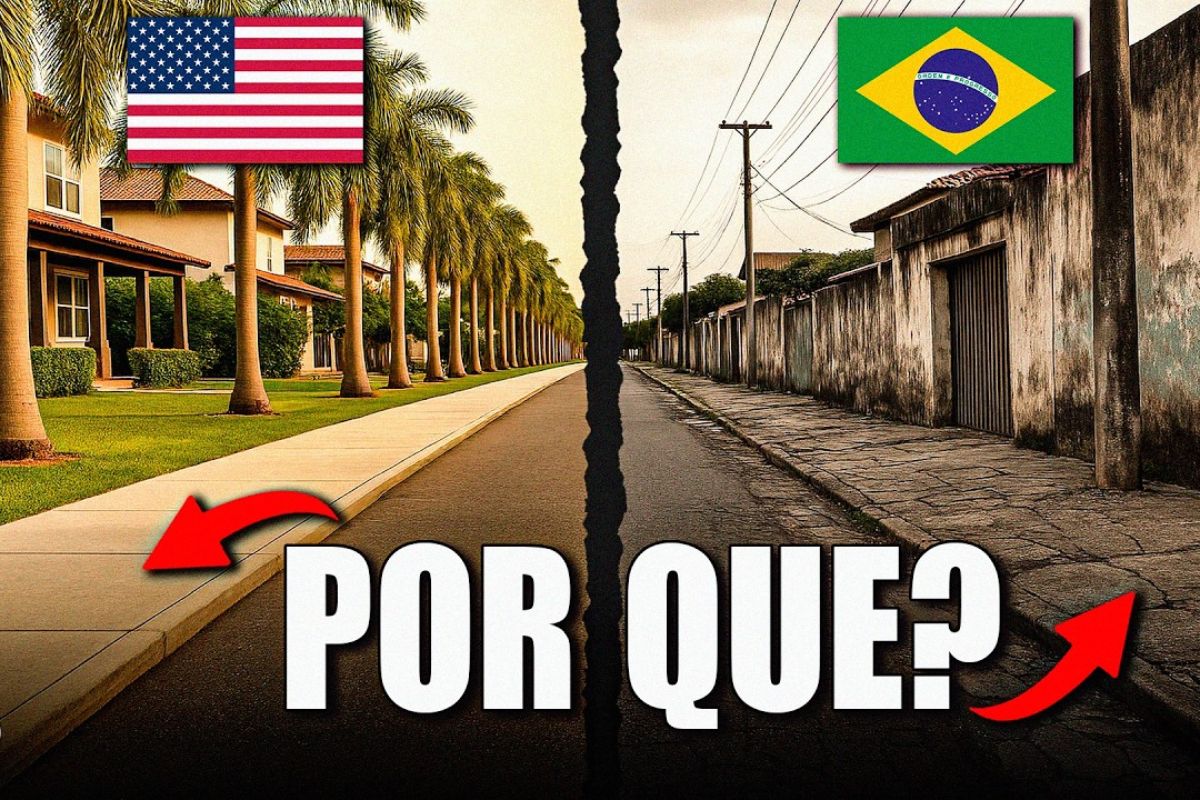


Even With Technical Knowledge, Standards, and Qualified Professionals, Sidewalks in Brazil Still Appear Crooked, Broken, Full of Unevenness, and Without Accessibility Standards Because the Construction Model is Fragmented, Oversight is Limited, and Urban Planning Continues to Prioritize Cars Over Pedestrians.
Sidewalks are the most used public space in the country, but they continue to be treated as an addition to the street rather than as essential urban infrastructure, which keeps Brazil behind European and North American cities that integrate sidewalks into the city design and plan for their durability for decades.
Sidewalks in Brazil should be the first link in daily mobility, as they are where pedestrian journeys begin, access to public transport is granted, and circulation for those with reduced mobility occurs. Even so, in 2025, makeshift floors, garage ramps occupying entire pedestrian lanes, scattered obstacles, and lack of continuity between one house and another still predominate. This does not happen for lack of knowledge. The country has standards, engineers, architects, and clear international references on how to create a flat, wide, drainable, and accessible sidewalk.
The persistence of this scenario is linked to historical choices. Instead of treating the sidewalk as an integral public good, many Brazilian cities delegated the responsibility of building and maintaining the sidewalk to the resident. The result is what is seen in the blocks: each lot uses a different material, a different slope, and a different width, creating an unsafe, uninviting, and exclusionary path for the elderly, wheelchair users, mothers with strollers, and delivery people.
-
How 5,000 Indian dabbawalas manage to deliver around 200,000 lunchboxes a day in Mumbai for over 130 years using bicycles, crowded trains, and a manual system that continues to operate with impressive accuracy.

-
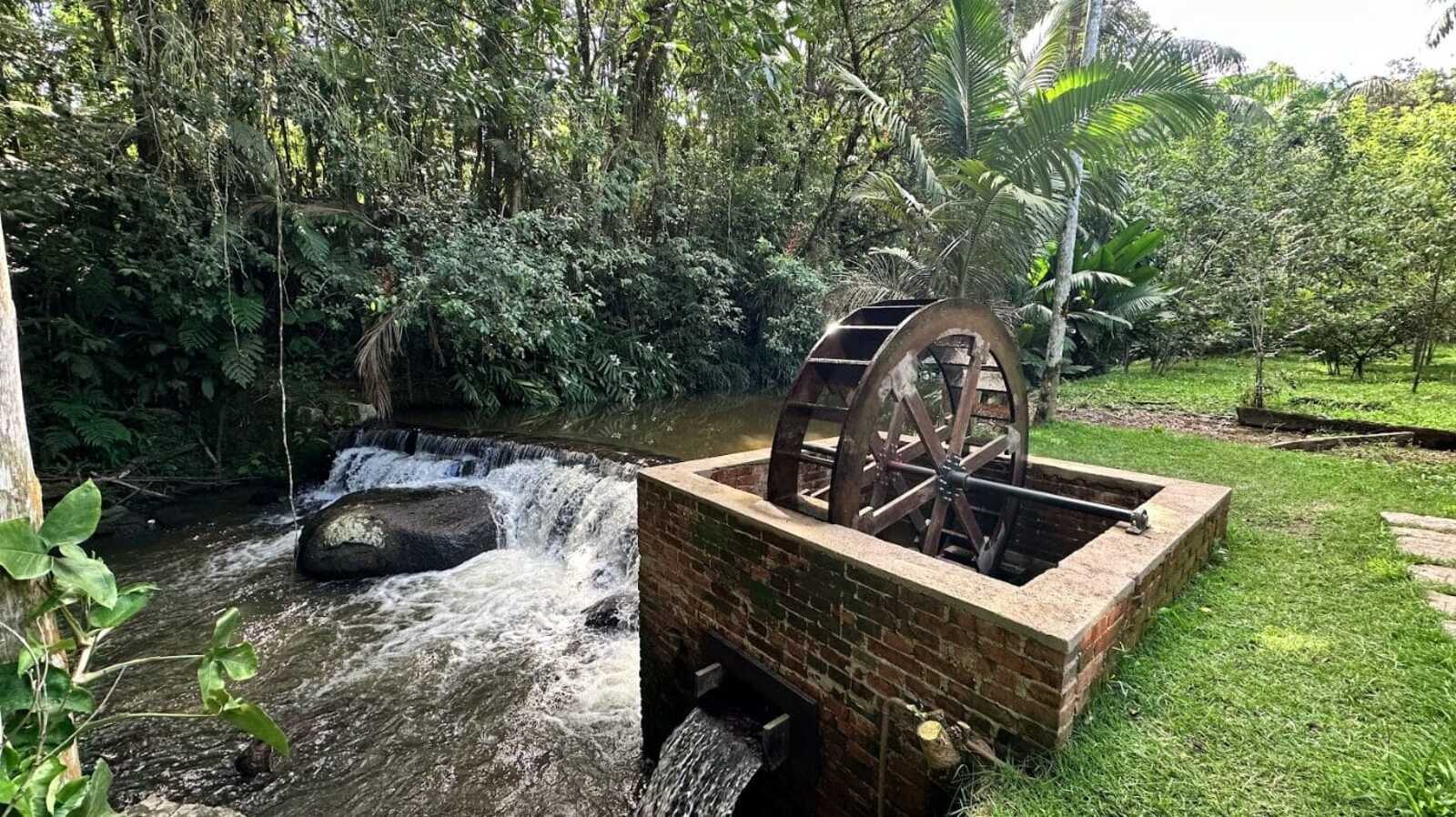
While restoring a historic mansion from 1910, a brick structure with an old turbine that generated energy from the Rio do Testo emerged, along with a hidden door and a rare floor concealed under layers of wax.
-
Italian researchers have detected what appears to be a second Sphinx buried under the sands of Egypt, and satellite scans reveal a gigantic underground megastructure hidden beneath the Giza Plateau for over 3,000 years.

-
There are 4,223 drums and 1,343 metal boxes concreted with 50-centimeter walls that store the radioactive waste from Cesium-137 in the worst radiological accident in Brazil, just 23 kilometers from Goiânia, with environmental monitoring every three months.

The Paradox of Brazilian Sidewalks
Brazil knows how to make good sidewalks.
There are technical references and professionals capable of designing sidewalks with the same quality as the engineered concrete sidewalks seen in Canada and parts of the United States.
Even so, urban practice does not align with the available knowledge.
This creates a paradox: the city knows the ideal standard but applies the possible standard.
This mismatch arises from a legal and administrative model that considers the public sidewalk in use but private in responsibility.
The street belongs to the municipality, but the sidewalk in front of the property belongs to the resident.
When each owner decides individually, what emerges is a broken pedestrian network, lacking continuity and quality control. A good sidewalk is useless if the next one is broken.
How Other Regions Treat Sidewalks
Unlike the Brazilian makeshift approach, many European cities designed their sidewalks as part of the city project.
There, walking is not an effort; it is a habit. Narrow streets, wide sidewalks, trees, benches, and direct connections to squares, cafes, and public transport create a continuous pedestrian circulation system.
In Vienna, Amsterdam, Barcelona, or even in historical areas of Lisbon and Florence, cars play a supporting role while pedestrians are the protagonists.
In Canada and parts of the United States where technical design is taken seriously, the common standard is concrete set on prepared soil, with a lifespan exceeding 30 or 40 years and even marked with the execution date.
This shows that when the public authority adopts standards, oversight, and maintenance, the sidewalk stops being an irregular piece of flooring and becomes planned infrastructure.
The Brazilian Model and Its Effects
In Brazil, urbanization has been accelerated and unequal. Cities grew before establishing a standardized network of sidewalks.
Public transportation lost space to cars, streets became wide, sidewalks narrow, and pedestrians were pushed to the edges of the street.
In this context, the sidewalk began to be treated as a detail of the lot, rather than as part of the mobility system.
This logic generates concrete effects. In the same block, it is possible to find smooth cement, then brittle ceramic tile, followed by loose stones, and then an inclined ramp invading the entire width of the sidewalk.
For those with reduced mobility, each change in standard becomes a barrier.
For the public authority, this creates a challenging scenario to oversee because there is no single responsible party nor a single construction model.
Walkability, Health, and Inclusion
The precariousness of Brazilian sidewalks is not just an urban aesthetic problem. It is a public health and inclusion issue.
National studies have shown that walking trips represent a very significant share of daily trips in Brazilian cities, accounting for between 36% and 50% of movements.
Even so, the infrastructure that should support this volume of people is weak and unsafe.
Urban mobility surveys have rated sidewalks in dozens of cities low, averaging around 3.4 on a scale that should reach 8 to be considered acceptable.
This means that most evaluated sections do not offer a regular surface, do not guarantee accessibility, and do not provide continuity.
The consequence appears in hospitals, with falls among the elderly, accidents involving people with reduced mobility, and the abandonment of walking trips due to fear or difficulty.
In addition to visible physical problems, there are invisible factors that drive pedestrians away from the streets, such as lack of lighting, pollution, noise, and absence of connected routes.
When the sidewalk does not invite, the city loses vitality, street commerce loses traffic, and people stay home more.
Why Do We Continue Like This in 2025?
If knowledge exists and international references are clear, why does Brazil still insist on crooked, broken, and dangerous sidewalks in 2025? Part of the answer lies in priorities.
When urban management looks first to the car, the pedestrian becomes a detail.
Another part lies in the fragmentation of responsibility, which prevents integrated solutions by neighborhood or mobility corridor.
There is also a political and budgetary component.
A good sidewalk is a piece of work that hardly shows up but requires planning, standards, and ongoing maintenance. Lighting, paving, and major roads tend to be more visible.
The result is that the sidewalk remains second-class infrastructure, even though it is the most used by the population.
What Needs to Change
A viable path is to treat the sidewalk as integral public infrastructure, with a single standard defined by the municipality and coordinated execution.
The public authority can directly take over the sections of highest circulation, near schools, hospitals, terminals, and central areas, and establish strict rules for the other sections.
Another possibility is a shared model with effective oversight. The city hall defines materials, minimum width, slope, curb lowering, free space, and deadlines.
The resident executes within the standard. If not executed, the municipality does it and charges.
Municipalities can also replace the punishment logic with incentives, offering discounts on local taxes for those who maintain the sidewalk properly or organizing community efforts with technical support.
It is also necessary to update the urban design culture.
Sidewalks are not leftover works; they are the beginning of a city. They should be considered alongside drainage, landscaping, accessibility, and transport. Where the sidewalk is good, the city is good.
The state of Brazilian sidewalks is not a result of ignorance but of choices.
By 2025, Brazil already has the technical foundation, mobility laws, and sufficient national and international examples to make a leap in quality.
It lacks transforming sidewalks into a true priority and acknowledging that continuous, accessible, and well-supervised sidewalks are public policy as important as paving or lighting.


Have you ever experienced a risky situation, a fall, or difficulty because of a bad sidewalk in your city? Share in the comments how the sidewalk on your street is and what you think the city hall should do first.








Essa matéria não falo sobre o básico, o essencial, que é a norma NBR9050 que define padrões para calçadas e já é exigida em muitas cidades. Não sai o “HABITE-SE” se a calçada do imóvel não estiver conforme a norma.
Sempre observei isso e o poder público não tem a menor preocupação com segurança, bem estar, estética, etc, às vezes é o primeiro a destruir o que está feito.