






 Portuguese
  Spanish
  3 min of reading
  0 comments



Even If Outdated, Checks Continue to Play a Relevant Role in Certain Situations, Proving That, Despite Technological Evolutions, the Transition to Digital Does Not Happen Uniformly for the Entire Population.
Amid the growing digitalization of payment methods in Brazil, the use of checks has drastically decreased in recent years, but it still remains alive in specific niches of the economy.
With only 0.5% representation among the country’s financial transactions, this payment method, although increasingly rare, continues to be a valid and legal option, especially in places where there is resistance to digital technologies or lack of connectivity.
The Historical Trajectory of This Payment Method in the World and in Brazil
Although it seems obsolete today, the check has a long and rich history.
-
A collective political will that allows for the creation of a cross-party and state agenda, focusing on concrete actions such as reducing the Custo Brasil; commitment to fiscal balance; feasible goals that enhance professional qualification and the adoption of a myriad of incentives aimed at innovation.

-
PIX from BRICS becomes reality: BRICS Pay advances to enable international payments without the dollar; system inspired by Pix and based on blockchain could move up to 20% of global trade by 2030, while bloc countries already account for 40% of the world economy.

-
After a motorcycle accident at 17, a Bahian agronomist borrowed R$ 40 from his mother, transformed a homemade granola recipe into Tia Sônia, and reached R$ 120 million, targeting São Paulo with 300 tons monthly and 80 products.

-
The CNPJ made up only of numbers is numbered in Brazil, and the Federal Revenue has already set the changeover for July 2026: the new model will mix letters and numbers to avoid exhausting combinations and also prepare the ground for tax reform taxes.


Records of rudimentary methods similar to checks date back to 350 B.C., in Ancient Rome, and reappear in documents from the 11th century.
However, it was in England, in 1660, that the modern format gained popularity, with the issuance of the first check by the country’s official bank.
In Brazil, checks arrived in 1845, with a note issued by the Banco Comercial da Bahia. Official regulation came five years later, and the method spread rapidly.
For decades, it was one of the most common forms of payment among Brazilians, especially because it allowed high-value transactions with security and physical record.
How Does Check Payment Work?
The check is a physical document, manually filled out and signed by the account holder.
It serves as an order for immediate payment, which can be cashed by the recipient directly at the bank. There are different types:
Nominal, with the name of the payee;
Crossed, which can only be deposited into an account;
Administrative, issued by the bank;
Bearer, valid for whoever presents it;
Post-dated, with a future date for compensation.
The compensation usually takes up to one business day, and the deadline for presentation to the bank is 30 days (same place) or 60 days (different place).
Essential Details of a Check
In addition to the signature, a valid check must contain:
- Full name and CPF/CNPJ of the holder;
- Account number, agency, and check number;
- Date of issuance;
- Value written out and in numbers;
- Name of the payee (if nominal).
Checks are issued in books, which must be requested from the bank and may have an additional cost.
Why Are Checks Still Used?
Despite the decline of over 96% in use since 1995, checks are still in circulation — with 137.6 million units used just in 2024, according to Febraban (Brazilian Federation of Banks).
Several reasons explain their persistence:
Technological resistance on the part of users and businesses;
Lack of internet access in remote areas;
Use as collateral (security) in contracts and negotiations;
Preference by older or more traditional individuals.
Interestingly, giant checks — symbolic — are still used in awards, although the actual value is transferred via deposit or Pix.
Security and Future of Checks
Although still accepted, checks are considered less secure than digital means.
This is because their validation depends solely on the signature, while digital transactions feature multiple layers of protection, such as two-factor authentication, tracking, and preventive locks.
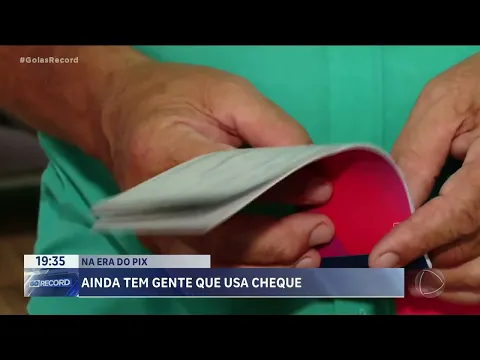

The digitalization of banks also contributes to the decline of checks. Some institutions even avoid offering checkbooks automatically, requiring direct customer requests.
With information from TecMundo




Be the first to react!