





 Portuguese
  English
  Spanish
  4 min of reading
  0 comments


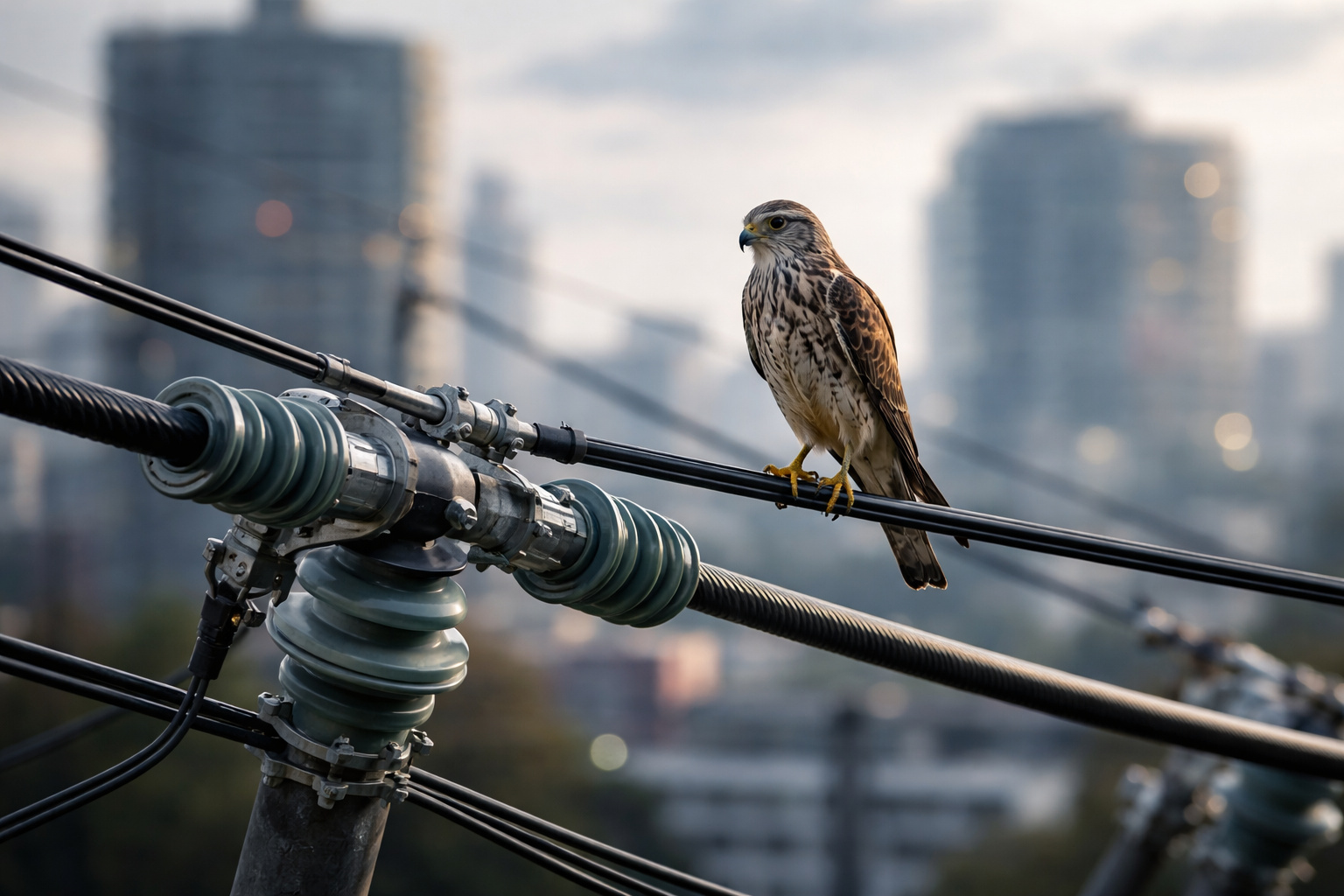
Even When Exposed to Alternating Current, Voltage Variations, and High-Voltage Networks, Birds Survive Thanks to Physical Principles Little Explained in Traditional Classes
It is a common scene in cities around the world: birds quietly perch on power lines carrying thousands of volts, as if they were completely immune to danger. At first glance, the explanation seems simple and is often taught in school. However, when physics goes into detail, the phenomenon proves to be more complex — and even counterintuitive.
This information was released by BBC Science Focus in an article that dismantles the simplified explanation taught in physics classes and presents the real factors preventing these birds from getting electrocuted. According to the analysis, birds do not escape shock because there is no current, but because the current that exists is too small to cause harm.
The Classic Explanation That Doesn’t Tell the Whole Story
Traditionally, it is taught that birds do not get shocked because both feet are on the same wire, which means there is no potential difference between them. Without this difference, there is no force capable of pushing electrons through the bird’s body. Thus, electricity continues to flow through the wire, which offers less resistance than the animal’s body.
-
Iceland accidentally drilled into a magma pocket at 2,100 meters and revealed that the extreme heat beneath the crust could pave the way for a new source of continuous energy.

-
Discovery of a 15-kilometer labyrinth beneath the buildings of Rome raises alarm for collapses and reveals the largest underground network ever found in the Italian capital.

-
A rare storm phenomenon in the United States alerts meteorologists worldwide due to four different forms of water falling from the sky, which freeze immediately upon touching the ground, poles, cars, or trees.

-
He has been using a wheelchair for almost 10 years, lives alone, is independent, and decided to become a delivery driver for an app: Samuel makes up to 6 deliveries a day, covering routes of 1 km in his wheelchair and has even managed to do 2.5 km in a single run.


This explanation is correct — but only in steady-state systems, where voltage does not vary over time. The problem is that power lines do not work this way. Unlike batteries, transmission and distribution wires carry alternating current (AC), in which the direction of the current constantly changes.
It’s enough to remember a common situation to see the flaw in the classic argument: a person can get shocked by touching a parked car, even if the vehicle is isolated from the ground and there is no closed circuit. This happens because voltage variation is enough to generate a momentary current through the body.
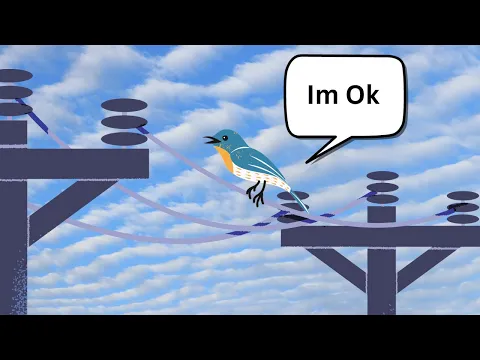

Alternating Current, Capacitance, and Microcurrents in Birds’ Bodies
Power networks use alternating current, where voltage oscillates between positive and negative values. In the United Kingdom, for example, the frequency of these oscillations is 50 hertz (50 Hz), which means 50 cycles per second. In each cycle, the voltage changes direction, charging and discharging everything connected to the wire — including a bird perched on it.
This means that, contrary to what many believe, there is indeed electric current passing through the bird’s body. The reason it does not suffer shock is related to another fundamental concept of physics: capacitance.
Capacitance is the ability of a body to store electrical charge. Birds are small and have a shape close to a sphere, which drastically limits this capacity. As a result, even on a 50 Hz wire, the current passing through the bird’s body is in the order of microamperes (μA) — around 0.00000001 amperes.
By way of comparison, in humans:
- 10 milliamperes (0.01 amp) are already sufficient to cause a painful shock;
- Electrocution can occur from about 50 milliamperes.
In other words, although there is electric current passing through the bird’s body, it is millions of times smaller than what is needed to cause any physiological harm.
High-Voltage Networks and When the Risk Becomes Real
The scenario changes dramatically when we talk about high-voltage transmission lines. These networks operate with values much higher than urban distribution, ranging from 275 kV to 400 kV in the UK, and can reach 800 kV in some regions of the world.
At such high voltages, the electric field around the wire becomes intense enough to ionize the air, creating a voltage gradient that increases as the proximity to the cable increases. This effect is easily observed when technicians approach these lines with conductive rods, and sparks appear even before physical contact.
Under these conditions, a bird can sense the presence of electricity before landing and, in many cases, avoids the wire. However, if it is flying at high speed or cannot divert in time, the electric gradient may be sufficient to generate an intense current through its body, leading to electrocution or a shock strong enough to cause the bird to fall and die.
Another risk occurs when the bird touches two wires with different voltages or comes into simultaneous contact with an energized wire and a grounded structure, such as poles or towers. In these cases, a short circuit is created, and the potential difference generates a lethal current.
The most vulnerable birds are large, fast-flying species, such as birds of prey, owls, pelicans, flamingos, storks, swans, and geese. There are even reports of forest fires started after birds collided with high-voltage lines and caught fire.
For this reason, conservation organizations and energy companies worldwide are developing preventive measures, such as spacers, insulators, and visual signaling, to reduce the impact of power lines on wildlife and the environment.








-

-

-

11 pessoas reagiram a isso.