





 Portuguese
  English
  Spanish
  9 min of reading
  0 comments


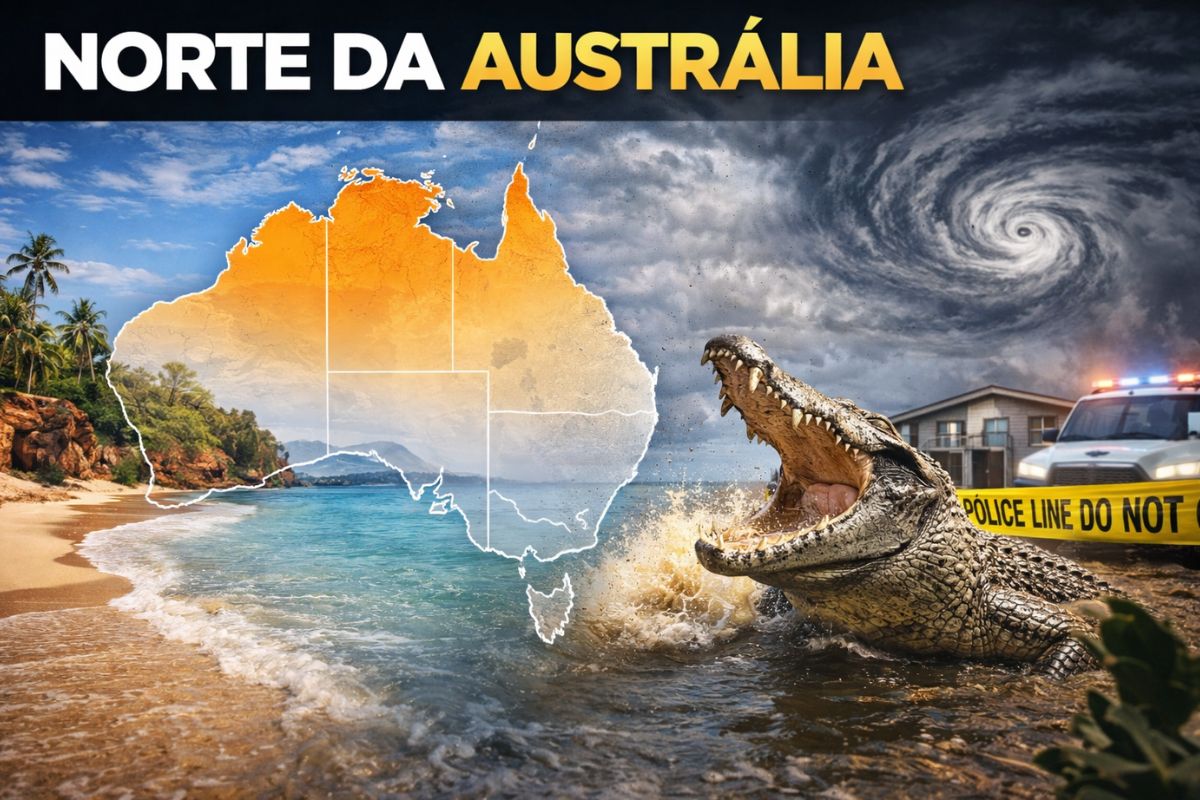
Understand Why Northern Australia, Beautiful in Photos, Is a Region Where Almost No One Lives, with Extreme Climate, Fragile Economy, Dangerous Wildlife, and Expensive Infrastructure.
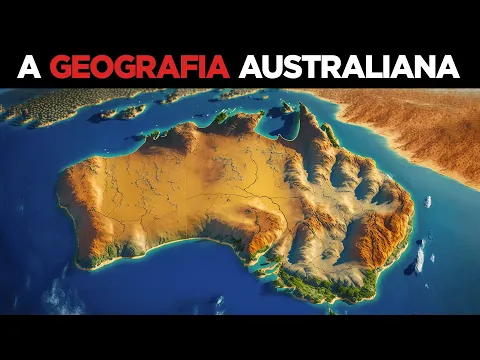
Visually, Northern Australia seems like an open invitation to live close to nature. Rivers, rugged coastlines, islands, dense vegetation, and a constant feeling of vastness. But behind the perfect images lies a territory that functions almost like a silent barrier to human presence. The history of colonization itself shows a succession of failed settlement attempts, one after the other.
From early on, it was clear that this piece of the map would be a place where almost no one lives for long without facing serious problems. Diseases, isolation, supply difficulties, natural disasters, and conflicts marked the early settlements. Over the years, even with some infrastructure and cities like Darwin, the region never became a natural destination for those looking to start a new life.
A Beautiful Place That Does Not Want Almost No One to Live There
From a distance, Northern Australia seems ideal for those dreaming of unspoiled nature. In practice, however, habitability is low.
-
Church from 1888 becomes a mansion of over 330 m² in Canada after a renovation of R$ 3.4 million and is eventually sold for nearly R$ 4.3 million.
-
How an innovative city combines high technology, well-being, and sustainability to become the largest reference in clean energy on the planet.
-
Couple buys 1846 church in ruins for R$ 660,000, invests R$ 3.2 million in renovations, transforms it into a millionaire mansion, and even preserved a historic cemetery with over 300 graves.
-
He started running at 66 years old, broke records at 82, and is now a subject of study for having a metabolic age comparable to that of a 20-year-old, in a case that is intriguing scientists and inspiring the world.


Since the Europeans landed on the continent, the north has functioned as a large graveyard of frustrated settlements.
Fort Dundas, Fort Wellington, Raffles Bay, Escape Cliffs, and other projects emerged, shined briefly, and vanished.
In almost all cases, the storyline was similar: settlers fell ill, died, ran out of supplies, encountered conflicts with local peoples, and struggled to move just a few kilometers away from camp.
The message was clear from the beginning: this would not be where the country would have a region full of towns and villages, but where almost no one lives peacefully.
Forts, Villages, and a History of Failed Attempts
In the first half of the 19th century, the British Empire viewed Northern Australia as a strategic point. The idea was to occupy, monitor, and transform it into a military and economic base. In practice, the attempts clashed with an extremely hostile environment.
Tropical diseases, scorching heat, transportation difficulties, irregular supply, and constant frictions with local tribes marked these projects. Many settlements left no visible ruins.
Before long, the region gained a reputation for being a place where almost no one lives for long, and where persistence means facing a series of problems that repeat from generation to generation.
Darwin, the City That Took a Beating from Cyclones and Wars
The first city that managed to establish itself somewhat was Darwin. Even so, it serves as a good example of how the north seems to resist human presence.
In 1974, on Christmas Eve, Cyclone Tracy hit Darwin with winds so strong that measuring instruments simply stopped recording accurately.
In a single night, most buildings were destroyed, dozens of people died, and thousands were left homeless.
After the tragedy, many evacuated residents never returned. The city, which was just beginning to grow, lost a significant portion of its population. And most importantly: the north did not escape the path of cyclones.
Anyone considering living there must accept that during any rainy season, nature itself may remind them who is in charge.
Adding to this is the fact that Darwin was also targeted by Japanese bombings during World War II, making it easy to understand why the region is marked as a place where almost no one lives without carrying a permanent sense of risk.
When the Economy Does Not Take Root, People Don’t Either

For a region to stop being just a beautiful point on the map and become a place where many people live, a minimally stable economy is needed. It is work that settles people. In Northern Australia, this is one of the most fragile points.
A clear example was the grand project to transform the region into a rice powerhouse. The logic seemed perfect: the north is close to Asia, there is a constant demand for the grain, and some experience in cultivation already existed in other areas.
The government invested heavily in roads, worker villages, electrification, dams, irrigation canals, and factories. For a brief period, everything pointed to the beginning of a great agricultural story.
The problem is that the environment itself did not cooperate. Control over water was lacking, sometimes scarce and sometimes overflowing.
The soil responded strangely; the fields did not produce as planned, and the project began to crumble. Farmers tried to continue on their own, but after a few years, they gave up.
The result was classic: a lot of money spent and no stable source of income. Without a solid economy, the region continued to be a place where almost no one lives because they cannot see a future there.
Poor Soil and a Climate That Exhausts Any Attempt at Normal Agriculture

Northern Australia faces a structural problem with its soil. In much of the region, the land is very deficient in nutrients.
From a distance, the field looks like a field, but in practice, it functions almost like an empty shell. Plants exhaust quickly, fertility does not sustain itself, and nutrients do not remain for long.
The obvious solution would be to use organic matter and fertilizers. However, the intense heat accelerates degradation and compromises the effect.
Attempts to bury organic matter deeper, to create a kind of slow reserve of nutrients, run into another problem: expensive, slow, and risky excavation. In other parts of the world, a farmer arrives at the lot and begins to work.
There, years are invested just to try to transform the land into something minimally useful, with no guarantee that it will work.
In such a scenario, it is not difficult to understand why almost no one lives depending on large-scale agriculture that does not consolidate.
Cattle, Cotton, Mango, and a Lot of Space with Few People
This does not mean that nothing is produced. In the north, mainly large cattle farms survive, which need vast areas but few people.
In some areas, crops like cotton and mango manage to adapt to conditions of heat, intense rain, and poor soil.
Even so, these activities are sporadic and do not support large cities. The overall picture shows a region with plenty of space and a small population.
There is work in some specific niches, but not in sufficient volume to turn the north into a population hub.
The practical result is a territory where almost no one lives, except those directly linked to these activities or basic services.
Crocodiles, Jellyfish, and Water That Is More a Threat Than a Resource

If there is one thing that Northern Australia does not lack, it is surface water. Rivers, estuaries, coastal areas, and beaches are part of the landscape.
The problem is that there, water is also a constant threat. On average, there are about five crocodiles per kilometer of river in the region.
Saltwater crocodiles are not rare. They roam rivers, appear in estuaries, climb onto beaches, and enter and exit the water as if they owned the place. They are fast, strong, and see anything that moves as potential prey.
It is very hard to imagine a peaceful life in a place where approaching the water requires constant attention and checking warning signs.
Even where no crocodiles are in sight, other risks arise, such as box jellyfish, which are practically invisible and potentially deadly, especially for children and the elderly. Add to that mosquitoes that can transmit diseases, venomous spiders, and dangerous snakes.
Together, this transforms daily life into an environment where nature itself constantly reminds that this is not a friendly place for people. Another reason why almost no one lives there voluntarily.
Invasive Species and an Ecosystem That Lives in Turbulence

In addition to native fauna, Northern Australia suffers from invasive species that have spiraled out of control. Camels were brought in as a means of transportation in remote areas, and after being abandoned, they multiplied to form giant herds that trample vegetation, damage water sources, break fences, and invade communities.
The cane toad, introduced to combat insects in plantations, became poisonous to many local predators and spread throughout the country.
Wild cats and pigs complete the picture. The result is an ecosystem that lives in imbalance, with problems accumulating.
This environmental instability reinforces the feeling that the region is in permanent conflict with human presence, contributing to the fact that almost no one lives there with the sense of being in a controlled system.
High Crime in a Place That Should Be Peaceful
At first glance, one would expect a sparsely populated region to be safer. But the Northern Territory has some of the highest crime rates in Australia, far surpassing other states. This adds a social layer to what is already complicated environmentally.
Cases of disappearances on remote roads and stories that shocked the country helped solidify the image of an unsafe place.
Combining the feeling of natural risk with the perception of violence and crime, the decision to move to the north becomes even less appealing.
Instead of appearing as a tranquil refuge, the north becomes yet another place where almost no one lives because of a lack of basic safety.
Few Roads, Expensive Energy, and Failing Infrastructure
When looking at road maps, the contrast is striking. While other regions of Australia have denser networks, the north appears almost empty.
Only two major highways connect the Northern Territory to other states, and many internal roads are unpaved. During rainy seasons, entire sections become impassable, isolating entire communities.
In practice, this means long travels, greater risk during trips, difficulty accessing health, education, and commercial services. Added to this is an energy supply that, in many cases, operates on a prepaid model.
In various locations, houses are not connected to a stable electrical network. Small local systems are managed by credit.
When the balance runs out, the lights go out. In a hot region like the north, this means losing cooling, communication, and basic comfort overnight.
The feeling is that even the essentials function like something temporary. Instead of stability, residents live checking whether energy, water, and communication will hold up.
It is not surprising that, faced with so much uncertainty, almost no one lives there by choice when they have alternatives in more structured regions.
Stalled Economy, Lack of Labor, and a Vicious Cycle
In theory, where there are few people, each worker is worth gold. In practice, Northern Australia breaks even this logic.
Businesses struggle to attract and retain qualified professionals. Everything is far, expensive, and unstable. The demand for services is irregular, infrastructure is fragile, and operational costs are high.
In this environment, businesses find it hard to grow, which means less competitive salaries and lower job security.
Industries such as mining, construction, and hospitality face labor shortages while people from other parts of the country do not feel motivated to move there.
The result is a vicious cycle: there are few residents, the economy stalls, and the economy stalls because almost no one lives in the region.
In the End, Why Does Almost No One Live in Northern Australia?
Putting it all together, Northern Australia is a mosaic of factors that push people away. There is natural beauty in abundance, but also extreme climate, cyclones, poor soil, dangerous wildlife, invasive species, high crime, sparse roads, expensive energy, and an economy that does not consolidate.
It’s not that living there is impossible. There are cities, farms, and communities. But the combination of risks, costs, and discomforts leads most people to prefer other places.
In the overall balance, it is easy to understand why, even in a developed country, the north remains a region where almost no one lives if they have the option to choose another part of the map.
And you, knowing all this, would you take on the idea of living in a beautiful but hostile place like Northern Australia, or do you think it is the kind of beauty that is better admired from afar, in photos and documentaries?



Seja o primeiro a reagir!