





 Portuguese
  English
  Spanish
  6 min of reading
  2 comments


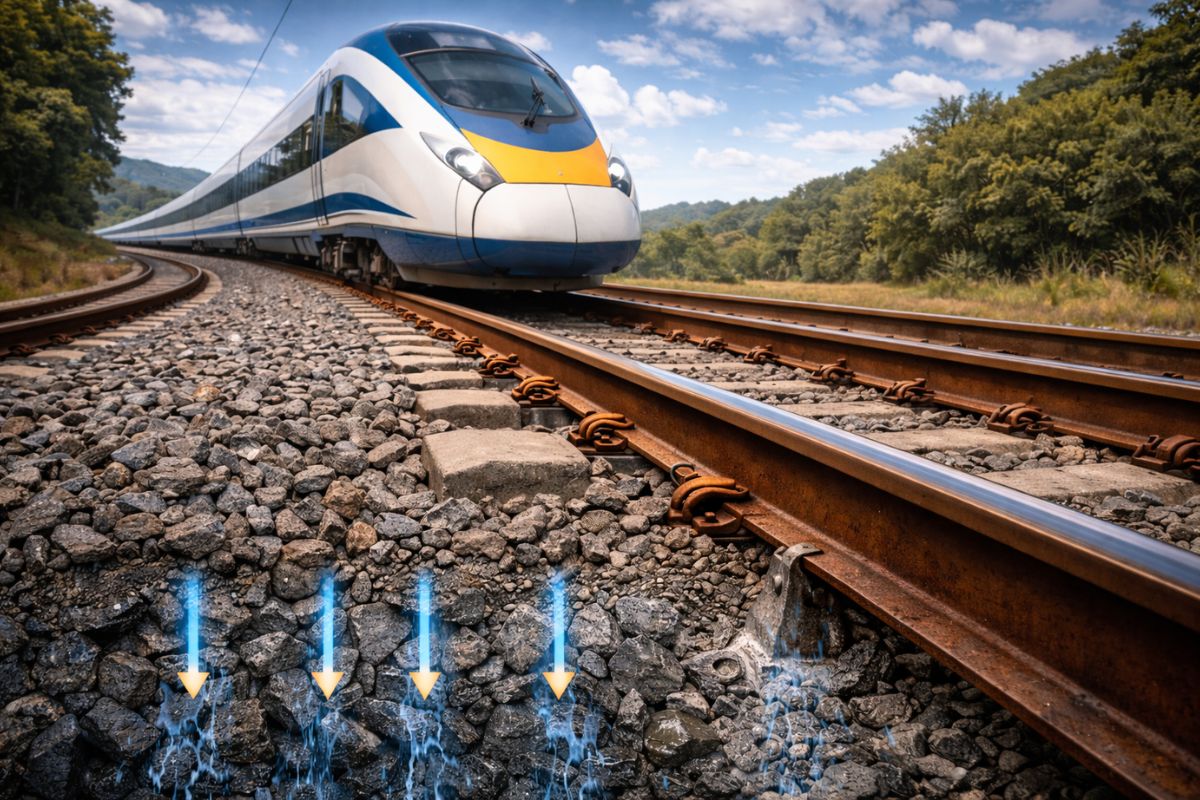


Instead Of Concrete, Modern Trains Use Stones Under The Tracks: The Rail Ballast Keeps The Railway Stable And Even Inherits Its Name From The Ancient Sailing Ships.
On a base of steel tracks, signaling technologies, and state-of-the-art locomotives, modern trains rest on something that seems rudimentary: a massive bed of gray, sharp stones that stretches for thousands of kilometers. These stones form the ballast, an apparently simple system that allows modern trains to run safely even while carrying millions of kilograms.
At first glance, it seems strange that, in the midst of the concrete and digital engineering age, we still use a “pile of loose stones.” But ballast is an elegant solution that distributes weight, absorbs vibrations, drains water, blocks plants, and carries a curious history that links modern trains to ancient sailing ships. Understanding these stones is to understand one of the invisible pillars of the railway.
The Colossal Weight That The Tracks Need To Withstand

Before looking at the ballast, it’s necessary to understand the problem. A loaded train is an incredibly heavy machine, with millions of kilograms of steel and cargo concentrated on small wheels that rest on a narrow strip of the tracks.
-
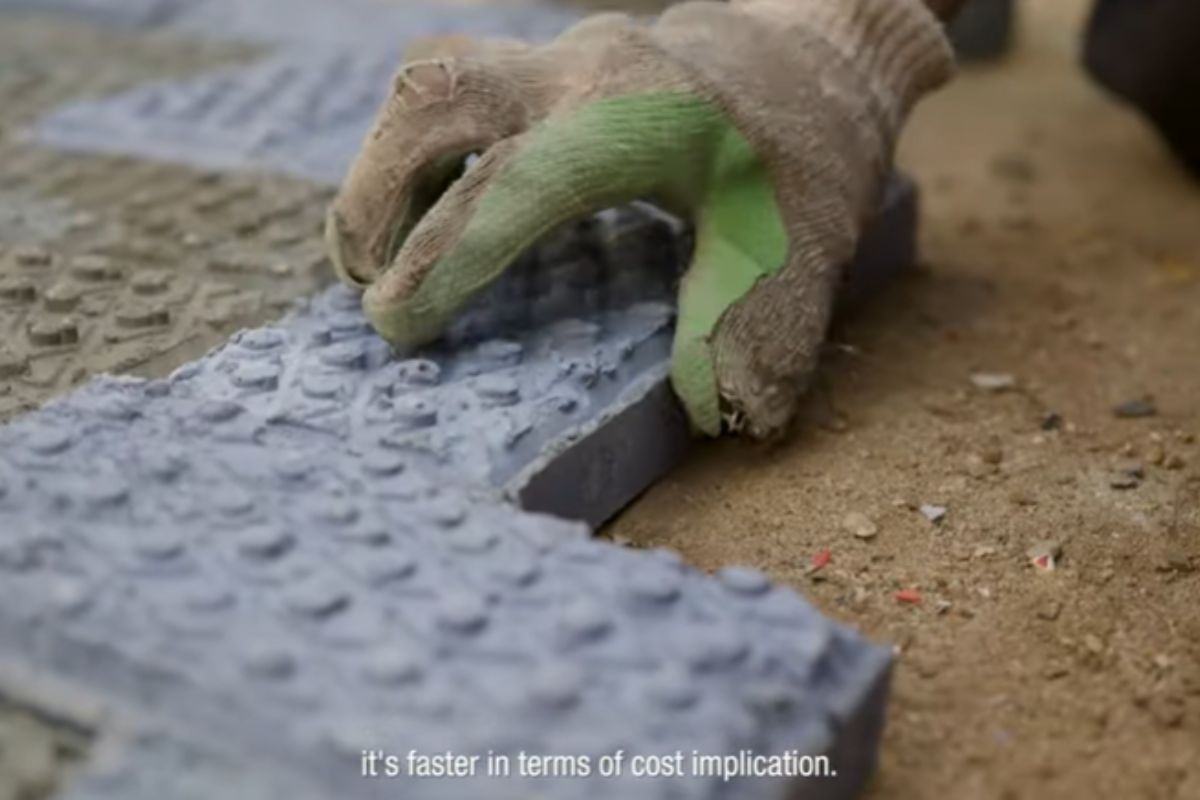
In Kenya, engineer Nzambi Matee created “bricks 2.0” using packaging plastic: a mixture with sand, heated and pressed; they are 5 times more resistant, already have official licensing, and are being used in streets and construction projects.
-
More than 20,000 positions could be opened, and thousands of technicians are starting to be trained in Brazil, as the expansion of data centers creates an urgent race for professionals to keep the internet, cloud, and artificial intelligence running 24 hours a day.

-
China approves the 15th Five-Year Plan 2026-2030 to become a global power: prioritizes brain implants, 6G with AI, humanoid robots, flying cars, quantum technology, and nuclear fusion, while strengthening defense and the economy.

-
HONOR X80i arrives with a massive 7,000 mAh battery, a 120 Hz AMOLED display with a brightness of 6,500 nits, and the new Dimensity 6500 Elite chip, promising up to 22 hours of video playback and impressive performance in casual gaming.


If this load were placed directly on the ground, the result would be disastrous in a few meters. The pressure would crush the earth, the soil would give way, the tracks would bend, and the train could derail.
It was necessary to create an intermediary layer that would distribute this brutal weight and allow the tracks to “float” safely over the terrain.
Ballast: The Bed Of Stones That Makes The Tracks “Float”
This is where the stones come in, technically known as ballast. Think of the railway as a layered cake: at the top are the steel tracks, just below are the sleepers, and supporting everything is the ballast layer.
The function of the ballast is to act as a large shock absorber and pressure distributor. It takes the concentrated weight of the wheels and spreads this load over a much larger area of soil, like a snowshoe that prevents a person from sinking.
The result is that, in practice, the tracks of modern trains are not fixed to a rigid block of concrete, but rather supported by a “floating” structure of compacted stones.
This system relies on friction, weight, and the interlock of the ballast to stay in place, absorb vibrations, and withstand decades of intense use.
If the track were entirely rigid, the stresses generated by modern trains at high speeds could cause cracks and serious failures. With the ballast, the track behaves like an organism that adapts to the stresses and “breathes” without breaking.
Why The Stones Are Sharp And Never Rounded

If you have ever picked up a railroad stone in your hand, you know they are rough, sharp, and uncomfortable. No river pebbles or smooth little stones here. And this is no coincidence.
Imagine filling the track with marbles or rounded river stones. With the vibration of modern trains passing, those stones would roll over each other like bearings, causing the whole system to slide and lose stability. In no time, sleepers and tracks would give way.
That’s why ballast is made of mechanically crushed stone, typically hard materials like granite or quartzite that go through crushers to achieve angular faces.
When these irregular stones are compacted, a phenomenon called interlocking occurs: the sharp edges of one stone fit into the voids of the neighboring ones, forming a solid mass that is difficult to displace.
This locking is crucial on straight tracks and even more so on curves. When a train makes a turn at high speed, the force tries to push the tracks outward, but the locked ballast holds sleepers and tracks in position, reducing the risk of lateral displacement and keeping everything aligned.
Defense Against Water And Vegetation
Weight and stability are not the only challenges. Water and vegetation are silent enemies of the railway. If the tracks were laid directly on the ground, rain would turn the soil into mud, and the base would be washed away, causing subsidence and deformation.
A pure concrete slab would have serious drainage issues, accumulating water and favoring cracks and corrosion.
The ballast solves this dilemma with a simple solution. Being a pile of angular stones, it is naturally porous.
Between one stone and another, there are small voids through which rainwater quickly drains to deeper layers of soil, instead of pooling next to the tracks.
At the same time, that dry, hard layer lacking fertile soil makes it difficult for plants to grow. Roots cannot easily anchor themselves, preventing vegetation from breaking the compaction and retaining moisture.
Thus, the stones serve as a foundation for load support, a drainage system, and a barrier against weeds all at the same time.
Why Ballast Still Beats Concrete In Many Sections

With so much concrete available, why do modern trains still use ballast on many lines? An important reason is maintenance.
When the ground settles a bit, special machines can lift the tracks and recompact or replenish the ballast, leveling the track accurately.
It’s a repairable and adjustable system. A rigid concrete slab, if it sinks at one point, tends to crack. Reinforcing or replacing that slab is expensive, complex, and often requires long interruptions in operation.
Another advantage is the ability to absorb vibrations and noise. Ballast acts as a mechanical filter between the train and the ground, reducing impacts and prolonging the lifespan of both the track and the rolling stock itself.
For these reasons, even in countries with modern trains and high-speed lines, ballast still appears in many sections, especially where flexibility and maintenance costs weigh more than the need for entirely rigid structures.
From The Hold Of Sailing Ships To The Tracks Of Modern Trains
One important curiosity remains: why call this collection of stones ballast? The answer comes from the sea.
Long before modern trains existed, sailing ships faced a classic problem. When they unloaded their entire cargo at a port and needed to return almost empty, they became too light and unstable, swaying dangerously with the wind and waves.
The solution was to ballast the ship. Sailors filled the hold with deadweight to sink the hull a bit more in the water and gain stability. And the cheapest and most abundant material for this was again stones. This extra weight was called ballast.
When these ships arrived at ports like those in England to load coal, they needed to dump the ballast stones on the shore, forming huge mounds of useless stones.
The first railroad engineers, looking for a cheap and available material to support tracks over often muddy soils, looked at these mounds and saw a ready solution.
They began to use the same stones under the tracks and, with them, adopted the name as well. The ballast moved from the holds of ships to the base of railways, unexpectedly connecting the age of sailing ships to the age of modern trains.
Today, when you look at that carpet of gray stones by the edge of a station, you see much more than rubble.
You see a key piece of civil engineering that has ensured stability, drainage, and safety for nearly two centuries, keeping the world moving with a technology that appears simple but is sophisticated in its function.
And for you, after understanding the role of ballast, what impresses you most about modern trains: the visible technology of locomotives or the silent work of those “invisible” stones under the tracks?






Adorei a matéria, parabéns ao edtor. Eu não sabia pra que servia as pedras, agora sei 👏👏👏👏👏👏
As pedras, mas é claro!