





 Portuguese
  English
  Spanish
  4 min of reading
  0 comments


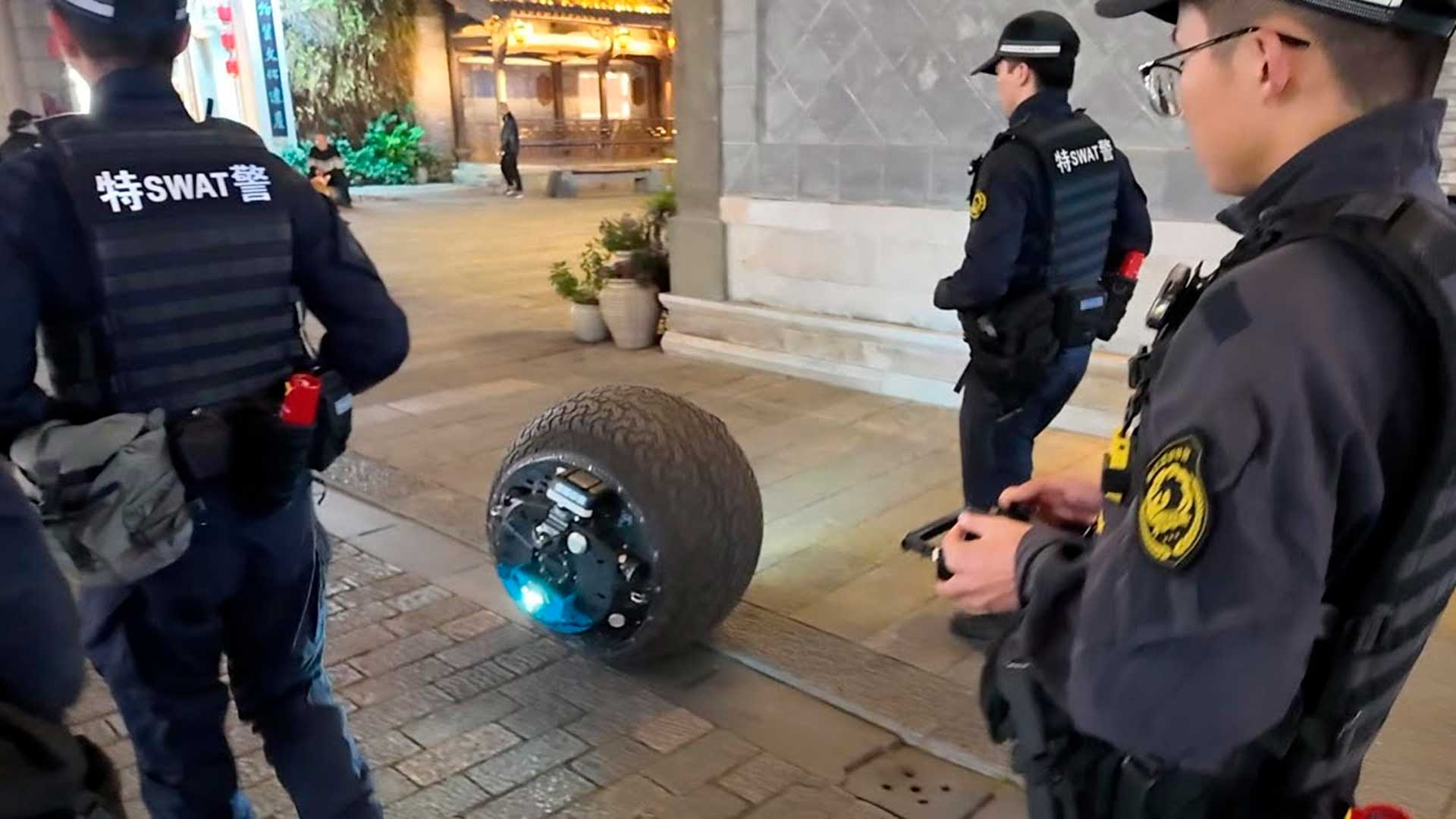
Spherical Amphibious Patrol Robot Enters Testing in Zhejiang Province and Reignites Debate on Technology Applied to Public Safety
The police in China have begun testing a spherical patrol robot in real rounds in the city of Wenzhou, in the east of the country.
According to the state agency Xinhua, the equipment was seen accompanying officers in a commercial area and stands out for its claimed acceleration, reaching 30 km/h in 2.5 seconds, as well as operating on land and in water.
This innovation appears amid a broader effort to increase the use of technology in public safety, with promises of reducing risks to police in confrontation situations and patrolling in hostile locations.
-
How an innovative city combines high technology, well-being, and sustainability to become the largest reference in clean energy on the planet.

-
Couple buys 1846 church in ruins for R$ 660,000, invests R$ 3.2 million in renovations, transforms it into a millionaire mansion, and even preserved a historic cemetery with over 300 graves.

-
He started running at 66 years old, broke records at 82, and is now a subject of study for having a metabolic age comparable to that of a 20-year-old, in a case that is intriguing scientists and inspiring the world.

-
Oldest tree on the planet reappears after 130 years of searches: Wattieza, 385 million years old, was 10 meters tall and had no leaves or seeds; Gilboa fossils in New York solved the mystery in 2007.


At the same time, the robot also reopens discussions about surveillance, usage rules, and how much semi-autonomous systems can advance in police routines without equivalent transparency regarding limits and auditing.
What Is Known About the Spherical Robot Used in Police Patrol in China
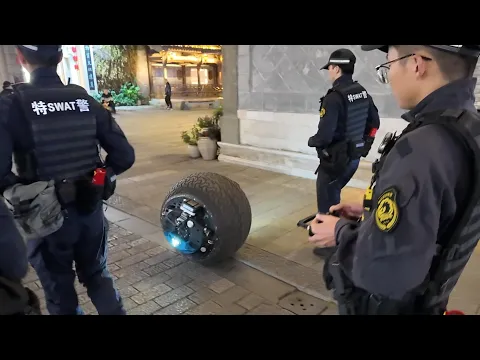

According to Xinhua, the robot seen in Wenzhou was presented as a “member” of the patrol team, weighing 160 kg and about 0.8 meters in diameter, in addition to having the ability to carry police equipment attached.
The same report links the concept to an unusual initial goal, a vehicle designed to traverse extreme surfaces like those encountered in planetary exploration, with the idea emerging in 2017 within the academic environment of Zhejiang.
Other publications describe variations in weight and maximum speed depending on the configuration, citing versions around 125 kg and a peak of 35 km/h, suggesting an evolution of prototypes and different equipment packages during testing.
Engineering and Performance of the Amphibious Robot That Runs on Land and Water
Xinhua attributes the mobility to an internal mechanism that shifts the center of mass and allows controlled rolling in various directions, maintaining balance and reducing the need for external stabilization.
According to the report, the design relies on a sealed shell and materials that protect the electronics, indicating operation in extreme cold and resistance to high impacts, which are important points for use in rain, mud, and risk environments.
The same text mentions significant practical autonomy under ideal conditions, referring to continuous operation for up to 10 hours or a range of about 120 km, figures that help explain the ambition for use in long patrols.
Sensors, Police Equipment, and How the Robot Sees the Environment
Technical reports and international articles describe a set of sensors that combines cameras, GPS, and ultrasound for perception of surroundings, obstacle avoidance, and target tracking, focusing on operation in busy areas.
In a similar vein, SCMP states that the robot can carry cameras and signaling lights and be equipped with suppression tools such as tear gas, within the narrative of supporting officers in crowded locations.
Meanwhile, the Global Times lists accessories aimed at dispersal and containment, such as net launchers, irritant spray, smoke bombs, horns, and acoustic devices, pointing to a package designed for close proximity scenarios.
In practice, some analyses observe that the robot still appears to be operating under remote human control during demonstrations and tests, even when discussing the evolution to greater autonomy over time.
Who Developed the Project and Where the Tests Gained Visibility
Xinhua cites Professor Wang You from Zhejiang University as one of the central voices in explaining the project and states that the team structured a startup in Hangzhou to take the concept forward.
The Global Times also points to the start of the research in 2017 and mentions interest from foreign customers, in addition to estimating manufacturing costs in the range of 300,000 to 400,000 yuan, a value that could decrease with scale.
Meanwhile, institutional texts from Hangzhou describe the model RT G with the ambition of more autonomous navigation and application beyond policing, citing usage in sectors like infrastructure and energy, reinforcing the argument for a multi-use platform.
The Debate That Grows With Police Robots and Surveillance With Artificial Intelligence
When a robot with cameras and tracking capabilities enters patrols, the point isn’t just performance; it’s governance: who defines the rules for activation, what data is collected, how long it is stored, and how to prevent abuse in oversight routines.
There is also the issue of scaling the use of force, since devices classified as non-lethal still require clear protocols, recording of activation, and supervision to avoid becoming shortcuts in approaches.
Another front is transparency regarding autonomy, as some descriptions talk about autonomous driving while others point to current remote operation, which can confuse the public and inflate expectations about what the system really does on its own.
Finally, there is an uncomfortable question that arises whenever technology enters the streets: is this a real gain in security for all or just another layer of permanent surveillance with low accountability.
If this spherical robot becomes standard in patrols, do you think the city will be safer or just more monitored? Would you trust approaches with machines alongside human police officers? Leave a comment.







Seja o primeiro a reagir!