





 Portuguese
  English
  Spanish
  5 min of reading
  0 comments


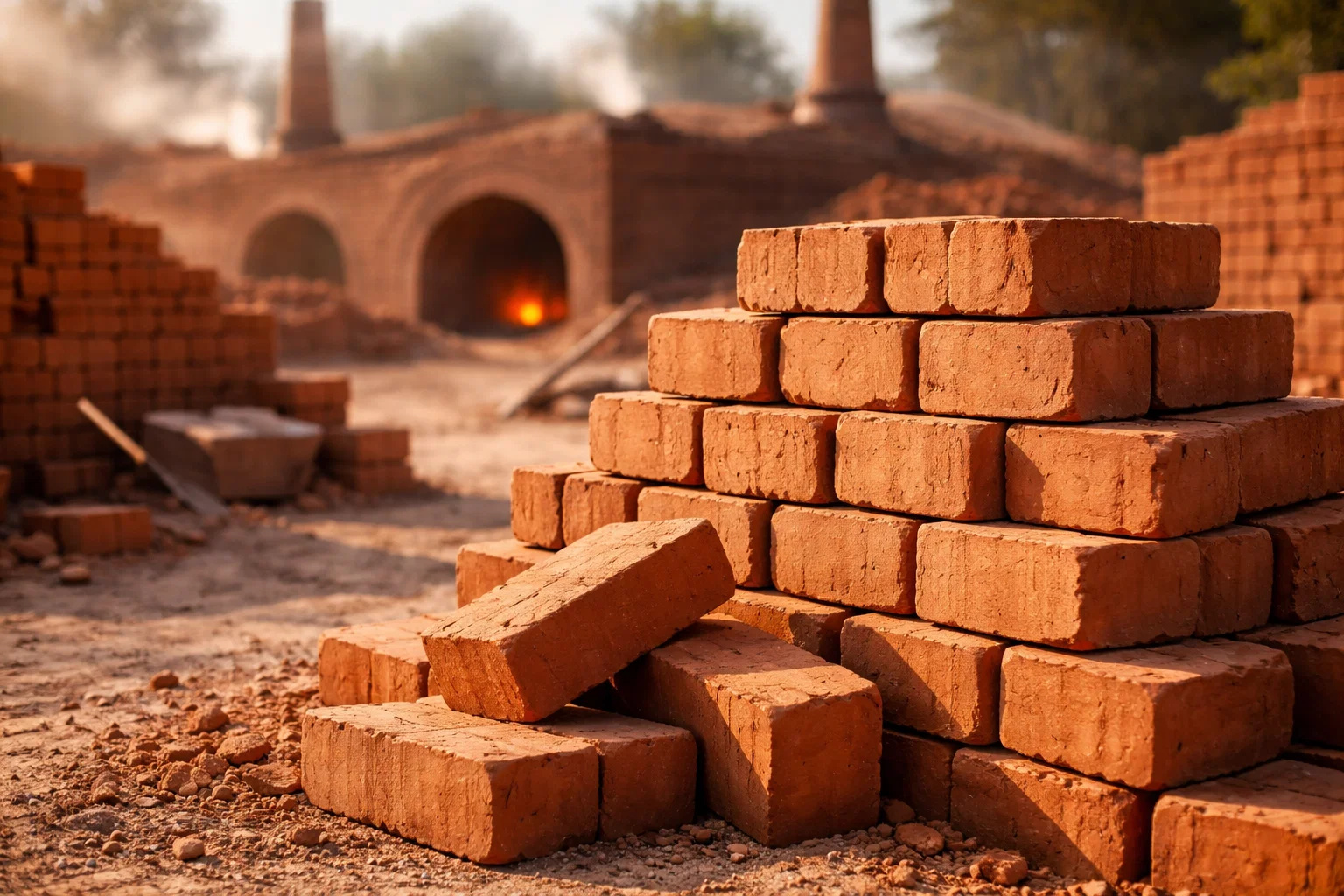
In An Area Where There Were Almost No Quarries, Builders Of Ancient Mesopotamia Found A Resourceful Solution By Turning Clay Into Baked Brick, Technology That Allowed For The Erection Of Dense Cities And Influenced Urban Engineering For Millennia
Have you ever thought about trying to build an entire city in a place where there is practically no stone, with baked brick? This was the challenge faced by the first civilizations that emerged in Mesopotamia, a region located between the Tigris and Euphrates rivers and considered by many historians as one of the cradles of urbanization.
Despite this geological obstacle, these societies achieved something impressive for their time. They developed a construction solution capable of supporting walls, giant temples, and entire neighborhoods. The key to this was something seemingly simple, the baked brick.
What started as an alternative to stone ended up transforming into one of the most important technologies of ancient engineering.
-
Attracting around 250,000 people a year, a lighthouse 200 meters from the sea, on a 60-meter high cliff, on the North Sea coast in Denmark, becomes one of the most impressive examples of how nature can threaten historical buildings.

-
The narrowest house in the world is only 63 centimeters wide, but inside it can accommodate a bathroom, kitchen, bedroom, office, and even two staircases.
-
In the middle of the sea, these enormous concrete and steel structures, built by the British Navy to protect strategic maritime routes, look like they came straight out of a Star Wars movie.
-
For years, no one could cross a neighborhood in Tokyo because of the tracks, but an impressive solution changed mobility and completely transformed the local routine.


The Challenge of Urban Construction in a Region Almost Without Stone
The Mesopotamia had fertile lands thanks to the rivers that flowed through the region, but it presented a serious problem for those intending to erect durable structures.
Unlike other areas of the ancient world, where quarries provided large blocks of stone for construction, the Mesopotamian territory was dominated by alluvial plains primarily composed of clay and sediments.
This meant that traditional building materials were simply not widely available.
According to specialists in archaeology and engineering history, this scenario forced local populations to develop creative solutions to build housing, temples, and administrative centers.
It was in this context that clay began to gain prominence.
First came the sun-dried molded bricks. They worked for simple structures but had an obvious limitation. They were fragile against rain and the wear of time.
The evolution would come with a decisive step.
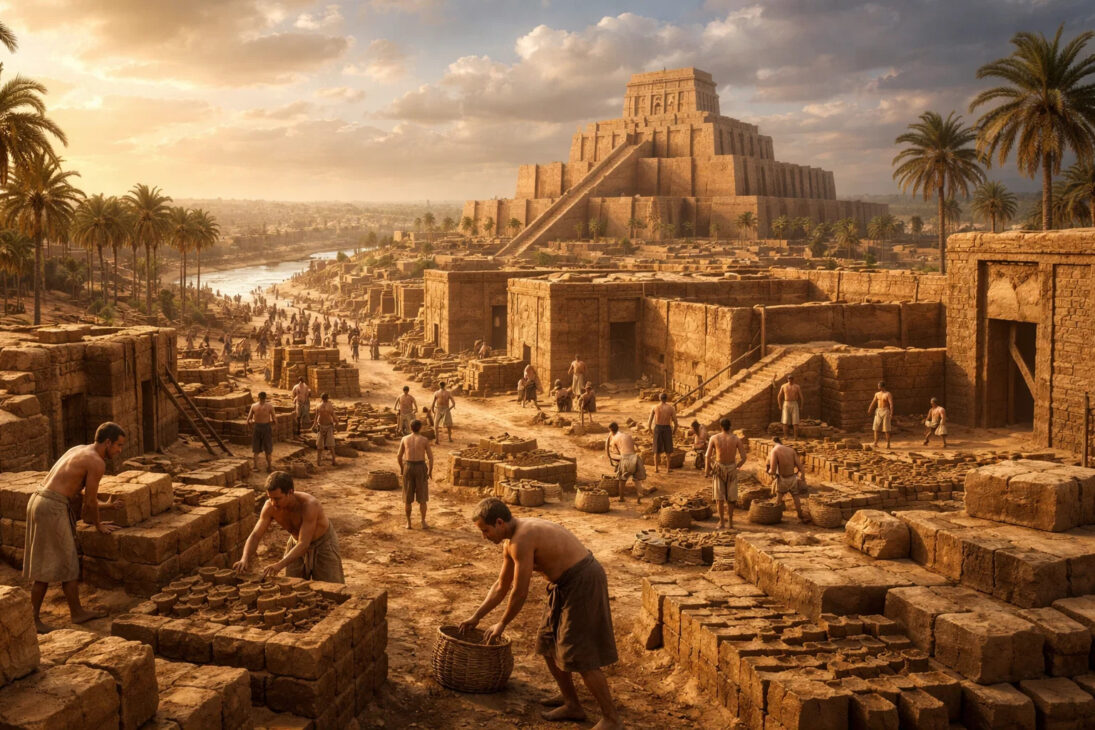
When Clay Entered The Fire And Changed Ancient Engineering
Around the second millennium BC, the use of oven-baked bricks began to expand significantly in Mesopotamia.
The principle was relatively straightforward. Molded clay blocks were subjected to high temperatures, a process that dramatically increased the material’s resistance.
This advancement brought profound changes to urban construction.
Baked bricks showed greater durability, withstood moisture better, and allowed for the erection of taller and more complex structures.
As a result, cities began to grow in a much denser fashion.
Archaeological records indicate that this technology was used in:
- Monumental temples
- Ceremonial platforms known as ziggurats
- Defensive walls
- Administrative complexes
Some of these constructions impress even today due to their scale and durability, considering they were erected thousands of years ago.
The Simple Technology That Allowed Dense Cities In The Stone Desert
The introduction of baked bricks had a direct effect on urban growth.
Without relying on distant quarries or heavy rock transport, Mesopotamian cities began to produce their own construction materials practically on-site.
The raw material was available in abundance along the riverbanks.
Clay was molded, dried, and taken to the ovens. The result was a standardized, relatively strong material that could be produced in large quantities.
This seemingly technical detail had immense consequences.
It enabled cities like Babylon and other important ancient metropolises to expand rapidly, creating entire neighborhoods and monumental structures.
Some experts point out that this capacity for local material production was one of the factors underpinning urban growth in the region.
In other words, the development of baked brick helped make some of the earliest large cities in history feasible.
The Engineering Detail That Helped The Technology Last For Millennia
Even though it is an ancient technology, the principle behind baked brick remains present in modern engineering.
The process of heating clay alters its internal structure, making the material more resistant and less vulnerable to water.
This same concept is still used today in the production of ceramic bricks in different parts of the world.
According to materials engineering specialists, this thermal transformation creates a product that is much more stable than sun-dried clay.
In practice, what the builders of Mesopotamia discovered thousands of years ago continues to be applied in contemporary construction systems.
This technological continuity reveals something curious. Many solutions used today have deep roots in ancient engineering.
The Impact This Construction Solution Had On The Birth Of The First Metropolises
When baked bricks began to become common, the impact was not limited to construction techniques.
The very organization of cities began to change.
Larger public structures became possible. More resistant walls began to protect urban centers. Administrative buildings gained greater durability.
This set of factors helped to consolidate more complex cities.
Archaeological estimates indicate that some of these urban centers already concentrated significant populations for the time.
Without a construction solution adapted to the local environment, this growth would likely have been much more limited.
In the end, a seemingly simple innovation helped shape the beginning of organized urban life.
Long before reinforced concrete or structural steel, engineering was already finding ways to solve enormous challenges with the resources available.
The discovery that clay could be transformed into a fire-resistant material ended up paving the way for some of the first large cities in human history.
This technical adaptation garnered attention because it shows that innovation in civil construction did not start in the industrial era. It was already present when the first civilizations attempted to solve a basic problem: how to erect entire cities in a place where there was practically no stone.
What do you think of this solution created thousands of years ago? Do you believe that many modern technologies still arise from simple ideas like this? Share your opinion in the comments.






Seja o primeiro a reagir!