





 Portuguese
  English
  Spanish
 4 min of reading
  0 comments


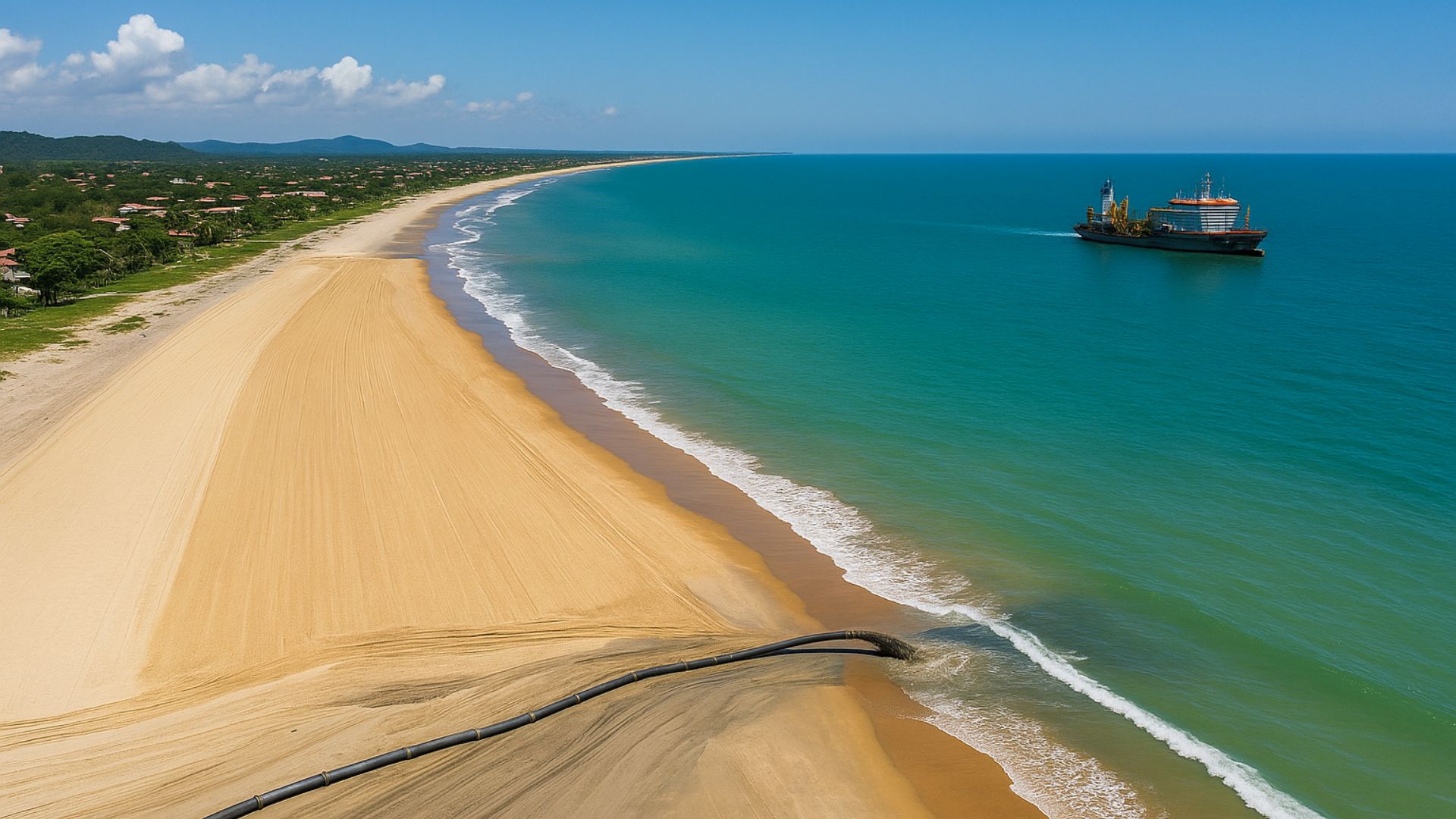
A Large-Scale Intervention Changes the Waterfront of Itapoá with New Sand Delivery, Navigation Channel Changes, and Continuous Environmental Monitoring, Gradually Transforming the Coastal Configuration and Port Operation of the Region.
The coastline of Itapoá, in Northern Santa Catarina, is undergoing one of the largest coastal interventions ever recorded in Brazil.
The sandbank widening project aims to recover about 7.5 km of waterfront, with the application of approximately 6 million cubic meters of sand extracted from the dredging of the access channel to Babitonga Bay, which serves the ports of Itapoá and São Francisco do Sul.
The work integrates the deepening of the navigation channel and is expected to be completed in the second half of 2026.
-
These living root bridges and ladders are over 700 years old and help indigenous people survive in one of the rainiest regions in the world.

-
From sertanejo star to international investor: Ana Castela invests millions in a mansion in the USA, creates a themed accommodation in Orlando, and shows that the “boiadeira” also wants to grow away from the stage.

-
The 10 most stunning motorhomes in the world: a $3 million trailer with a rooftop nightclub and garage for a Ferrari, “palaces on wheels” with Italian marble, private cinema, and five-star hotel luxury for billionaires.

-
Trump wanted to spend $400 million on the White House, but the courts prohibited the million-dollar construction.


Beach Widening in Itapoá Underway
The widening of the beach in Itapoá is classified by port authorities and the state government as the largest ongoing sand widening in the country, both in length and in the volume of sediments moved.
The intervention expands a continuous stretch of coastline and reaches consolidated urban areas and tourist hotspots.

Recent data from the Port of São Francisco do Sul indicate that more than 1.4 million cubic meters of sediments have already been dredged from the Babitonga channel.
Of this total, about 940 thousand m³ have been distributed over just over 1 km of beach, forming a new sandbank.
The technical projection is that, by the end of the work, the waterfront of Itapoá will have sections with up to 200 meters wide, changing the current configuration of the beach.
Dredging in Babitonga and Sand Supply
The intervention depends on the ongoing dredging in the access channel to Babitonga Bay, which serves one of the main port complexes in Santa Catarina.
The deepening project envisions the removal of about 12.5 million cubic meters of sediments, a volume necessary to adapt the channel to the new depth and supply the beach widening.
The estimate is that half of the material will be allocated to the waterfront of Itapoá.
The remainder will be transported to a disposal point offshore, authorized by federal environmental agencies.
The dredger Galileo Galilei, a large vessel responsible for the operation, has a tank capacity of about 18 thousand m³ per cycle.
The material is pumped through pipelines to the beach, where teams perform distribution and leveling.

This method allows for control of the volume applied in each section and follows the planning established in the executive project.
Coastal Erosion and Changes in the Sandbank
According to technical reports from the project, the widening aims to reduce the advance of coastal erosion and restore the width of the sandbank.
The sand nourishment process, applied in various regions of the country, is indicated by specialists as a way to expand the area for wave energy dissipation.
The increase in beach width also tends to create more space for recreational activities.
According to the municipal government and entities linked to the tourism sector, the intervention may influence the use of the region by residents and visitors, especially during peak periods.
As required by licensing, the work is accompanied by environmental monitoring.
The evaluations include analyses of water quality, observations of marine fauna, and monitoring of possible changes in sandbanks in the Babitonga estuary.
Deepening the Channel and Port Operations
In addition to changes to the beach, the dredging of the channel has an operational role for the surrounding ports.
The project envisions the deepening of the access from about 14 to 16 meters, which will allow for the reception of larger ships, up to 366 meters long with an approximate capacity of 16 thousand TEUs, according to estimates from port authorities.

The Babitonga complex accounts for over 60% of port activity in Santa Catarina, and the deepening is treated by managers as a necessary step to maintain competitiveness against other ports that already operate with large vessels.
The intervention is financed through a public-private partnership between the public port of São Francisco do Sul and the private terminal of Itapoá, with an estimated investment of R$ 333 million.
Progress of Works and Continuous Monitoring
The set of dredging and beach nourishment works is expected to be completed in the second half of 2026, according to official schedules.
The waterfront is undergoing gradual changes, with sections being released as stages progress.
Throughout the process, the project maintains continuous environmental monitoring, which includes analyses of water turbidity, observations of fauna, and monitoring of possible changes in current circulation.
With the combination of beach nourishment and the deepening of the navigation channel, what changes should the local population observe over the coming years in the dynamics of the waterfront and the use of the coastline?







-

-

-

-

-

-

46 pessoas reagiram a isso.