





 Portuguese
  English
  Spanish
  4 min of reading
  0 comments


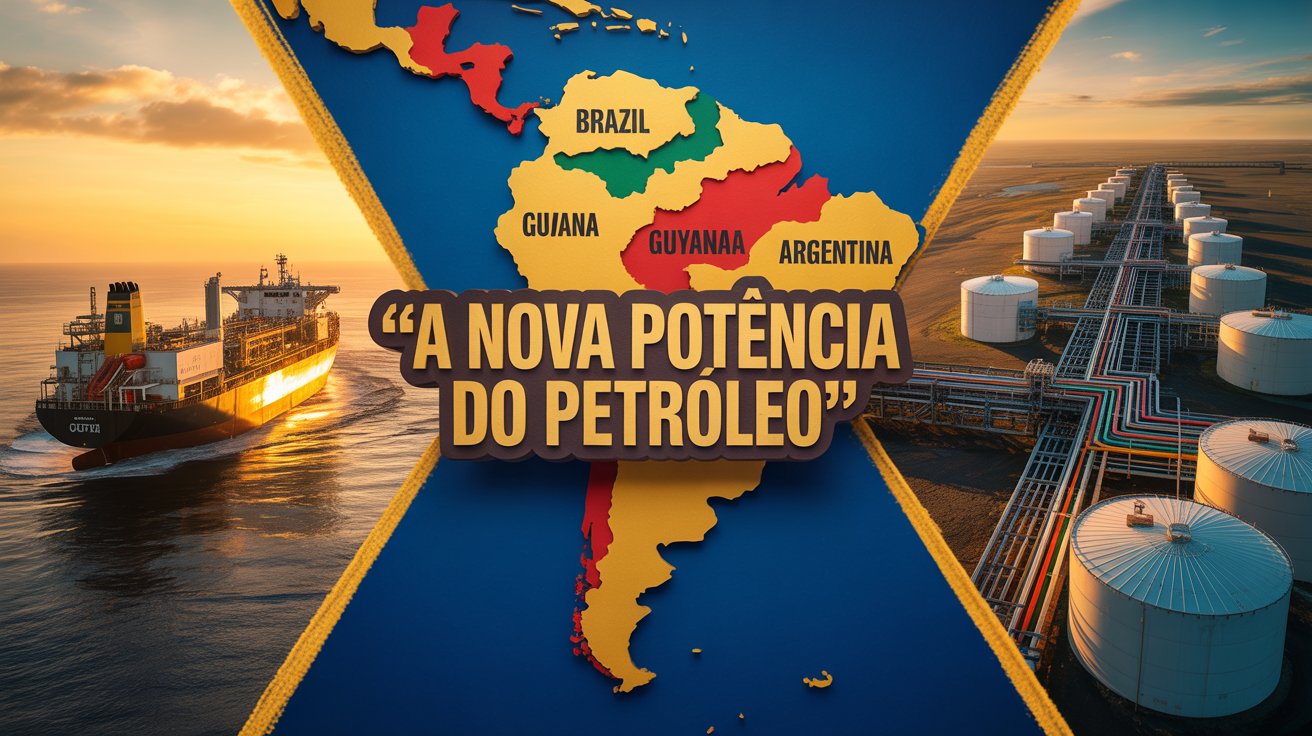
Oil Production In South America Expected To Register Largest Global Expansion By 2030, Led By Brazil, Guyana And Argentina, In Deepwater Projects And Rock Formations, Changing Global Energy Balance.
Oil production in South America is advancing rapidly and is expected to lead global growth in the coming years.
Projections indicate an increase of around 30% between 2024 and 2030, driven primarily by the Brazilian pre-salt, the Stabroek block in Guyana, and Vaca Muerta in Argentina.
The expansion surpasses, in percentage terms, the expected growth for the Middle East and the United States, according to the International Energy Agency (IEA) and industry consultancies.
-
Lula reveals a masterstroke by Petrobras to undo a deal made by Bolsonaro, which involves the return of an important refinery that currently produces less than half of what was expected and makes Brazil dependent on international diesel.
-
A study confirms that the natural gas sector will reduce greenhouse gas emissions in Brazil by 0.5% and accelerate the energy transition by 2026.

-
Petrobras implements a severe adjustment and confirms a 55% increase in the price of aviation kerosene with a proposal for installment payments for the companies.

-
The rise in oil prices could ensure an extra revenue of R$ 100 billion for the Federal Government, indicates a recent economic study.


With this momentum, the region is expected to increase production from nearly 7.4 million to almost 9.6 million barrels per day, compensating for the decline of mature fields.
Brazil And The Advance Of Pre-Salt
Brazil, the largest producer in the region, has set new records this year.
In June, according to the ANP, the country extracted an average of nearly 5 million barrels of oil and natural gas per day, combining the volume of oil and gas.
The focus of the expansion is on the pre-salt, a geological layer beneath thick salt rocks that holds high productivity reserves in ultra-deep waters.
This set of assets has attracted continuous investment, with large-scale projects and state-of-the-art platforms.
In addition to the volumetric potential, executives and analysts emphasize efficiency gains with high-output wells.
According to Rystad Energy, approximately half of the South American growth by 2030 will come from offshore hydrocarbons, reinforcing the role of Brazilian basins as drivers of global supply.
The productivity of the fields has maintained competitive costs, a decisive factor given the cycles of oil prices.
Guyana Accelerates With The Stabroek Block
To the north of the subcontinent, Guyana has been experiencing a boom since 2015, when discoveries in deep waters put the country on the map of major oil provinces.
In the Stabroek block, a consortium led by ExxonMobil operates in one of the most relevant areas in the current market.
Projections indicate that production is expected to double by 2030, boosting revenues for a country of just over 800 thousand inhabitants.
Experts assess that the performance of Stabroek has consolidated South America as the leading region for deepwater production in the world.
As Flávio Menten from Rystad summarized, “South America is the largest region for deepwater production globally.”
The outlook also includes the advancement of Suriname, whose contribution is expected to add to the new phases in Guyana in the second half of the decade.
Vaca Muerta Expands Presence In Argentina
Away from the sea, Vaca Muerta represents Argentina’s bet on unconventional oil and gas.
It is a rock formation in the Neuquén Basin, whose development relies on hydraulic fracturing to release trapped hydrocarbons.
The province of Neuquén recorded its highest historical production level of oil in July, with an annual increase of 28%, a milestone that illustrates the learning curve and the adoption of more efficient drilling and completion techniques.
The potential is significant, but the growth schedule depends on the expansion of pipelines, terminals, and flow systems.
Professor María Cristina Pacino from the National University of Rosario notes that the speed of expansion “will depend on investment in infrastructure,” which is essential to bring the incremental volume to markets.
The start of operation for a pipeline over 400 kilometers long, connecting Vaca Muerta to a terminal on the Atlantic, is expected for the end of 2026, a crucial step to boost exports and scale the project.
Growth Projections Until 2030
Estimates from McKinsey Energy Solutions indicate that, if prices remain close to current levels, South American production could grow up to 35% by the end of the decade.
This would imply an average annual increase of 4% to 5%, compared to roughly 1% per year worldwide.
Even so, the Middle East will continue to be the largest production hub in absolute numbers, with about 35 million barrels per day by 2030, compared to around 10 million in South America.
The difference will be in the pace of expansion. In the field portfolio, Brazil concentrates world-class deepwater projects.
Búzios, Mero, Sépia, and Atapu are among the largest in the world in productivity and scale.
In Guyana, additional phases of Stabroek support the doubling by 2030.
In Argentina, authorities and the state-owned YPF are working to raise Vaca Muerta to 1 million barrels/day by the end of the decade.
On the Brazilian side, Petrobras is directing resources to new units in the Búzios field, enhancing the installed capacity and the export profile of the country.
Challenges Of Oil Expansion
Although the scenario is favorable, there are challenges to maintain momentum after 2030.
Consultancies such as Wood Mackenzie emphasize that the region combines high productivity with low carbon intensity per barrel in many deepwater projects, a valued attribute by large companies.
Still, the continuity of the cycle depends on the discovery of new fields and the renewal of the portfolio.
Without new frontiers, the natural decline of mature fields tends to reduce supply. In the Argentine case, the critical factor is infrastructure.
Without pipelines, terminals, and transportation solutions compatible with the production increase, flow becomes a bottleneck.
Meanwhile, countries like Colombia, Ecuador, and Venezuela are expected to register reductions in volumes, highlighting the importance of emerging hubs to offset declines.








-

-

-

7 pessoas reagiram a isso.