





 Portuguese
  English
  Spanish
  6 min of reading
  0 comments


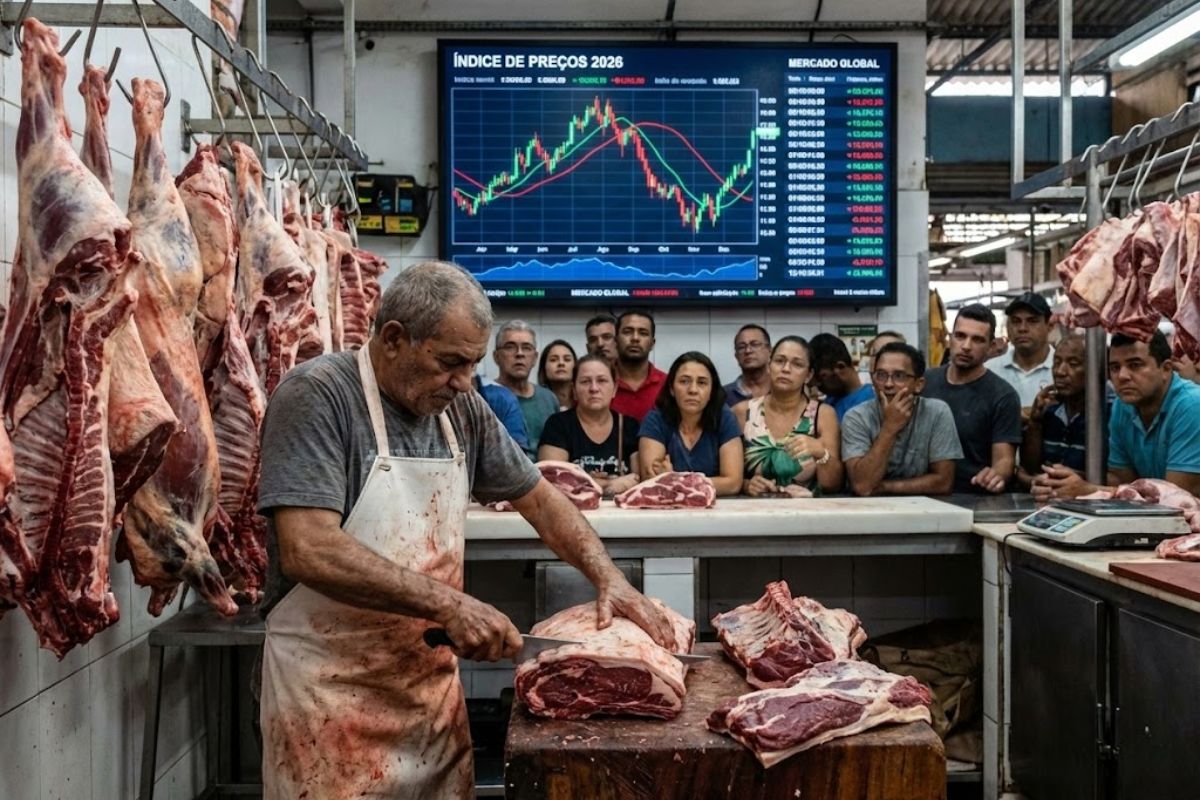
With Export Limits for China and Mexico, Meat Prices Face Pressure: Up to 1.1 Million Tons for Chinese with 12% Tariff, and 70 Thousand to Mexico Without Tax. Above, Rates Rise. Herd in Recomposition May Reduce Supply and Maintain High in 2026.
Beef prices in Brazil enter 2026 under two simultaneous external brakes, with China and Mexico imposing purchase limits and tariff rules that change the cost of each exported ton. This movement occurs while experts observe signs of lower supply linked to the herd and the slaughter cycle.
The initial reading, that less exportation would mean more product in the domestic market and lower prices at the butcher, encounters a diagnosis repeated by experts: meat prices depend on a set of forces that cannot be resolved solely by quotas. Meat inflation had already accumulated 5% increase over 12 months in November’s IPCA, and the trend indicated by analysts interviewed by g1 is maintaining pressure.
China Imposes Ceiling and Creates Tariff Leap Above Quota
China, the main destination for Brazilian meat, decided to limit imports in 2026 with a two-layer rule.
-
The institute that trained the greatest aerospace engineers in Brazil has just opened its first campus outside São Paulo after 75 years: ITA Ceará will have R$ 445 million, new courses in energy and systems, and classes are expected to start in 2027.

-
Luciano Hang, owner of Havan, goes to Juiz de Fora after the tragedy in February, brings R$ 1 million, hands out R$ 2,000 cards, and donates up to R$ 15,000 to victims in the region.

-
The Brazilian passport allows legal residence in dozens of countries without the need for a prior visa, and most Brazilians are unaware that they can apply for residency directly upon arriving in nations in South America, Africa, and even Europe.

-
Petrobras sends a message to Brazilian truck drivers after fuel collapse and reveals plan to have 100% domestic diesel.


Up to 1.1 million tons can enter with the current tariff of 12%. What exceeds this ceiling faces a 55% tariff, a leap that raises the product’s price and tends to discourage additional purchases.
In 2025, the Chinese imported about 1.6 million tons of beef from Brazil.
This data illustrates the size of the potential cut: part of the volume that previously flowed without this barrier now competes with a tougher tariff.
In practice, the debate about meat prices ceases to be solely about “how much Brazil produces” and also becomes “how much the market absorbs without penalty.”
The new tariff also creates a predictable behavior: the quota becomes a benchmark, and exports above the limit cease to be a purely commercial decision and turn into a tax decision.
When the tariff rises, the margin decreases, and the incentive changes.
Mexico Repeats the Quota Model and Adds Tax Above the Limit
Mexico adopted a similar mechanism, with a central difference: the country opened a quota of 70 thousand tons free of tax.
Above this limit, a 20% tariff on imported meat applies. In 2025, Brazil exported 113 thousand tons to the Mexican market, which until then had not applied a tariff.
The design changes the shipping calculations. Within the quota, the costs remain lighter. Outside it, the tariff adds a step that may reduce the buyer’s appetite.
As China and Mexico appear together in the 2026 debate, the risk to meat prices lies not only in one market but in the combination of two limits in relevant destinations.
The direct consequence, within the presented rules, is an environment where exports cease to be a continuous flow and become a conditional flow.
When the tariff changes, the predictability of demand also changes.
Why Less Exportation Does Not Guarantee Immediate Relief at the Butcher
At first glance, the logic seems simple: if China and Mexico reduce their buying pace, there would be more meat in Brazil, and meat prices would fall.
However, experts describe a more complex scenario. The central point is that 2026 is cited as a period of herd adjustment, with lower supply of animals for slaughter.
In this context, possible excess exportation does not automatically translate to product abundance.
Supply may shrink for internal reasons, while domestic demand continues to exist.
The result is a competition for volume where meat prices do not find easy space to retreat.
The November IPCA snapshot, with 5% accumulated increase over 12 months for meats, reinforces the signal that pressure was already present even before 2026 began.
The discussion becomes whether the new quotas from China and Mexico would be strong enough to offset the effects of the herd in recomposition.
Herd, Slaughter Cycle, and Expectations of Lower Supply in 2026
The technical vocabulary used by analysts to explain the pressure is “herd cycle” and “herd recomposition.”
The idea presented is straightforward: after a period of more intense slaughter, there is a phase in which the supply of animals for slaughter tends to decrease, and this appears in the market as lower availability.
This point is what keeps meat prices at risk of rising, even with export barriers.
In other words, the tariff may hold back part of the flow out, but the herd may hold the total available quantity both in and out.
That is why experts insist on separating “lower export” from “guaranteed drop.” The herd acts as a base variable, and 2026 is described as a year when this base may become narrower.
Production and Export in 2025 Help Measure the Size of the System
The numbers from 2025 show the size of the Brazilian market and explain why tariff changes in China and Mexico gain weight.
In 2025, Brazil took the world lead in beef and veal production, with about 12.4 million tons, surpassing the United States, with 11.8 million.
China appears in third place, with 7.8 million, according to data from the U.S. Department of Agriculture.
In foreign trade, Brazil also led global exports, with over 4 million tons, ahead of Australia, India, and the United States.
This high level exposes the country to decisions by major buyers. When the tariff changes in a large destination, the effect propagates through the price chain.
For 2026, the cited projections indicate declines in both Brazilian production and exports, precisely due to herd recomposition.
The combination of a herd in adjustment and new tariffs becomes the center of risk for meat prices.
Experts Diverge on Intensity, but Converge on Pressure
The presented framework encompasses two movements that go hand in hand. On one side, China and Mexico adopt quotas and tariffs, suggesting an external brake. On the other, experts point to the herd as an internal factor reducing supply. The divergence appears in consumer expectations: some anticipate relief at the butcher with less export, while others see persistent pressure.
The point of convergence, however, is that 2026 does not start with a promise of easy declines. The very question dominating the debate, “Will meat prices spike or fall?” arises from the coexistence of contradictory signals. When the tariff rises, volumes may shift. When the herd tightens, there may be a lack of volume.
What to Watch in 2026 to Understand Meat Prices
Within what has been presented, there are four specific points to observe throughout 2026. First, whether China will operate close to the ceiling of 1.1 million tons and how the market reacts to the risk of the 55% tariff.
Second, whether Mexico will quickly exhaust the quota of 70 thousand tons and how the 20% tariff factors into the calculations.
Third, how the recomposition of the herd materializes in the supply of animals for slaughter, as this is the mechanism pointed out to sustain the pressure.
Fourth, how the inflation measured by the IPCA, which had already indicated a 5% increase over 12 months, evolves with the combination of supply and export.
For the consumer, the practical translation is: meat prices may not respond automatically to quota news because the herd variable remains at the center of the gameboard.
Monitoring these milestones helps understand why the butcher may not deliver the expected relief.
With China and Mexico using quotas and tariffs to modulate purchases, and with the herd described as a factor of lower supply, 2026 tends to keep meat prices under pressure.
The issue is not just exportation, but how supply and tax rules combine.
If you are trying to plan expenses, it is worth monitoring the changes in tariffs and the behavior of the herd throughout the year to adjust expectations at the butcher. In your view, will meat prices in 2026 feel more the weight of China and Mexico or the tightening of the herd?










Seja o primeiro a reagir!