





 Portuguese
  English
  Spanish
 5 min of reading
  0 comments


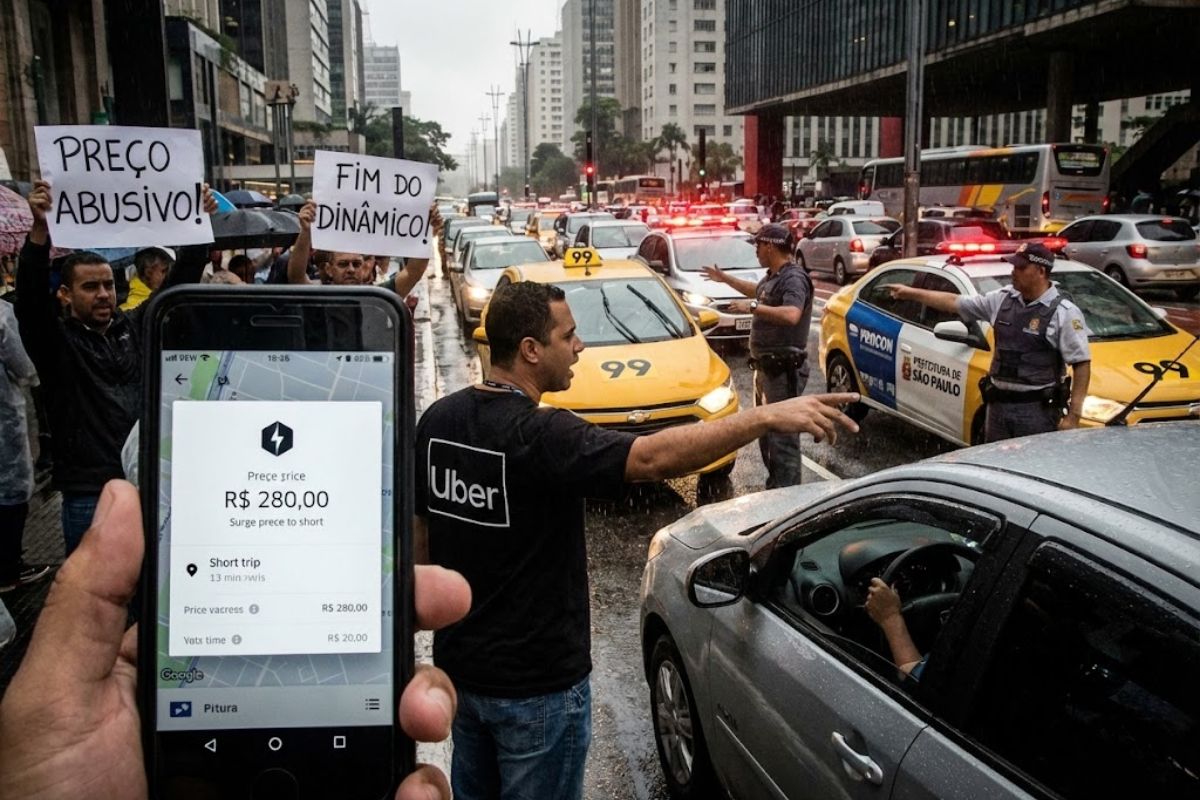
São Paulo City Hall Notified Uber and 99 via Procon Paulistano on 12/13/2025 and Demanded Explanations About Rides with Dynamic Prices That Users Say Almost Tripled in December in the Capital; Companies Have Ten Days to Respond, Justify Criteria, Inform Limits, and Avoid Fines, Suspension, and Other Penalties.
On 12/13/2025, at 9:43 AM, São Paulo City Hall announced that, through Procon Paulistano, it notified Uber and 99 to clarify the rise in fares in December in the capital. The Ricardo Nunes (MDB) administration stated that disproportionate prices, without clear technical or economic justification, may constitute abusive practices, with possible violations of the principles of the Consumer Protection Code.
The charge against Uber and 99 comes after reports from users that dynamic prices nearly tripled from November to December. Tests and posts on social media gathered examples with values and dates, including a simulation from 12/05/2025 and comparisons between 11/28/2025 and 12/08/2025 in regular routes.
Notification from Procon Paulistano and Focus of São Paulo City Hall
São Paulo City Hall claims that Procon Paulistano’s actions focus on possible increases in prices for app-based rides in December, highlighting the use of dynamic pricing.
-
Oil surged to $115 a barrel due to the war in the Middle East, and diesel in Brazil has already risen to R$ 7.45 per liter, while the United States…
-
Brazilian city bets on the business environment to generate jobs and attract investments in the energy sector — secretary reveals strategy at Macaé Energy 2026.

-
50 viaducts, 4 tunnels, 28 bridges, and 40 kilometers of bike paths: BR-262 in Espírito Santo will receive 8.6 billion reais for the largest engineering project in the state’s history, inspired by the Immigrant Highway in São Paulo.

-
Brazil produces too much clean energy and doesn’t know what to do with it: over 20% of solar and wind capacity was wasted in 2025 while investors flee and 509 renewable generation projects were abandoned in the last year.


In the statement, the agency linked to the Municipal Justice Department mentions that this conduct may violate principles of Article 6 of the Consumer Protection Code, especially transparency, pricing moderation, and adequate service provision.
São Paulo City Hall maintains that imposing values considered disproportionate, without clear technical or economic justification, may characterize abusive practices.
The goal of the notification, according to Procon Paulistano, is to obtain technical and economic elements that explain price formation for rides and communicate this policy to consumers during high demand periods.
Deadline of 10 Days and What Uber and 99 Need to Explain
Procon Paulistano set a ten-day deadline for Uber and 99 to provide clarifications.
The formal request targets the technical and economic basis for pricing, the operation of dynamic pricing, and the internal mechanisms to prevent abuses during peak demand periods. The items requested are:
What is the technical and economic justification for adopting dynamic pricing, including dynamic prices, in December
What measures are taken to prevent abusive pricing during high demand for rides
Is there a price ceiling for rides; if so, what is the value and how is it applied
How and when is the pricing policy communicated to the consumer, especially when there are dynamic prices
What internal mechanisms ensure pricing moderation and prevent disproportionate advantages in rides
São Paulo City Hall stated that failure to meet the deadline could lead to administrative measures provided for in the Consumer Protection Code.
Among the mentioned consequences are fines, temporary suspension of activities, and other applicable penalties.
User Complaints and Examples of Rides That Almost Tripled
User reports indicate that it only took the change from November to December for fares to become more expensive in São Paulo, with cases where the price almost tripled at certain times.
In a test conducted late on 12/05/2025, a ride between Jardins and Mooca, which cost around R$ 35 in November, appeared in December for R$ 95, following the dynamic pricing logic indicated by the apps themselves.
On social media, the complaint gained traction.
A post by communicator Nanda Xie on platform X received over 3.5 million views and surpassed a thousand comments, with users reporting similar increases in other cities outside the capital and state.
The content highlights short routes and high values, reinforcing the perception that rides have begun to exhibit high dynamic prices in different areas.
From Black Friday Onward, Comparison of Values and Impact on Transport
In the comments, users say they noticed an increase in fares starting the week of Black Friday at the end of November.
A financial analyst from São Caetano do Sul reported variations in December, with price jumps in rides from R$ 20 to almost R$ 50 and from R$ 70 to almost R$ 130, while others cite stretches of less than 2 km reaching R$ 45.
There are also objective comparisons at specific times.
Users who usually travel from Barra Funda to the Engenheiro Luiz Carlos Berrini Avenue area around 5 AM reported that the same ride went from R$ 64 on 11/28/2025 to R$ 102 on 12/08/2025.
With more expensive rides, some passengers claim to have reduced their use of Uber and 99 and switched to public transport, especially on Saturday mornings.
This report appears in the context of the announcement of operations on four subway lines between Saturday and Sunday, cited by users as an alternative when dynamic pricing makes rides unviable.
What Uber and 99 Say About Dynamic Prices
Uber Brazil stated that when the demand for rides in a certain area exceeds the number of partner drivers available in that region at that moment, the price becomes dynamic and it can be more expensive for the same route.
The company claims that the application of dynamic pricing aims to encourage more drivers to connect to the app to increase supply, and that when supply rises again, prices tend to return to the standard.
Uber further states that dynamic pricing is communicated to the user at the time the ride is requested.
99 Tecnologia reported that the final price of the ride uses an equation that considers the distance traveled and the time taken, defined according to the supply and demand of drivers in the region.
The company added that the final value can be affected by variables such as traffic congestion, rain, or an increase in requests through the platform, which influences the level of dynamic prices under pressure.
Next Steps, Oversight, and Risk of Penalty
With the notification, Procon Paulistano is awaiting documents and technical responses from Uber and 99 about the functioning of pricing, the criteria for dynamic prices, any limits, and mechanisms for transparency to the user.
The case may result in administrative penalties if São Paulo City Hall finds information failures, disproportionality, or a lack of technical and economic justification for the behavior of fares.
For consumers, the central point is to verify if the communication about dynamic pricing was clear at the time of request and if there were instruments for comparison and predictability.
The outcome depends on the consistency of the responses and the demonstration of internal controls against abuse, including pricing ceiling criteria, where they exist, and standardized information practices.
If you frequently use Uber and 99, take screenshots of the price before confirming the ride, keep the receipt, and compare similar routes at nearby times.
If you identify extreme price variation without explanation, formally report it to São Paulo City Hall and Procon Paulistano, providing the date, origin, destination, time, and displayed value.
What was the highest increase you saw in rides with dynamic prices in December, and in which neighborhood of São Paulo did this happen?








Seja o primeiro a reagir!