





 English
  Francês
  Alemão
  Italiano
  Japonês
  Norueguês
  Portuguese
  Spanish
  6 min of reading
  0 comments


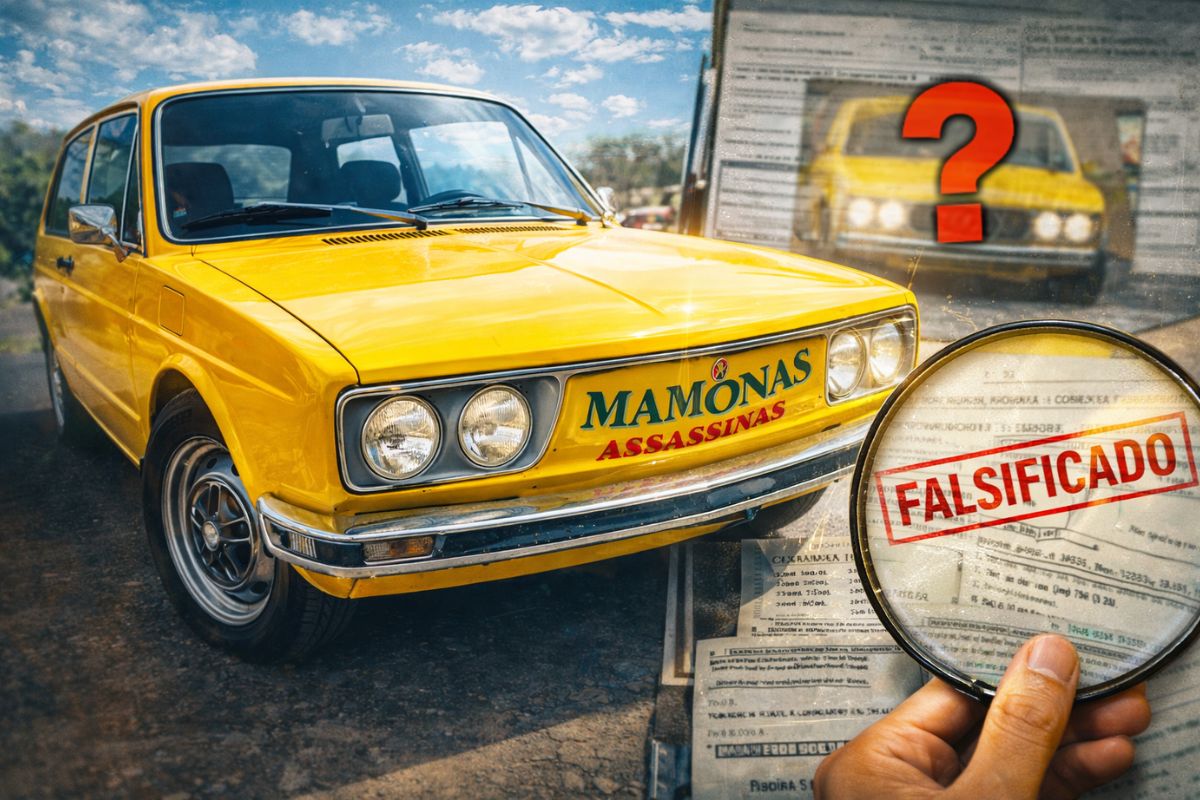
The history of Brasília attributed to Mamonas Assassinas gained new suspicions after old versions, conflicting records, and testimonies from different programs began to indicate that the car shown today may not be the same as the clip.
The yellow Brasília linked to Mamonas Assassinas has always been treated as one of the greatest visual symbols of the band, but the version currently presented as original has raised difficult-to-ignore doubts. The problem lies not only in the car’s appearance, which still resembles that of the clip, but mainly in the sequence of incompatible stories about raffles, seizures, recoveries, restorations, and ownership transfers.
The more these versions are compared, the more the case seems to drift away from a common restoration and closer to a more uncomfortable hypothesis. The main suspicion is that the car displayed today as an authentic relic of Mamonas Assassinas may actually be a very well-made replica, supported by a narrative that changes depending on the source.
The car became a symbol long before the controversy

The yellow Brasília gained strength in popular imagination because of Mamonas Assassinas and the song “Pelados em Santos,” where the car became a central part of the band’s visual identity.
-
‘Populous’ city in Rio among the worst in Brazil in national ranking and exposes silent development crisis.
-
Couple buys house in the South Zone of São Paulo, opens a hidden door in the garage, and finds a secret wine cellar with dozens of old wines forgotten since the 1970s.
-
With 19,000 tons, 199 meters in length, and the capacity to carry 720 marines, the ROKS Marado has become a floating amphibious base that extends South Korea’s naval reach in one of the most tense regions on the planet.
-
The United States has unveiled the MQ-25 Stingray, the world’s first carrier-based tanker drone designed to operate on aircraft carriers and extend the range of naval fighters.


The model featured striking elements, such as characteristic wheels, fog lights, adapted mirrors, and a look reminiscent of the type of customization very common in used cars of the time.
This symbolic weight helps explain why the car continued to attract so much attention after the members’ deaths.
It was not just an old vehicle painted yellow, but an object directly linked to the public image of one of the most popular bands in the country in the 1990s.
The versions about the car’s whereabouts never matched
Over the years, the most repeated narrative said that the Brasília of Mamonas Assassinas would have been raffled in 1996, gone to Rio de Janeiro, ended up seized for lack of licensing, and then recovered and restored by Dinho’s family. The problem is that this story never appeared in a stable form.
At different times, versions emerged claiming that the car was very deteriorated and that it was necessary to combine parts from two vehicles.
In other accounts, it was said that the chassis was original and the body was not. In others, the opposite. When the same historical piece changes so much in identity according to the account, what comes into question is not a detail, but the entire authenticity of the car.
The document in Dinho’s name made the story even stranger
The suspicion gained more strength when the Brasília was presented on television as the original car, accompanied by the claim that it was still in Dinho’s name, Alexander Alves Leite. This point draws attention because it contradicts the logic of the most well-known story about the vehicle.
If the car was really raffled and passed through other hands, the permanence or formal return to the name of a member who died decades ago sounds at least improbable.
The documentary contradiction became one of the heaviest elements of the case, because it does not depend only on memory or oral account, but on a registral explanation that does not seem clear.
The name of the previous owner also does not add up
Another layer of doubt appears when trying to trace who the previous owner of the car was. Comments cited in the investigation point to a fan named Valmir, but the consultation mentioned in the material would indicate another name, Marizete Prada dos Santos, as the previous owner.
This mismatch weighs heavily because it directly affects the link that could explain the origin of the car currently displayed.
If the chain of ownership is confusing, the chance that we are facing a narrative reconstruction increases significantly. Instead of a firm documentary line, what emerges is a succession of names, gaps, and transfers without clear dates.
An old report brought a detail that changed everything
The case became even more delicate when an older report from Record began to be re-evaluated. In it, a Brasília with license plate CFW7948 appears, associated with an owner named Valmir.
In the material, the owner does not present the car as original. On the contrary, he describes it as a “cover,” a tribute to the true Brasília.
This excerpt is decisive because it anticipates by many years the circulation of a Brasília very similar to the one that would later be treated by some programs as the original recovered.
If this car already existed before the restoration narrative consolidated, the hypothesis of a replica ceases to be mere speculation and gains concrete basis within the presented chronology.
The media history itself helped to confuse the story


Another important element is that different programs began to treat different cars as if they were the same vehicle.
At one moment, a replica appeared as original. At another, the Brasília presented years later came surrounded by a new explanation about rescue and restoration. This created a perfect environment for confusion.
In the case of Mamonas Assassinas, the emotional appeal also contributes to fragile versions gaining strength easily.
The public wants to believe that that symbol has been preserved, and this opens space for poorly verified narratives to continue circulating for years.
When emotion comes before verification, the story can be repeated many times without ever having been truly proven.
What supports the suspicion of a well-made replica
The current distrust does not arise from a single detail, but from the accumulation of inconsistencies. There is the document in Dinho’s name, there is the doubt about the sequence of owners, there is Valmir’s old statement classifying his Brasília as a cover, there is the absence of solid visual evidence about seizure and recovery, and there is also the reminder that making a faithful replica of an old Brasília would not be technically difficult.
Therefore, the most prudent conclusion is not to categorically assert that everything was fraud, but to recognize that the authenticity of the Brasília associated with Mamonas Assassinas today is far from seeming resolved.
In light of what has been gathered, the hypothesis that the car currently displayed is merely a very well-constructed replica has begun to seem more plausible than the official narrative repeated in programs and reports.
The mystery continues to be greater than certainty
In the end, what remains is a void of definitive proof. The yellow Brasília remains visually linked to Mamonas Assassinas, but that is no longer enough to settle the discussion about its real origin.
There are no consistent transfer dates, there are no clear ownership records, and there are contradictions between testimonies, programs, and cited documents.
When a historical object depends more on conflicting versions than on solid evidence, doubt ceases to be a detail and becomes the center of the story. And that is exactly what happens here.
Do you think the Brasília displayed today as the car of Mamonas Assassinas is original or does everything indicate that it is a very well-made replica?






Seja o primeiro a reagir!