





 Portuguese
  English
  Spanish
  3 min of reading


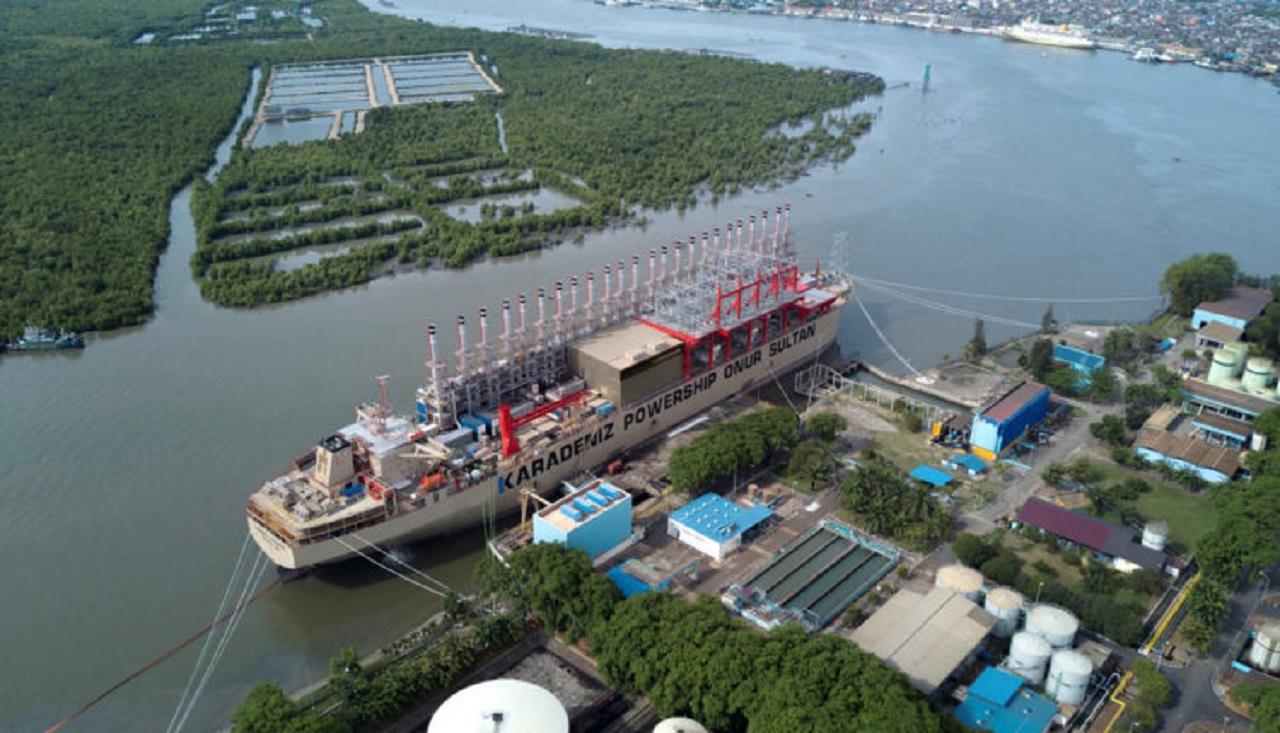
The First Floating Thermoelectric Power Plant Arrives in Brazil, and During the Next Few Weeks, Four More Units Will Arrive in the Country, Together Capable of Generating 560 MW of Electricity.
The first floating thermoelectric power plant expected to operate in Brazil arrived in the country this Tuesday (17). The thermoelectric plant, which is also a ship, is currently anchored at the Port of Angra dos Reis, on the Costa Verde, but officially is in customs waters, waiting for an environmental license to enter the country in fact. In the coming weeks, it is estimated that other similar plants will arrive in Brazil. In total, the four units will be able to generate 560 megawatts, enough to supply about 2 million people.
Floating Thermoelectric Plants Will Stay in Sepetiba Bay
Karpowership, the Turkish company responsible for the plants, was one of the winners of the emergency auction held at the end of last year, precisely during the period of water scarcity, which brought back one of the worst rationings in history.
According to Gilberto Bueno, project director of the company, the contract for the floating thermoelectric plant has a defined term of three and a half years to guarantee energy reserves during this period. The executive states that some unforeseen events occurred in the transmission line of one plant; the floating thermoelectric plant can be called to operate instantaneously and within minutes the energy will all be on the grid, ensuring Brazil’s energy security.
-
Florianópolis will receive a million-dollar BRT that will begin construction in 2026 with nearly 400 million in funding from the federal government and the Inter-American Development Bank, and the map already shows the routes for the exclusive bus corridors.

-
Without a blueprint, without an engineer, and using scrap from the dump, a father spends 15 years building an 18-room castle for his daughter, featuring tram tracks, 13 fireplaces, and over 700 m², which may now be demolished.

-
A megaproject worth R$ 89 billion is advancing in Iraq and promises to change the game in global trade by creating a new corridor between Asia and Europe, reducing traditional routes and repositioning the country as a logistics powerhouse.

-
Goodbye bedside table: floating shelves become a trend in 2026 by freeing up space in the bedroom, improving circulation, bringing visual lightness, and integrating technology without taking up floor space.


According to the project, the thermoelectric plants will be anchored in Sepetiba Bay, 3 km from the coast, alongside the unit that supplies the other vessels with gas. All units will be connected to the transmission line, which is about 15 km long: three in the water and the other twelve on land, cutting through the industrial district of Santa Cruz, located in the West Zone of the Fluminense Capital, until reaching the Furnas substation, where electricity enters the National Interconnected System (SIN).
MPF Questions Environmental Licensing of Floating Plants
Despite everything, the project has become the target of an action by the Federal Public Ministry, which is questioning the environmental licensing conducted by Inea, the competent state agency. According to the MPF, there are flaws in the process, despite the floating thermoelectric plant being the first in the country.
As there is no assembly or construction, considering that the thermoelectric plant already comes ready, there was no prior licensing of the floating plants. However, the company claims that various studies are underway to assess the environmental changes when the plants enter operation.
It is worth noting that the transmission line, which has 36 towers, estimates the clearing of vegetation of at least one hectare, equivalent to a football field. The Turkish company committed to carrying out compensations to the environment. According to Inea, the request for licensing to begin operations of the floating plants is still under analysis.
Offshore Projects are Gaining Attention in Brazil
Samsung Heavy Industries is also developing the first floating nuclear power plant off the coast of Korea and will have contributions from Danish Seaborg for the project’s development.
So far, Samsung has signed a memorandum of understanding with Seaborg, a company specialized in the development of compact molten salt reactors (CSMRs). The compact reactors can generate energy very efficiently, without emitting polluting gases, such as CO2.
These reactors are much smaller compared to conventional nuclear power plants and can be used in any type of project that requires a relatively small amount of energy compared to the scale of traditional nuclear power plants.









Seja o primeiro a reagir!