





 Portuguese
  English
  Spanish
  4 min of reading
  1 comment


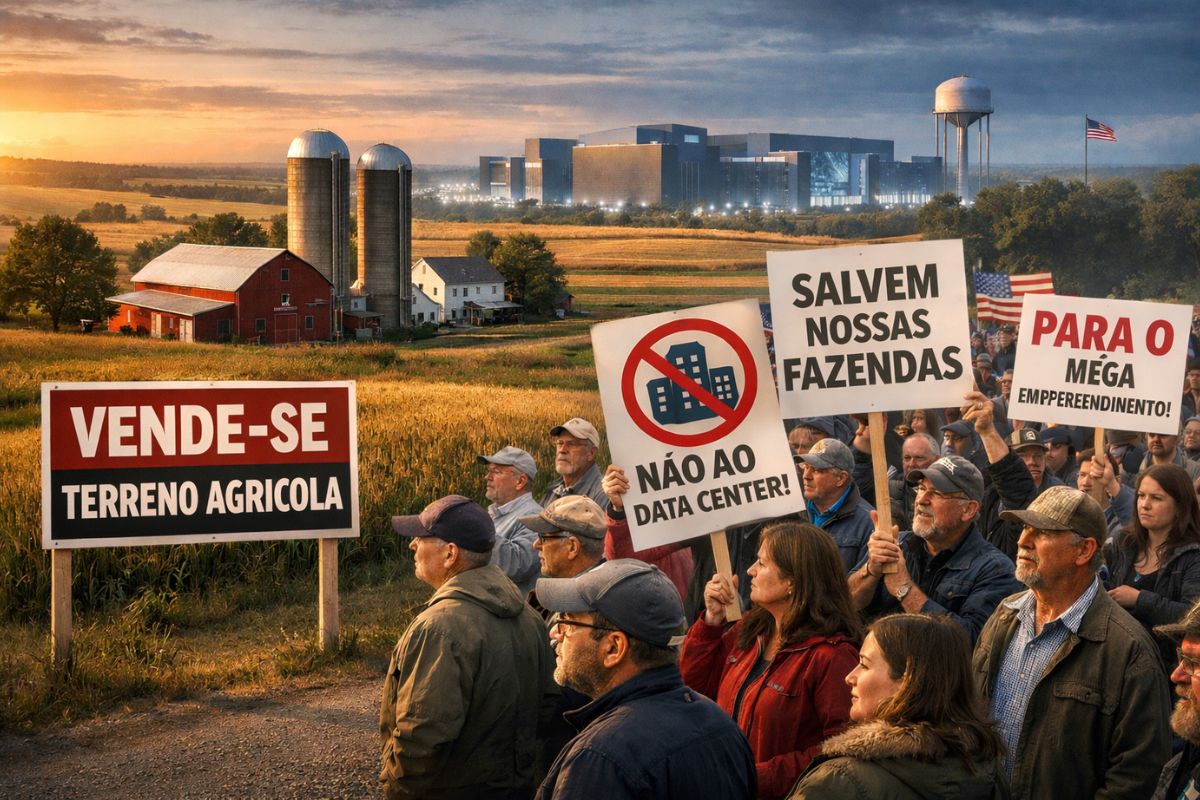


Producers And Neighbors In Mishicot, Northeastern Wisconsin, Reacted After Land Companies Like Cloverleaf Infrastructure And NSI Land Services Sought Farms For An AI Data Center. A Farmer Received An Offer Of US$ 70 To 80 Million For Up To 6,000 Acres; The Debate Exposed Local Fear And Uncertainty.
The Producer who lives off the land usually measures the future in harvests, fences, and seasons, but in Mishicot, Northeastern Wisconsin, that calendar was upended by an offer that came with big numbers and even bigger questions.
On Monday night, dozens of residents packed a restaurant to take a stand against the possibility of an artificial intelligence data center in the area, after local farms began to be approached by companies prospecting and developing land for this type of venture.
Mishicot On Alert: How The Conversation Left Private And Turned Into A Packed Meeting
The mobilization in Mishicot did not begin as an abstract debate about technology, but rather as a series of direct contacts with rural property owners.
-
In a flooded well, archaeologists found a 1,700-year-old Roman egg that still contains clear and yolk intact inside the very thin shell.

-
Something is happening around the Earth: Inside the huge explosion of fireballs in 2026

-
A hot air bubble coming from Argentina expands over Brazil, causing thermometers to exceed 38 degrees with a thermal sensation of 40 degrees in late March, affecting 6 states at once.

-
The radish leaf that almost everyone throws away has more polyphenols, flavonoids, and fiber than the consumed root, and a 2025 study showed that the leaf contains compounds that protect the intestine, combat inflammation, and may inhibit the growth of cancer cells.

Companies like Cloverleaf Infrastructure and NSI Land Services reportedly sought farms to buy properties, or parts of them, in a typical move for those trying to assemble a mosaic of contiguous areas.
When the approach stops being a phone call and turns into a feeling of siege, the community reacts. Monday’s meeting, with dozens of people, signaled that the issue no longer belongs just to the Producer who received the offer: it now involves neighbors, other farms, the layout of the neighborhood, and the identity of a region that organizes itself around rural work.
Offer Of US$ 70–80 Million And The Dilemma Of The Producer Who Sustains An Ongoing Operation
Among the accounts, Anthony Barta from Two Creeks makes clear why the discussion strikes so deep.
He stated that his farm was one of those that received an offer to buy and described the weight of responsibility: he and his family own the business and raise nearly a thousand animals.
His question was not just “how much is it worth,” but rather “what happens on this side of the fence” if a mega-development is installed next door.
For a Producer, it is not just land: it is the source of livelihood, daily logistics, the well-being of the animals, and the predictability needed to keep everything running.
In this scenario, the offer attributed to a farmer in Mishicot, between 70 and 80 million dollars, for a project that could encompass up to 6,000 acres, does not automatically resolve the main issue: the uncertainty about coexistence, impacts, and the permanence of those who stay.
What Is At Stake With An AI Data Center Next To Agricultural Areas
An AI data center is often perceived as a “building of computers,” but the local debate generally goes far beyond the building itself.
The installation tends to involve a chain of needs and adaptations, such as robust electrical infrastructure, connectivity, access routes, security protocols, and continuous operations—elements that can alter the routine of an area where the Producer relies on operational tranquility and a stable environment.
The central fear expressed by residents and rural Producers is the cumulative effect, not just an isolated detail.
Even without a specific project publicly confirmed for a precise point on the map, the mere possibility is enough to raise practical doubts: how would neighboring farms fare, the local flow, the perceived noise, the dynamics of services, and even the community’s ability to influence decisions when the issue gains regional scale.
Declared Interests, Recent Retreats And The Weight Of Municipal Regulations
When approached, Cloverleaf Infrastructure stated that it still has interest in Northeastern Wisconsin as a potential site for a data center, but avoided commenting on a specific project or geographical area, classifying the region as “viable.”
For residents and the Producer trying to plan for the coming years, this combination of declared interest and lack of detail often sounds like an announcement without contour: enough to raise concern, insufficient to answer concrete questions.
The recent history also weighs in. Two weeks prior, the company announced that plans for an AI data center in Greenleaf were canceled after negative community feedback.
Additionally, the company decided not to proceed with the acquisition of land for another center near the border between Kewaunee and Manitowoc counties.
In parallel, in Kaukauna, the City Council amended a law to allow data centers in industrial zones, but with restrictions.
For the Producer and neighbors, these local rules become the real battleground: it is there that the “can or can’t” takes shape and limits.
Mishicot is facing a clash of logics: on one side, the Producer and the community that depend on continuity, neighborhood and predictability; on the other, the attempt to make a mega-project feasible that begins with silent prospecting and advances when it finds regulatory and social space.
If You Were A Producer In Such A Region, Would An Offer Of This Size Change Your Decision Or Would The Weight Of The Community Speak Louder?
And, for those who live nearby, what limits would be non-negotiable before accepting an AI data center as a neighbor: distance, zoning, project transparency, or another very specific condition?









Quem realmente precisa da IA?!