





 Portuguese
  English
  Spanish
  8 min of reading
  0 comments


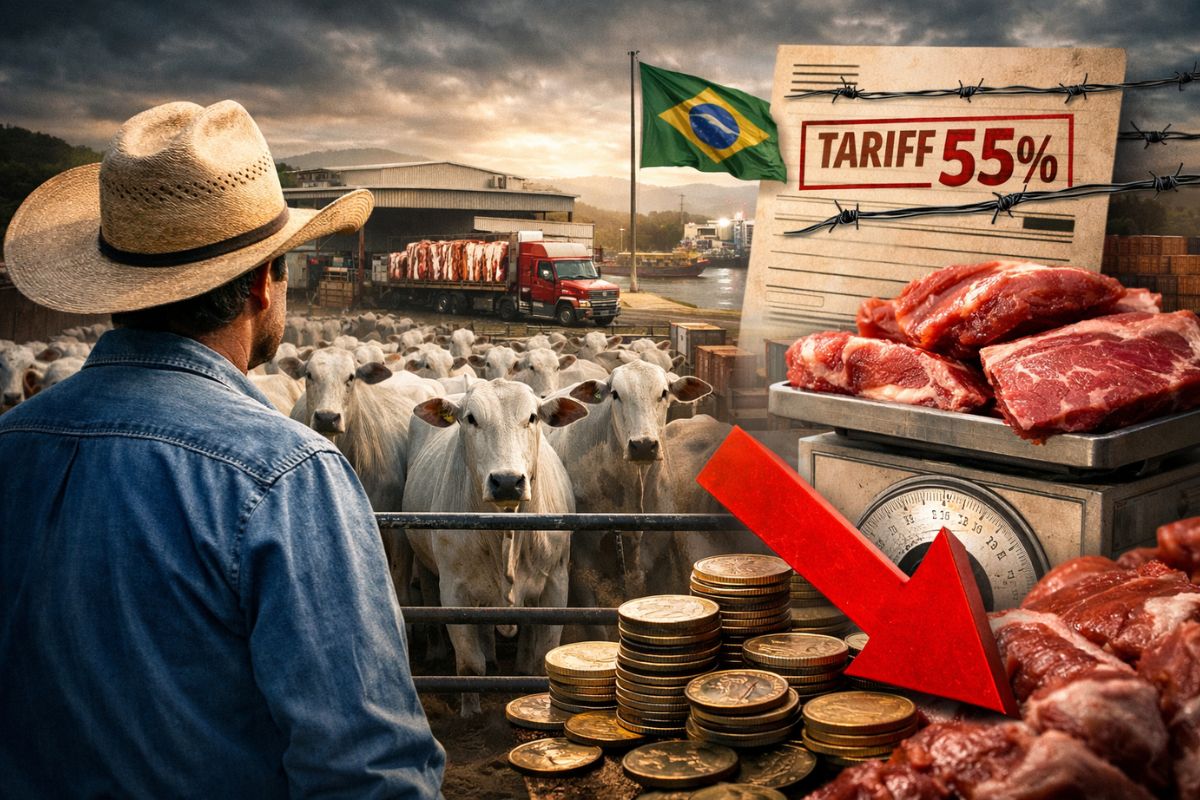
With the 55% tariff applied to the excess of the Chinese quota, Sinduscarne, which represents about 850 companies, anticipates a redirection of volumes, a decline in margins, and pressure on the fat cattle. The rule has been in effect since January 1st and will last for three years, until December 31, 2028, impacting investment decisions.
On January 1st, the new import rules announced by China came into effect and raised an alert in the beef sector in Minas Gerais: the Asian country set an annual quota for Brazilian protein and determined a 55% tariff on the volume that exceeds this limit. The measures, expected to last three years, will remain in effect until December 31, 2028, and Sinduscarne states that it is closely monitoring the developments.
On Wednesday (December 31), the Brazilian government reported that it will act to reduce the impacts of the decision and stated that it will continue working with the Chinese government, both bilaterally and within the WTO, to mitigate effects and defend the interests of the sector. Among the points mentioned, there is the intention to request that the meat already shipped and in transit not be counted within the newly announced quota for additional tariff purposes.
What China Changed and Why the Measure Concerns Minas Gerais
The core of the change is simple to understand and hard to absorb: China, the main destination for Brazilian beef, established an annual cap for the entry of the product without additional tariffs. If Brazil exceeds the cap, the excess will incur a 55% tariff, which may make part of the sales economically unviable or, at the very least, less competitive.
-
Agricultural drone sprayed poison into the air and destroyed the neighbor’s crops, causing 1 million in damages; 48 cows died from nitrite poisoning in the pasture, and Russia is hiding a possible outbreak of foot-and-mouth disease: the week was brutal for the rural sector.
-
Russia cut fertilizers, China cut fertilizers, and oil prices soared with the war in the Middle East: sugarcane producers in the interior of São Paulo are seeing costs explode from all sides and warn that the effects will take months to be absorbed.
-
It does not come from flowers, is produced only every two years, and more than 90% goes straight to Europe: meet the bracatinga honeydew honey from Santa Catarina, considered one of the rarest in the world and overlooked by Brazil itself.

-
They said no to 26 million dollars and would do it all over again: mother and daughter from Kentucky reject a million-dollar offer from a mysterious company that wants to build the largest data center in the state on more than 2,000 acres of rural land.


For Minas Gerais, the fear is not abstract. The state gathers producers, slaughterhouses, processing industries, and a supply chain that depends on predictability to maintain the buying rhythm of cattle, slaughtering, exports, and investments. When the largest global buyer imposes a limit and adds a heavy tariff on the excess, uncertainty spreads throughout the supply chain.
The Yearly Quota and the Numbers That Put Brazil Close to the Limit
China defined annual quotas for Brazil without additional tariff, with gradual increases, but still below what the sector projects as actual export flow:
- 2026: 1.106 million tons
- 2027: 1.128 million tons
- 2028: 1.154 million tons
Sinduscarne argues that the announced levels would not be sufficient to absorb Brazilian production intended for the Chinese market, using recent historical data as a reference:
- In 2024, Brazil exported about 1.34 million tons of beef to China
- In 2025, the sector expects to end the year with shipments close to 1.6 million tons
The calculation that underpins the concern is straightforward.
If Brazil were to repeat in 2026 the level of 2024, there would be an approximate excess of 234,000 tons above the quota of 1.106 million. If Brazil approaches the projected level for 2025, the excess could be close to 494,000 tons.
In other words, with the volumes cited by the sector, exceeding the quota would not be a distant risk; it would be a real possibility, and each ton above the limit could fall under the 55% tariff rule.
Why the 55% Tariff Changes the Economics of Shipping
The 55% tariff is not a “light adjustment”. It alters the financial viability of the excess because it directly impacts the final entry price of the product in China. In practice, this creates three interconnected effects:
- Forced Discount on the Selling Price of the Excess
To keep the product competitive even with the tariff, exporters may be pushed to negotiate lower prices, eroding margins. - Redirection to Other Markets
If selling to China becomes more challenging for the excess, the alternative is to seek other destinations. However, as highlighted by Sinduscarne, these markets may have lower absorption capacity or offer less attractive prices. - Internal Volatility
When part of the volume that was going to export needs to find a new path, the adjustment can hit the domestic market in the form of price pressure and fluctuations.
It is at this point that the concern from Minas Gerais gains strength: external trade shocks can lead to price instability here.
The Alert from Sinduscarne and the Sector’s Perspective in Minas
In a statement, Sinduscarne, an entity that brings together about 850 companies, stated that it is closely monitoring the changes and highlighted risks to competitiveness and planning. President Pedro Braga was direct in pointing out the kind of effect that may appear first.
According to him, the new rule may reduce competitiveness and generate the need to redirect volumes. When a large volume is redirected to smaller markets, the price tends to decrease because the competition for space increases and the buyer gains bargaining power.
The entity also listed the expected consequences for the sector:
- Pressure on beef prices
- Reduced margins for slaughterhouses
- Increased volatility in the domestic market
The phrase “closely monitoring” may sound generic, but the content of the statement points to a specific fear: losing commercial predictability precisely in the most relevant market for Brazilian beef.
Fat Cattle, Margin, and the Domino Effect in the Production Chain
Fat cattle is often the indicator that summarizes the market mood. If exports slow down or lose profitability, slaughterhouses recalibrate purchases, and the impact reaches the producer.
The mechanism is known in the sector, but the 55% tariff adds a new layer: even if Brazil continues exporting, the existence of a cap creates an “invisible line” in the market. Up to the quota, shipments tend to follow the normal course. Above the quota, costs rise abruptly, and the excess begins to compete for alternatives.
This scenario may provoke:
- Loss of a clear price reference when the market tries to guess how much of the volume will remain within the quota and how much will fall into the taxable excess
- Greater difference between contracts, depending on the time of year and the level of quota usage
- Risk of concentration of shipments during periods when there is still “quota space”, increasing logistical and commercial competition
For producers, this raises practical doubts: sell now, hold, fatten more, slaughter earlier, negotiate contracts. When the rule changes, planning also changes.
The Uncertainty That Could Hinder Investment in Minas and Brazil
Another point emphasized by Sinduscarne is the effect on investment. The logic is clear: investment depends on a stable horizon. If the main destination creates an “artificial” limitation on volumes, producers and industries start operating with uncertainty.
The statement mentions that the measure tends to hinder investments in the production chain, as China is the main destination for Brazilian beef. Even if Brazil remains the largest supplier, limiting volume creates revenue and margin risks, affecting the decision on:
- Industrial capacity expansion
- Hiring and retaining labor
- Purchase of technology and modernization
- Expansion projects and new slaughters
- Production planning throughout the year
In Minas, where the meat and derivatives industry has reach and presence in different regions, the concern spreads: the problem is not just the exporter; it is of the entire chain, from the field to the slaughterhouse.
What the Government Said on December 31 and Which Fronts It Intends to Activate
On Wednesday (December 31), the Brazilian government stated that it will act to reduce the impacts of the additional tariff. The statement was signed by the Ministries of Foreign Affairs, Development, Industry and Commerce, and Agriculture and Livestock.
The text states that the government has acted in a coordinated manner with the private sector and will continue working with the Chinese government both bilaterally and within the WTO, aiming to mitigate the impact and defend the interests of workers and producers in the sector.
In addition, there is a relevant operational point: the government is expected to request the Chinese authorities that Brazilian beef already shipped and in transit not count against the newly announced quota for tariff application purposes.
In practice, this request attempts to prevent a scenario seen as particularly unfair by the sector: products already on their way being “caught” by the new rule, reducing the margin of a shipment that was negotiated under another commercial expectation.
Why the Quota May Be Small for the Volume Cited by the Sector
Sinduscarne maintains that Brazil may exceed the authorized limit if the quotas remain at the disclosed levels. This assessment stems from a simple comparison between quotas and recent volumes.
If the sector estimates shipments of 1.6 million tons in 2025, the quota of 1.106 million in 2026 does not keep pace, even with an increase to 1.128 million in 2027 and 1.154 million in 2028.
This creates an operational dilemma: either Brazil reduces the volume destined for China, or accepts that a significant part of the excess will fall under the 55% tariff, directly impacting price, margin, and commercial strategy.
What Could Happen with the Excess: Three Paths and Their Costs
The excess that exceeds the quota faces difficult choices, none of them perfect.
1) Pay the 55% Tariff and Continue Selling
This is the most straightforward path, but it may require price reductions to maintain competitiveness, eroding margins.
2) Redirect to Other Markets
Sinduscarne warns that other destinations may pay less or absorb less volume. This means seeking alternatives, but possibly with lower profitability.
3) Rebalance the Flow of Production and Export
This is the most complex adjustment: it involves buying cattle, planning slaughter, and the export schedule, which may generate volatility in the domestic market.
In all scenarios, the critical point is the same: the 55% tariff acts as a barrier that changes the economics of the excess, and the market needs to reorganize itself around this new line.
Next Steps and What the Sector Says It Will Defend
Sinduscarne concludes the statement by affirming that it will continue monitoring developments and advocating for solutions that preserve commercial predictability and market stability.
The choice of words reveals the priority: predictability. For producers and industry, predictability is worth money, as it reduces the risk of wrong decisions in cattle purchases, hiring, exports, and investments.
From now on, the discussion is likely to focus on two axes:
- Negotiation and Mitigation, to reduce the impact of the excess and seek understanding with China
- Commercial Strategy, to deal with the volume that may remain above the quota and, therefore, subject to the 55% tariff
In your opinion, will the 55% tariff actually drive down the price of fat cattle in Brazil, or will the sector manage to redirect the excess without suffering a severe blow to margins?








Seja o primeiro a reagir!