





 Portuguese
  English
  Spanish
  7 min of reading
  4 comments


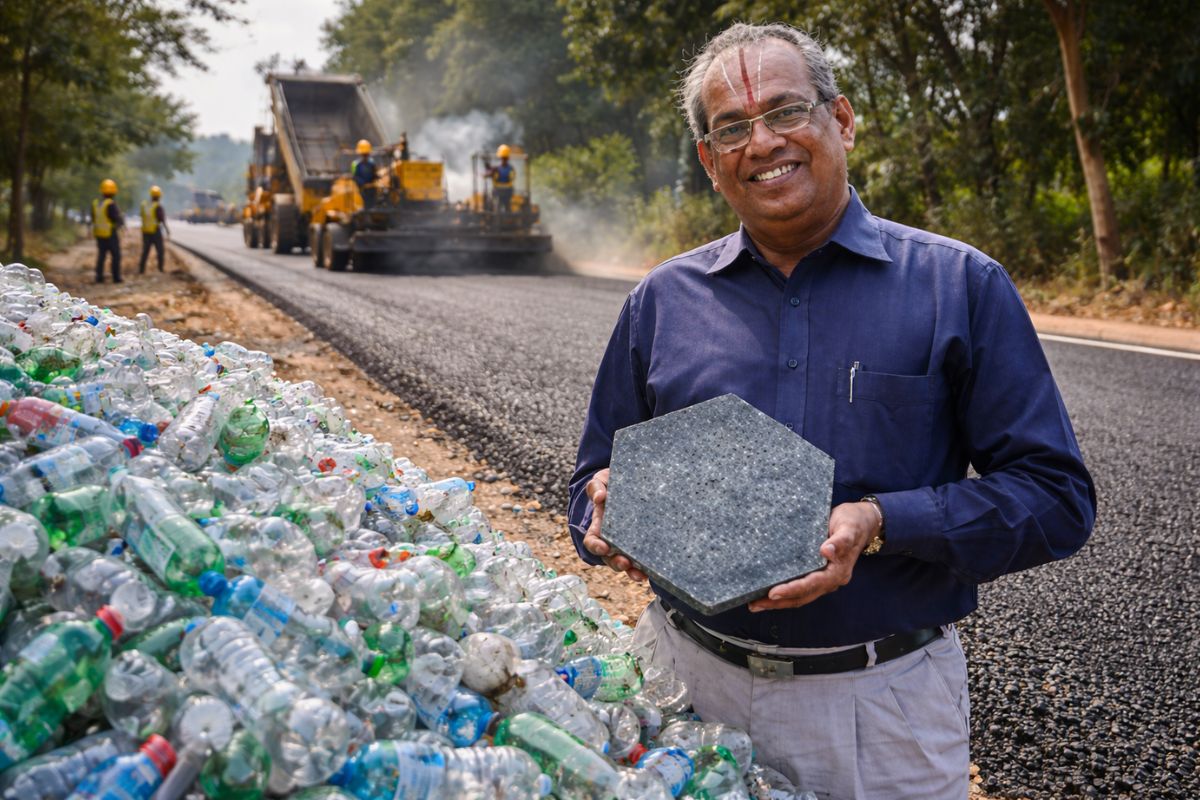


In India, the use of crushed plastic in mixtures with stone and bitumen transformed a university workshop into a reference for more durable roads, with a 6% to 8% reduction in asphalt consumption, adoption in thousands of kilometers, and official support to expand the technique in different regions of the country.
The use of crushed plastic in Indian highways transformed a chemistry professor into a global reference for road infrastructure. Starting from experiments initiated in 2001 at the Thiagarajar College of Engineering in Madurai, Dr. Rajagopalan Vasudevan developed a technique that incorporates plastic waste into the mixture with stone and bitumen, creating a more durable surface with a lower need for conventional binder.
The proposal gained traction because it tackles two problems at once. On one hand, the disposal of plastic waste that accumulates in landfills, streets, and drainage systems. On the other, the fragility of roads that suffer from infiltration, poor traction, and pothole formation. By turning waste into part of the road, the technique aims to convert environmental liability into structural gain.
How a Chemistry Professor Decided to Address the Problem Through the Material

Rajagopalan Vasudevan did not start with the idea of banning plastic. On the contrary. The professor argued that the material had a concrete importance for low-income families and that banning it could affect the quality of life of those who depend on it in their daily lives.
-
The lack of welders, electricians, and operators becomes a structural threat in 2025, with the construction industry and manufacturing already suffering from delays, cost pressures, and labor shortages in Brazil.
-
Brazil and Paraguay are just 46 meters away from a historic union on the bioceanic bridge that promises to revolutionize trade between the Atlantic and the Pacific.

-
With 55 km over the sea, a cost of US$ 20 billion, and enough steel to build 60 Eiffel Towers, China’s largest project has connected Hong Kong, Zhuhai, and Macau in a colossal bridge that defies the logic of engineering.

-
A trick with joint compound transforms a Styrofoam ceiling into a plaster-like ceiling: leveled panels, wires and mesh at the joints, sand, paint, and change the environment while spending little today.

The problem, in his view, was not the plastic itself, but the way it was discarded.
It was with this logic that he began a series of experiments in his workshop in Madurai, in southern India. The goal was to find a useful destination for plastic waste without resorting to simple burning or landfilling, two paths that, according to him, exacerbate environmental impacts.
Instead of treating plastic as an automatic enemy, he began to treat it as poorly managed raw material.
By heating the material in a molten state, Vasudevan observed that plastic had favorable behavior as a binder.
The subsequent connection was almost chemical by instinct: if bitumen is also a substance rich in hydrocarbons and polymers, perhaps the two materials could interact functionally within the pavement.
When the crushed plastic was incorporated into the mixture of stone and bitumen, the result showed firm adhesion between the elements.
From there, the professor maintained that he had found not only a method of disposal but a new way to build roads with better performance.
What Crushed Plastic Changes in the Road Mixture

The logic of the process is relatively straightforward. The asphalt is heated to about 170 °C, and crushed plastic with a size smaller than 70 microns, including multilayer fragments, is sprinkled over it. Then, the heated bitumen is added.
The melted plastic interacts with the stone and the binder, forming a final surface described as shiny and more resistant.
According to Vasudevan, this method reduces by 6% to 8% the amount of bitumen typically used in paving.
In practical terms, a conventional road would require 10 tons of bitumen per kilometer. The modified road with plastic would use nine tons of bitumen and one ton of recycled plastic for surfacing.
For each kilometer, the system saves one ton of bitumen and absorbs one ton of waste.
The structural gain appears in two main fronts. The first is the tensile strength, which improves the durability and flexibility of the pavement. The second is the reduction of infiltration.
When the layer of molten plastic fills the gaps between gravel and bitumen, it makes it difficult for rainwater to enter, which helps avoid structural defects and pothole formation.
This combination makes the technique attractive in contexts of difficult maintenance and intense wear.
A road that cracks less, infiltrates less, and consumes less binder tends to interest both public managers and those thinking about urban waste, especially in countries that deal with high volumes of plastic disposal and extensive road networks.
From the 18-Meter Road to the Advancement of Thousands of Kilometers

The physical starting point of the technology was modest but symbolic. In 2002, after receiving encouragement from then-scientist and future president Abdul Kalam, Vasudevan paved an 18-meter road within the university campus using bitumen modified with plastic. The section, according to reports, remains intact to this day.
From there, the technique left the university environment and gained administrative scale. Vasudevan received a patent for the process in 2006, and the kilometers began to accumulate.
The baseline material indicates that almost 10,000 kilometers of Indian roads had already been paved with his technique at one point, while later the advancement in Tamil Nadu reached 16,000 kilometers.
At the national level, the government authorized the paving of at least 13,000 kilometers with the material. Of this total, 8,600 kilometers were already completed, according to Dr. IK Pateriya from the Ministry of Rural Development in New Delhi.
This means that the proposal ceased to be an academic curiosity and became part of public infrastructure policy.
This scale explains why Vasudevan’s name gained visibility beyond the university.
In January 2018, he received the Padma Shri, one of India’s highest civilian honors, precisely for this applied research.
The tribute serves as recognition that the technique has gone beyond the testing bench and entered the concrete map of the country’s road works.
The Environmental Advantages and the Sensitive Point of Collection
The technique is not sold simply as road engineering. It is also presented as a response to the accumulation of waste.
In the professor’s workshop, crushed plastic comes from bottles, notebook covers, thin bags, and other daily discards.
The material, once reduced to strips and fragments, enters a productive circuit that tries to push waste away from landfills.
Almitra Patel, linked to the solid waste management committee of the Supreme Court of India, emphasizes that the technology could push the system towards “almost zero landfills” if adopted seriously for different types of multilayer packaging.
The argument is strong because it shifts post-consumer plastic from a purely terminal condition to a structural function.
The problem, according to her, lies in collection. It is not enough for the technique to exist. It is necessary to gather and sort the material in quantity and with some operational consistency.
The road may absorb waste, but someone needs to collect that waste in the real world, where it is scattered, contaminated, and often outside organized sorting systems.
That is why self-help groups, citizens, and schools from various states have begun to collaborate on collection to supply the initiative.
Without this prior link, the technique loses some of its strength. The pavement depends on chemistry but also on waste logistics.
The Debate Over Toxic Gases and the Limits of the Solution
Not all readings of the technology are enthusiastic. One of the criticisms raised by environmentalists concerns the risk of emitting toxic gases from heating plastic waste.
Vasudevan counters this point by stating that the material used is only softened at 170 °C and that decomposition with the release of toxic gases would only occur above 270 °C.
According to him, as the plastic coats the stone and interacts with hot bitumen, its properties change, and the material does not decompose later under exposure to light and heat.
This technical defense helps support the safety of the process, but it does not entirely eliminate doubts when working with mixed waste on a real scale.
Polymer science specialist Noreen Thomas from Loughborough University considers the proposal creative but warns that plastic waste is often a complex mixture of materials, not all suitable for the method. Some might burn with the heat; others might become too soft for use as pavement.
Her point is not to reject the idea but to remind that mixed waste rarely behaves as a homogeneous input.
This caveat matters because it prevents the technique from being treated as a universal miracle. The method is promising but depends on composition control, temperature, and application.
In infrastructure, this makes all the difference between a replicable solution and poorly measured enthusiasm.
When the Road Becomes a Symbol of a Bigger Policy
Vasudevan’s case shows how infrastructure can take on a broader role than simply connecting points on the territory.
When a highway begins to incorporate urban waste and reduce part of the consumption of bitumen, it ceases to be just a road work and approaches an integrated policy of disposal, reuse, and public maintenance.
This shift explains why the technique gained so much visibility. It offers a powerful narrative because it transforms discarded waste into useful surface, while promising fewer potholes, more flexibility, and less reliance on a conventional input.
In countries with large road networks and massive waste problems, this has immediate appeal.
Vasudevan furthered the reasoning by creating “plastone,” a building material that uses up to 40% more plastic waste than paving and can become plates for ecological bathrooms or sidewalks. Each block, he says, consumes almost 300 plastic bags and between four and six bottles.
The logic is the same: if the waste can adhere, it can structure.
In the end, the strength of this story lies less in the catchphrase and more in the persistence of a technique that left the workshop, entered the street, gained official support, and became a global reference.
Crushed plastic has ceased to be merely waste and has begun to compete as an infrastructure input.
If your city had to choose today between continuing to landfill plastic waste or transforming part of it into a highway, what would weigh more in your evaluation: the durability of the road, the savings in bitumen, or the care with potential risks of heating and mixing the material?









My No +91 9175796868
pleasectake in account that
1 aging effect out cum since pkatic is waste is might exposed to the Infrared rays by sunlight
2 how microplastic release in invironment since when use in Road constrction material tear& wear is their
3 in food chain how it affect
as well in utility chain how is feasible
since we are shifting its allocation in our utility chain ( CYCLE)
we are not converting
Sir be in touch with me
my above no is whats up no I will share my sincer initiative regarding
i am basically product designer & application engineer
thanks for Your efforts to tackle pkatic waste issue
Dattatray Shantaram Mahale
Dear sir, the plastics in road construction will eventually get into lungs and blood circulation and brains of ever living beings. Yes or no ? Pls advise. Thanks n regards / Satish
Dear Dr. Rajagopalan Vasudevan,
I am truly inspired by your innovative approach of using shredded plastic in road construction. Your work not only contributes to sustainable infrastructure but also provides a practical solution to plastic waste management. It is remarkable to see how this method reduces bitumen consumption while enhancing the durability of roads. I hope to learn more from your research and explore similar sustainable practices in my own studies related to road pavement conditions in Kandahar City, Afghanistan.
Respectfully,
Ahmadullah Angar