





 Portuguese
  English
  Spanish
  3 min of reading
  8 comments


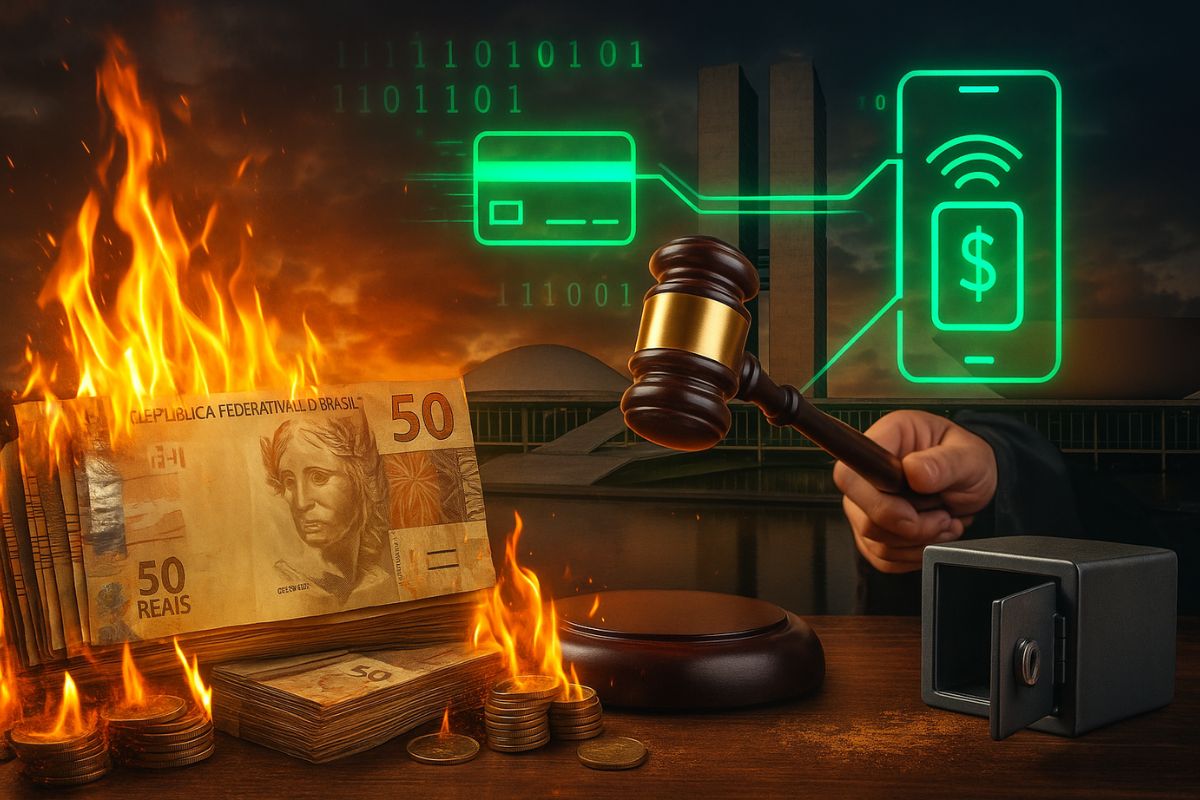


Proposal Presented in the Chamber Proposes Gradual Withdrawal of Bills, Creation of Limits for Carrying Cash, and Total Transition to Digital Means by the End of the Decade.
The Bill 4068/2020, authored by Deputy Reginaldo Lopes (PT-MG), reignited one of the most controversial debates in the Brazilian economy: the end of cash. According to the Marcello Benevides Lawyers office, the proposal could directly impact millions of Brazilians, by establishing deadlines for the withdrawal of circulating notes and even criminalizing the carrying of amounts considered high.
The text provides that notes above R$ 50 would cease to circulate within 1 year after approval. The complete extinction of paper money would occur within 5 years, making Brazil a cashless economy by 2030.
Carrying more than R$ 15.5 thousand in cash would become a crime, and amounts above R$ 1 thousand would require justification of route and proof of origin.
-
A new Brazilian shopping center worth R$ 400 million will be built in an area equivalent to more than 4 football fields, featuring 90 stores, 5 cinemas, a supermarket, a college, and parking for 1,700 cars, potentially generating 3,000 jobs.

-
Larger than entire cities in Brazil: BYD is building a 4.6 km² complex in Bahia with a capacity for 600,000 vehicles per year, but the discovery of 163 workers in conditions analogous to slavery has shaken the entire project.

-
With an investment of R$ 612 million, a capacity to process 1.2 million liters of milk per day, Piracanjuba inaugurates a mega cheese factory that increases national production, reduces dependence on imports, and repositions Brazil on the global dairy map.

-
Brazilian city gains industrial hub for 85 companies that is equivalent to 55 football fields.


Timeline for the Extinction of Physical Money
The Bill establishes a strict calendar: elimination of notes above R$ 50 in just 12 months and complete replacement of paper money with digital means by 2030.
The goal is to prepare the ground for the Drex, the Central Bank’s digital currency expected to operate in 2025.
According to the Marcello Benevides Lawyers, this change would reduce costs associated with printing notes and facilitate the traceability of financial operations.
The Central Bank argues that the Drex could reduce fraud and increase transaction security.
Criminalization of Carrying Cash
One of the most controversial points of the Bill 4068/2020 is the criminalization of carrying large amounts.
Those caught with more than R$ 15.5 thousand in cash would have to prove the origin of the money under the risk of criminal liability.
Additionally, carrying above R$ 1 thousand would require proof of route and purpose of the amount.
For the Marcello Benevides Lawyers, this could create backlogs in the Judiciary and insecurity for merchants, farmers, and transporters, who still rely on cash in their activities.
Official Justifications and Political Resistance
The official argument is to reduce costs and modernize the economy.
Deputy Reginaldo Lopes asserts that digitalization increases efficiency and combats financial crimes.
The Central Bank emphasizes that the Drex will bring traceability and integration to the financial system.
However, there is strong resistance.
In 2024, Deputy Júlia Zanatta (PL-SC) introduced a conflicting project, arguing that eliminating physical currency threatens individual freedom, especially in areas with limited internet access.
Social and Legal Impacts
Jurists and economists warn that the criminalization may directly affect small merchants, street vendors, and rural workers.
Many of them operate in regions where digital means are not accessible.
Another point raised by the Marcello Benevides Lawyers is the risk to citizens’ privacy.
With all transactions recorded, the State would have greater control over the financial lives of the population, which critics consider a form of economic surveillance.
International Comparisons


The Bill 4068/2020 would place Brazil among the countries with the strictest rules against cash.
In China, the digital yuan has been implemented, but without completely eliminating bills. In the European Union, the digital euro is also moving toward coexistence with physical money.
In other words, none of these models have completely eliminated notes, as the Brazilian proposal intends.
The Bill 4068/2020 is still under consideration in Congress, but it has already mobilized supporters and critics.
For some, it represents technological advancement; for others, a threat to freedom and the informal economy that still supports millions of families.
And you, do you think that criminalizing the carrying of R$ 15.5 thousand in cash is a legitimate fight against crime or a threat to the financial freedom of Brazilians? Share your opinion in the comments — we want to hear from those living this reality daily.









Resumindo………. vamos virar uma ****! Sendo rastreados o tempo todo. Vamos viver sendo vigiados a cada passo e a cada respiro. 🤬🤬
É uma ameaça a liberdade financeira de qualquer cidadão brasileiro, tendo em vistas também que nesse projeto tem uma cláusula que seu dinheiro passa a ter validade, se você não usar ele todo automaticamente ele já passa para as mãos do governo. Ou seja estamos fadados a miséria, onde nenhum brasileiro mais conseguirá a prosperar, juntar dinheiro dinheiro ou fazer fortuna.
De louco todo brasileiro tem um pouco, mais saber da loucura dos políticos ainda está pra nascer quem estude está doença crônica que se chama poder ir