





 Portuguese
  English
  Spanish
  4 min of reading


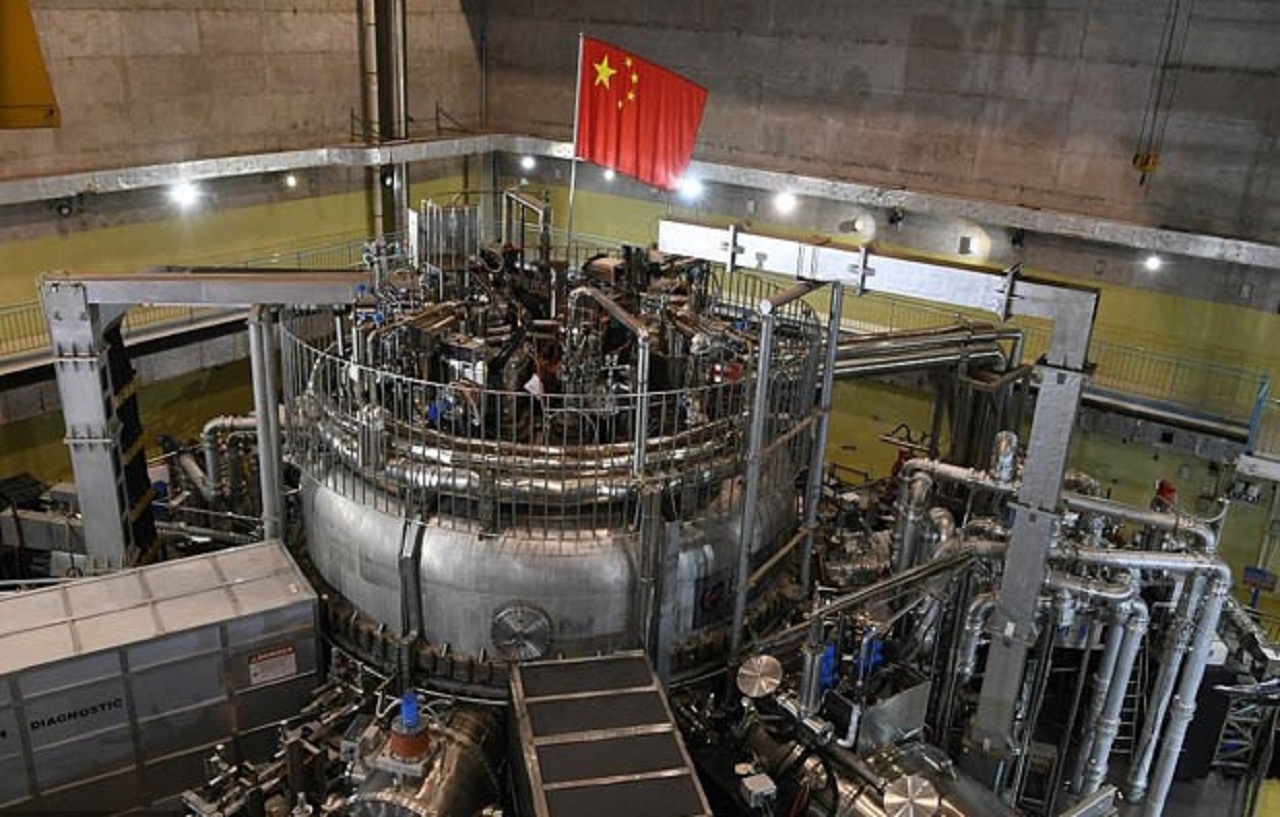
With Various Improvements Already Made on the “Artificial Sun,” Chinese Researchers Believe That Very Soon They Will Be Able to Use This Clean Energy Source to Its Unlimited Potential
Some Chinese scientists, amid an experiment with the Chinese artificial sun, were able to achieve a new world record regarding renewable energy, managing to reach a plasma temperature of 120 million degrees Celsius, lasting exactly 101 seconds, last Friday (31/12). This is considered a critical step towards the direction of an experimental operation study of a fusion reactor.
Read Other Related News
Details About the Chinese “Artificial Sun” Experiment
The announcement about the advancement in the experiment was made by researcher Gong Xianzu from the Institute of Plasma Physics of the Chinese Academy of Sciences (ASIPP), who was also responsible for the experiment conducted in Hefei, the capital of Anhui Province, located in eastern China.
-
Renewable energy advances over protected areas in Brazil, and a survey by the Energy Transition Observatory reveals silent impacts that challenge environmental conservation and pressure sensitive traditional territories.

-
Rio Grande do Sul accelerates energy transition: State invests in renewable technologies and consolidates decarbonization strategies and pathways to attract billions in new industrial investments.

-
With 160,000 m² of collectors, an area larger than 20 football fields, Silkeborg, in Denmark, hosts a solar thermal plant that heats 19,500 homes and could become the largest solar heating plant in the world.

-
A study reveals the expansion of renewable energy procurement in Brazil and shows how companies are taking advantage of opportunities to reduce expenses, ensure energy efficiency, and strengthen strategic environmental commitments.

According to Xianzu, the so-called “artificial sun” managed to maintain a temperature of around 70 million degrees Celsius for about 17 minutes and 36 seconds during the experiment last Friday (31/12).

To exemplify why this experiment is considered fundamental and so important, it can be said that the temperature reached by EAST is impressive, as only the Sun can register “only” a temperature of 15 million degrees Celsius.
The Chinese “Artificial Sun”
The reactor was named “artificial sun” because its aim is to recreate nuclear fusion, which is a process similar to what happens in stars, including the Sun, something that could become a super almost unlimited source of clean and renewable energy.
In May 2021, during other experiments, the Chinese facilities managed to reach temperatures around 160 million degrees Celsius, but for a shorter duration, only 20 seconds. With this new reactor, or “Chinese artificial sun,” the possibilities of having renewable energy for long periods of time increase, reducing costs and acting in favor of sustainability.
The Experimental Advanced Superconducting Tokamak (EAST) is located in the city of Hefei, which is about 500 km west of Shanghai, China. The device is approximately 11 meters tall, eight meters in diameter, and weighs around 400 tons.
Importance of the Artificial Sun
Since mid-2018, China has been working on this “artificial sun”, seeking various means to recreate the nuclear reaction process that occurs in the Sun and other stars.
China believes that the improvement of this reactor – or Chinese artificial sun – will achieve a long-awaited result: an almost unlimited renewable energy source. For this reason, China continues to refine and reassess the possibilities for improvements so that this renewable energy source can be utilized as soon as possible.
Two other reactors are part of the project of the Hefei Institute of Physical Sciences of the Chinese Academy of Sciences. The reactors are located near EAST, but they are smaller than it. One of the reactors was installed in the southwest of China, in the city of Chengdu, and the other reactor was built in Wuhan.
Renewable Energy in Brazil: Aneel Projects Double Investment in Wind and Solar Energy for 2022
Investments in solar and wind energy will continue to grow in Brazil next year due to the expansion of renewable energy sources among residential, industrial, and commercial consumers, and the new regulation for distributed generation. The high cost of electricity in the regulated market, which has no reduction estimates for the coming year, is also contributing to users switching to renewable energy and distributed generation.
The solar energy sector will be a major highlight for next year, according to the National Electric Energy Agency (Aneel). The renewable energy source will contribute about 3% of the national energy matrix by the end of this year.
The number of companies, rural properties, and residences that currently have solar energy installations increased from over 123,000 in 2019 to 215,000 last year and 314,000 by the beginning of this month, according to Aneel.










Seja o primeiro a reagir!