





 Portuguese
  English
  Spanish
  6 min of reading
  54 comments


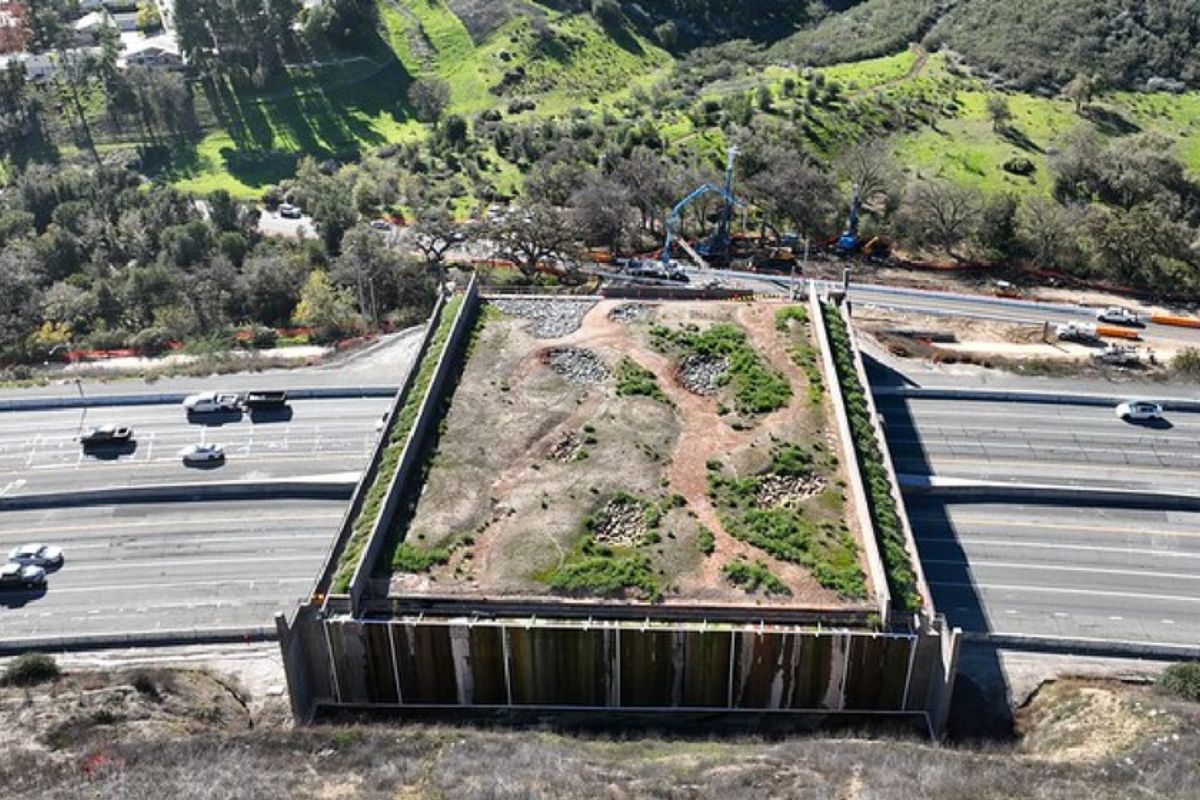


Wallis Annenberg Bridge in California Was Designed as the Largest Ecoduct in the World, It Sits Over US-101 and Is Exclusive to Wildlife and Aims to Reconnect Ecosystems Separated by Asphalt While Reducing Deaths and Billion-Dollar Losses
Roads were made for cars, trucks, and motorcycles, not for deer, cougars, and coyotes. However, when a highway cuts through a natural area, it does not erase the fauna that already lived there. The result is a silent conflict: animals trying to cross, drivers unable to brake in time, serial collisions, lost lives, and billions in damages. It was in this context that California decided to build what is already presented as the largest ecoduct in the world, a mega bridge over US-101 that cost around R$ 100 million and cannot be used by any humans.
Since 2022, the state has been constructing the Wallis Annenberg bridge, a structure that crosses one of the busiest highways in California with a very specific goal: to allow wildlife to cross safely, away from headlights and the noise of traffic. Budgeted at around US$ 19 million, it is expected to be completed between September and December of this year and, upon completion, will be recognized as the largest ecoduct in the world, an elevated ecological corridor that restores continuity to a habitat that asphalt had torn apart.
What Is the Largest Ecoduct in the World and Why Was It Created in California
The logic behind the largest ecoduct in the world is simple but powerful. Instead of forcing animals to compete for space with cars on the road, the bridge creates an exclusive path for fauna, above the highway.
-
The lack of welders, electricians, and operators becomes a structural threat in 2025, with the construction industry and manufacturing already suffering from delays, cost pressures, and labor shortages in Brazil.
-
Brazil and Paraguay are just 46 meters away from a historic union on the bioceanic bridge that promises to revolutionize trade between the Atlantic and the Pacific.
-
With 55 km over the sea, a cost of US$ 20 billion, and enough steel to build 60 Eiffel Towers, China’s largest project has connected Hong Kong, Zhuhai, and Macau in a colossal bridge that defies the logic of engineering.
-
A trick with joint compound transforms a Styrofoam ceiling into a plaster-like ceiling: leveled panels, wires and mesh at the joints, sand, paint, and change the environment while spending little today.


Roads, by definition, connect cities. Ecoducts, on the other hand, exist to reconnect nature that has been separated by those very roads.
In the case of Wallis Annenberg, the mission is to link two green areas cut off by US-101: the Santa Monica Mountains and the Sierra Madre, in the region between Calabasas and Westlake Village.
There, the flow of vehicles has transformed a continuous landscape into two “islands” of habitat. Many animals have become isolated, with less space to hunt, breed, and move around, which increases genetic risks, conflicts, and collisions.
The largest ecoduct in the world is born precisely to weave this ecological fabric back together. It is an attempt to correct, through engineering and vegetation, an impact caused decades ago by the advancement of road infrastructure.
A Bridge That Does Not Carry People, But Reconnects Ecosystems
Unlike a common bridge, full of exposed concrete, metal guardrails, and sidewalks, the largest ecoduct in the world has been designed to “disappear” into the landscape from the animals’ perspective. The structure will be covered with soil, native vegetation, and a terrain shaped to mimic the natural environment of the areas it connects.
In practice, this means that when it is finished, the bridge should look more like a piece of forest than a piece of engineering. The idea is for animals to cross without realizing they are passing over a highway, feeling only a continuous corridor of vegetation beneath their feet.
Images of the construction in progress have caught attention on social media, as for now, the bridge looks like a path that ends in nothing.
This strange appearance is part of the schedule: the connection to the edges of the highway and the complete restoration of the surrounding habitat will be left for the final stage, when the ecosystem will be “stitched” together on both sides.
Collisions, Billion-Dollar Losses, and the Urgency of a Solution
The decision to build the largest ecoduct in the world did not come out of nowhere. It is a direct response to heavy statistics. Estimates from the 11th report “Collisions: A Preventable Disaster,” from the University of California in Davis, indicate that nearly 50,000 deer are killed by vehicles in a year on the state’s highways, not counting dozens of cougars and thousands of other animals that also lose their lives in these collisions.
This data has a symbolic detail: in 2024, more deer were killed by cars than by hunters in California.
It is a clear picture of how highways have become one of the main causes of mortality for local wildlife. And the impact is not only ecological.
The report estimates that collisions with wildlife have generated over R$ 1 billion in damages to California in 2024, including damages to vehicles, medical services, and losses associated with biodiversity.
Each animal struck is, at the same time, a piece of nature lost and an expensive accident for the state.
The largest ecoduct in the world seeks to tackle this problem on two fronts: save lives and reduce future costs.
How Much Does It Cost and Who Pays for the Largest Ecoduct in the World
The Wallis Annenberg bridge project was budgeted at around US$ 19 million, about R$ 100 million.
The investment was made possible by the California Transportation Commission (CTC), which allocated US$ 18.8 million through the Environmental Improvement and Mitigation Program, aimed specifically at reducing the impacts of infrastructure works on the environment.
At first glance, the amount may seem high for a bridge that no human can use. But, in the planners’ logic, the largest ecoduct in the world is a project that pays for itself over time.
Each avoided collision means less spending on ambulances, repairs, lane closures, insurance, and the entire chain of costs that a major accident involves.
Moreover, there is the component that does not directly enter the accounting sheet: preserving biodiversity, preventing the fragmentation of populations, and keeping ecosystems functioning.
For a state that markets itself to the world as an environmental reference, investing in an ecoduct of this scale is also a choice of image and coherence with its discourse.
Who Will Use the Largest Ecoduct in the World
The largest ecoduct in the world was designed to primarily serve large mammals, such as cougars, coyotes, and deer. These are the animals that suffer the most from the lack of ecological corridors and the risks of crossing a highway like US-101.
However, the project is not limited to them. Rabbits, frogs, lizards, snakes, and other smaller species should also benefit from the bridge, using the corridor to cross the highway away from traffic. The greater the variety of species using the ecoduct, the greater the potential to restore ecological flows that are currently blocked.
For drivers, nothing changes in terms of route. US-101 remains in the same place, with the same layout. The difference is that, above the heads of those passing by, there will be a living, silent, and green corridor, through which wildlife resumes paths that existed long before the highway.
When Will Brazil Follow the Same Path with Its Own Ecoducts

The idea behind the largest ecoduct in the world is not exclusive to California. Brazil has also begun experimenting with similar solutions. A recent example is the country’s first vegetated overpass, inaugurated in early 2024 in Rio de Janeiro.
Built at km 218 of BR-101, in Silva Jardim, it was designed to protect the golden lion tamarin, an endangered species and symbol of the Atlantic Forest.
Like the Californian ecoduct, the Brazilian overpass connects two forest fragments separated by the highway, allowing animals to cross without the risk of collisions.
With an investment of about R$ 9 million, the overpass was covered with native vegetation and fauna guiding fences that “direct” animals to the safe crossing point.
It is a smaller version of the concept of the largest ecoduct in the world, but points to the same future: infrastructure that does not ignore nature, but rather tries to coexist with it.
In the end, the message is clear. Roads are not going to disappear. But the way we design these works can radically change the lives of those who do not drive or choose to see their own habitat cut by asphalt.
And you, do you think every major roadway corridor should have at least one ecoduct like this, or do you still see the largest ecoduct in the world as too expensive a luxury compared to other priorities?








Excelente! Cada nación que lo haga es de reconocer y según qué fin, así su dimensión y presupuesto. Mi país Costa Rica lo practica hace mucho en diferentes zonas, tanto para especies arbóreas como terrestres, y siempre habrá obras de éste tipo por hacer. Acá a pesar de nuestro pequeño territorio de 51000 km2, la creación de parque nacionales es proporcionalmente alta respecto a su territorio y esto obliga a la protección de flora y fauna. No todas las naciones lo hacen desgraciadamente.
A engenharia e a indústria, não pensa no alheio,( no próximo). Só visa lucros!
Tinha que virar lei em todo país….. principalmente no Brasil…