





 Portuguese
  English
  Spanish
  4 min of reading
  0 comments


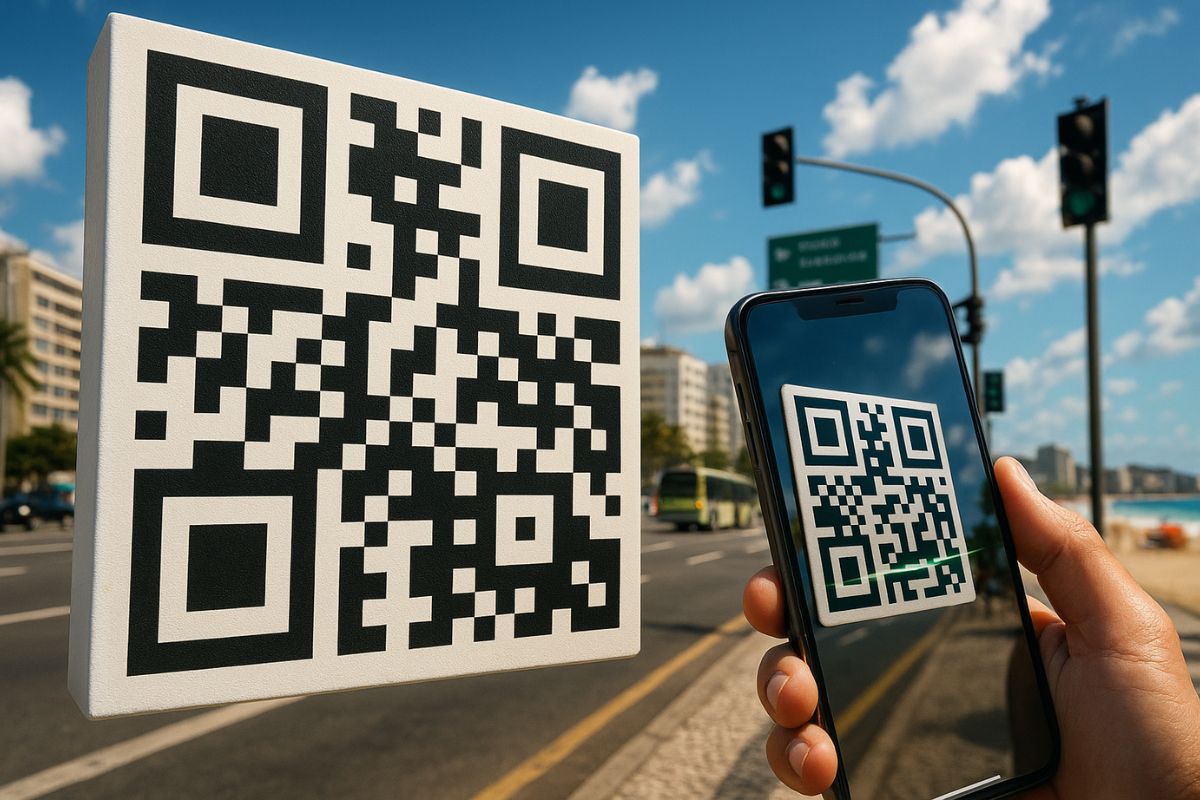
Technology Created in Japan in 1994 Evolved from Industrial Control to Mass Use in Payments, Tourism, and Digital Authenticity, Making the QR Code One of the Most Versatile and Accessible Tools in the Modern World
The QR Code is one of those technological resources that seems simple but hides sophisticated engineering. Created over 30 years ago, the two-dimensional code has established itself as one of the most used tools in the digital everyday, <strong,revolutionizing payments, transportation, tourism, and security authentications.
The technology, which was born in Japan, is now integrated into almost all areas of modern life. From restaurant menus to airplane tickets, the QR Code has become a symbol of the instant reading era and automated validation, driven by the cell phone camera and mobile connectivity.
What Is the QR Code and How Does It Work
The term QR Code comes from the English Quick Response Code, or “quick response code”, and accurately translates its main characteristic: the instant reading of information.
-
Brazilian regions will suffer from the heat: the first heatwave of 2026 raises temperatures to up to 38°C for 5 consecutive days, driven by a heat bubble between Paraguay and Argentina that blocks cold fronts and intensifies dry air.

-
Will Artificial Intelligence replace your job? 31 million are already at risk in Brazil, salaries are falling in technical roles, while AI specialists earn up to R$27,000 and companies are paying record bonuses.

-
Second Sphinx detected under Giza with 80% reliability: radar reveals giant structure, underground cavity, and network of tunnels aligned with the pyramids that could rewrite the history of Ancient Egypt.

-
In China, the world’s longest road tunnel is 22 km long, cuts through a mountain that has challenged engineers for 70 years, includes a 706 m ventilation tower, and reduces dangerous journeys from hours to just 20 minutes.

It is a direct evolution of the traditional barcode, but stores data both horizontally and vertically, which exponentially increases its capacity for information.
Each sequence of black and white squares forms a unique pattern, capable of representing texts, numbers, URLs, and even encrypted authentications.
Three large squares in the corners serve as positioning patterns, allowing the camera to identify the code at any angle.
Other small blocks act as alignment and correction markers, ensuring accurate reading even if the image is partially damaged or tilted.
The Japanese Origin and the Leap from Industry to Everyday Life
The QR Code was created in 1994 by Denso Wave, a subsidiary of Toyota, under the leadership of engineer Masahiro Hara.
The initial objective was to speed up the tracking of parts on automotive assembly lines.
The barcode had already been used since the 1970s but had limitations: it stored few characters and required specialized scanners.
The Japanese innovation was so efficient that the company decided to make the technology publicly available without charging royalties.
This gesture allowed the QR Code to be quickly adopted in various sectors, from factories to logistics systems, until it became a global and free tool for digital identification.
From Anonymity to Success: The QR Code Reaches the Consumer
Despite its technical efficiency, the QR Code took time to win over the public.
In the 2000s, the lack of fast mobile internet and cameras capable of reading codes directly hindered its everyday use. It was common for users to need specific apps to scan the symbol, which reduced interest.
The scenario changed with the popularization of smartphones and the advancement of 4G and 5G connectivity.
Cameras began to automatically recognize the code, and data plans became more accessible.
Thus, the QR Code gained new momentum—first in advertising campaigns and tourism, and then in systems for validation, tickets, and airline boarding passes.
The Role of the QR Code in Digital Payments
The definitive turning point came with the rise of QR Code payments, especially in China and Brazil.
Apps such as WeChat Pay, Alipay, and Pix transformed the black and white square into a symbol of modernity and financial practicality.
In Brazil, the Central Bank’s system established the code as the primary means of instant payment, eliminating the need for physical cards in many situations.
Moreover, the pandemic accelerated the process.
The search for contactless solutions boosted the use of QR Codes in bars, restaurants, and stores, allowing quick payments and inquiries without handling cash or machines.
The format has also been incorporated into official documents, vaccination certificates, and banking authentications, expanding its social and technological function.
Evolutions, Customizations, and New Applications
The QR Code technology continued to evolve.
Versions such as Micro QR, for small packages, and FrameQR, which allows the inclusion of logos and personalized visual elements without compromising readability, were created.
There is also the SQRC, used in corporate and security contexts, capable of storing private data accessible only under specific conditions.
These variations have made the QR Code a hybrid instrument of design and technology, integrating visual aesthetics and digital functionality.
Today, it is an essential part of authentication systems, electronic ticketing, access control, and interactive campaigns.
The Future of the QR Code and Its Challenges
Even with new technologies emerging, the QR Code is expected to remain prominent in the coming years.
Its simplicity, low cost, and compatibility with any camera make it a universal solution.
Still, there are challenges: virtual scams, link cloning, and misuse of fake codes require awareness campaigns and more rigorous digital validation.
Companies and governments are studying the incorporation of cryptographic verification layers and authenticity seals to prevent fraud.
At the same time, the growing use of the QR Code in payment systems and digital identity reinforces its importance in the trust infrastructure of the connected economy.





Seja o primeiro a reagir!