





 Portuguese
  English
  Spanish
  4 min of reading
  0 comments


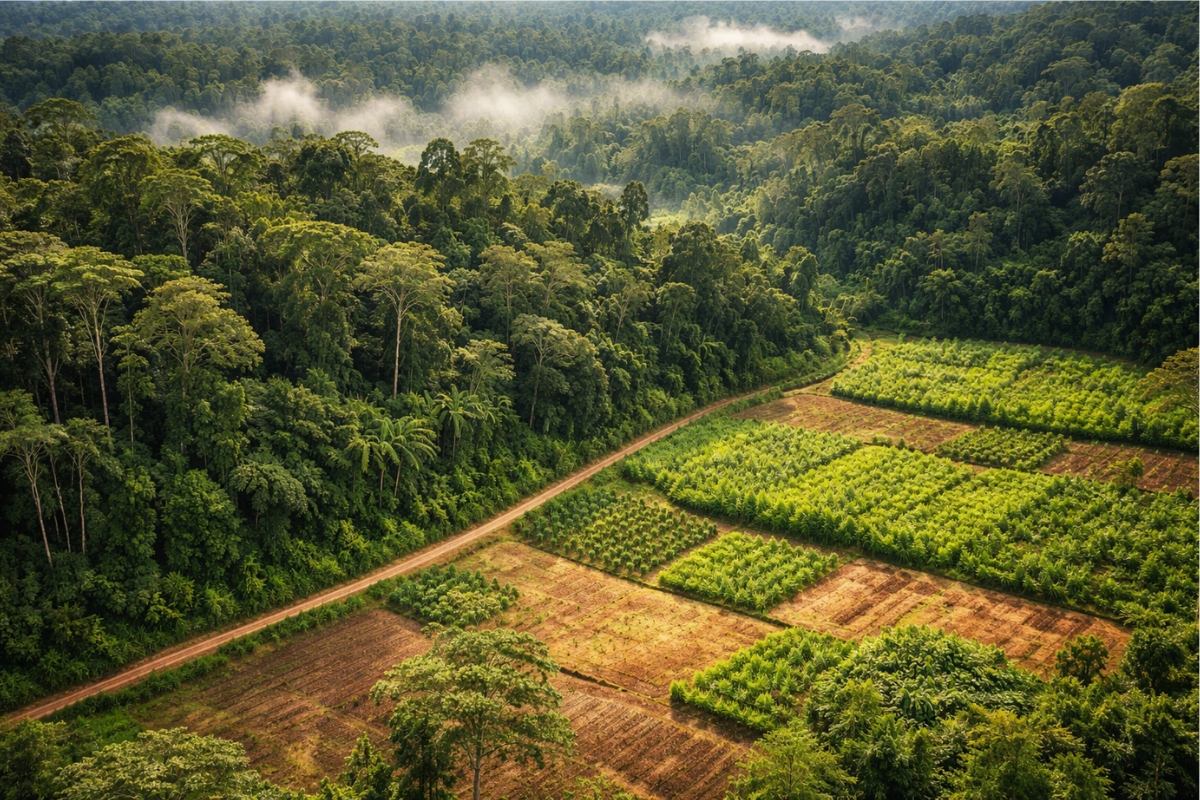
Mass tree planting without criteria can waste soil and reduce climate efficiency, while well-chosen tropical areas concentrate carbon capture, humidity in the air, and greater global cooling capacity.
Researchers have mapped the most efficient tropical areas for global reforestation with up to 50 percent less land and similar climate effects.
The idea that simply planting as many trees as possible is enough has lost ground in light of a new climate picture. The central point now is: the location where the forest grows matters more than the total area reforested.
In practice, this changes the way we look at environmental goals, land use, and public policies. Instead of expanding projects indiscriminately, the more efficient path is to choose regions with greater cooling capacity and lower risk of adverse effects.
-
Something is happening around the Earth: Inside the huge explosion of fireballs in 2026

-
A hot air bubble coming from Argentina expands over Brazil, causing thermometers to exceed 38 degrees with a thermal sensation of 40 degrees in late March, affecting 6 states at once.

-
The radish leaf that almost everyone throws away has more polyphenols, flavonoids, and fiber than the consumed root, and a 2025 study showed that the leaf contains compounds that protect the intestine, combat inflammation, and may inhibit the growth of cancer cells.

-
A planet that seemed to defy the laws of physics has intrigued scientists for decades, until the James Webb revealed what is really affecting Saturn’s rotation.


Up to 450 million hectares less can deliver a similar climate effect
Simulations showed that scenarios with a difference of up to 450 million hectares achieved a very similar global cooling result. This volume corresponds to a gigantic area and reveals that expanding surface area does not always bring proportional gains.
This data repositions the debate on global reforestation. The focus shifts from the race for absolute numbers to geographical efficiency, with a direct impact on agriculture, water, and land use.

Tropics concentrate the greatest cooling potential of the planet
Tropical regions such as parts of the Amazon, West Africa, and Southeast Asia appear to be the most favorable for forest recovery. In these areas, trees remove a lot of carbon from the atmosphere and also help cool the air by releasing moisture.
This mechanism strengthens cloud formation and reduces some of the solar energy that warms the surface. Therefore, the tropics bring together the strongest combination of carbon capture and positive climate effect.
In snow areas, planting trees can increase local warming
In cold zones of the Northern Hemisphere, such as parts of Canada, Siberia, and Alaska, the behavior changes significantly. Snow and ice reflect a lot of sunlight, but the dark canopies of trees absorb more heat and alter this balance.
This effect can reduce or even exceed some of the gains obtained from carbon removal from the atmosphere. The result shows that reforestation at high latitudes requires more caution, because not every new forest cools.
The climate responds not only to carbon but also to water, light, and surface

The action of forests goes beyond carbon absorption. The study considered changes in solar light reflection, water vapor release, and how vegetation alters the land surface.
These factors help explain why two reforested areas of similar size can produce very different effects. When this set is taken into account, it becomes clearer that the climate reacts to the entire forest, not just to the carbon stored.
Local effects can change rain and temperature over long distances
A new forest does not act in isolation within its territory. Changes in vegetation cover can influence air circulation, rainfall patterns, and even climate responses in very distant regions.
This point reinforces that local decisions have a greater reach than they seem. When reforestation advances without coordination, the planet loses climate efficiency, and the strategic reading changes.
Global gain exists, but does not replace emission cuts
Even in the most ambitious scenarios, the projected cooling by the end of the century was around 0.25 degrees Celsius. It is a relevant effect, but insufficient to solve the climate crisis on its own.
This means that reforestation remains important, but as part of a larger package. Without a strong reduction in emissions, forest recovery loses its ability to offset the advance of global warming.
Biodiversity, water, and land use enter the center of decision-making
The choice of areas also affects issues that impact real life. Well-positioned projects can recover biodiversity, protect soil, improve moisture retention, and create more stable conditions for production and communities.
When planting ignores the original ecosystem, risks arise such as pressure on agricultural land, loss of open natural environments, and excessive water use. Therefore, reforesting intelligently is worth more than simply expanding hectares.
The new picture of reforestation shows that the right forest in the right place can deliver more results with less land. This logic reduces waste, avoids unnecessary disputes, and improves the efficiency of climate policies.
The main consequence is direct: planting trees remains a relevant response, but it works best when the strategy prioritizes areas with higher climate returns and lower environmental risks. This changes the strategic reading.
Sources: ETH Zurich, Nature







Seja o primeiro a reagir!